The Top Scams Retirees Fall For Every Time
Scammers have spent years studying exactly how to bypass the defenses of adults 65 and older, and the tactics they use now are far more sophisticated than most families realize. Knowing what these schemes look like before they arrive is…

This post may contain links from our sponsors and affiliates, and Flywheel Publishing may receive compensation for actions taken through them.

One of the best aspects of retirement is stepping away from the 9-to-5 grind and focusing on enjoying each day. Unfortunately, adults 65 and older have become a primary target for scammers, who see this group as especially vulnerable. Seniors are frequently perceived by criminals as more trusting, more polite, and more financially stable than younger adults, which makes them attractive targets.
The financial damage is staggering. According to the FBI’s Internet Crime Complaint Center (IC3), victims aged 60 and older reported losses of nearly $4.9 billion in 2024 alone, a 43% increase from the year before. By 2025, that figure climbed above $7.7 billion. These numbers likely capture only a fraction of actual losses, since many victims are too embarrassed to come forward or simply don’t know how to report fraud.
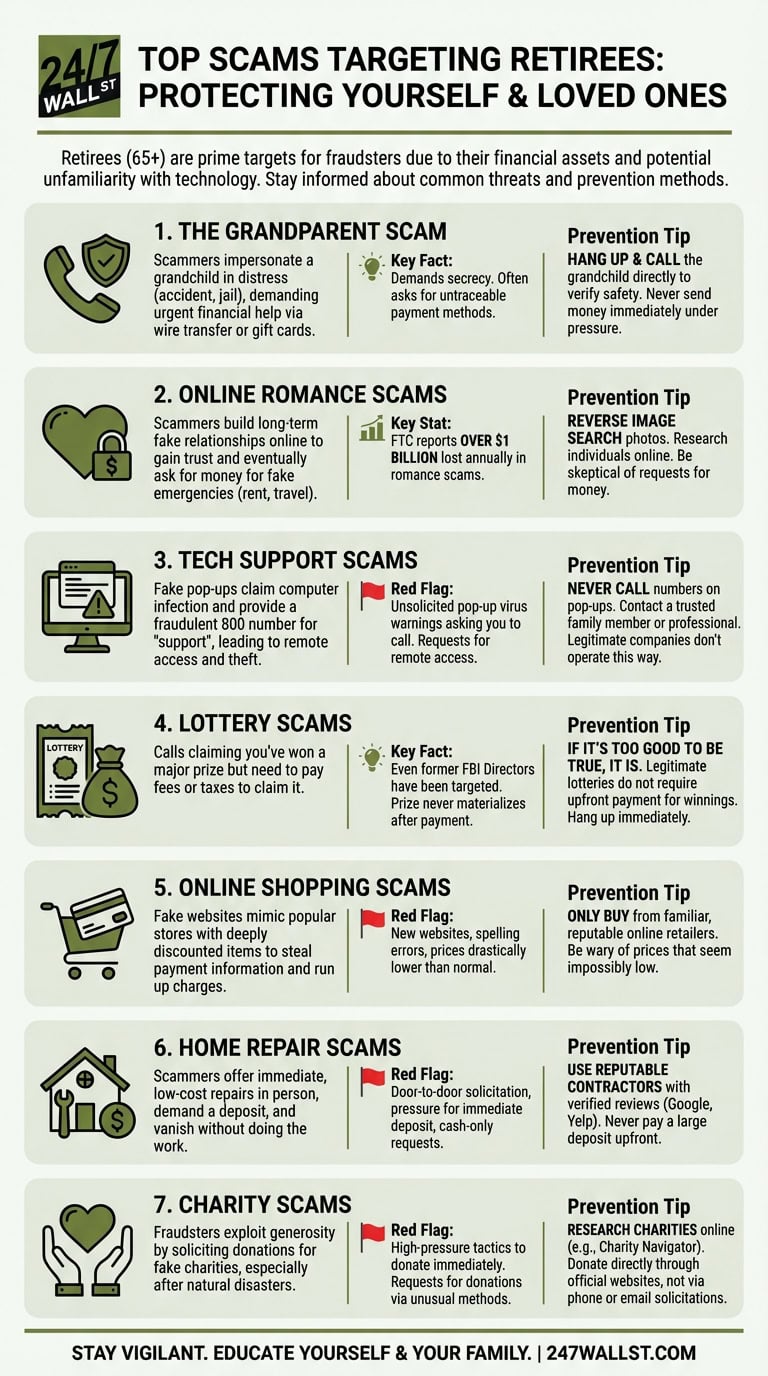
Below are the top scams targeting retirees today, along with practical steps families can take to protect their loved ones.
The Grandparent Scam
The grandparent scam ranks among the most emotionally devastating frauds targeting seniors. A scammer calls pretending to be a grandchild in serious trouble, claiming to have been in a car accident, arrested, or stranded far from home. The goal is to trigger a panic response before the target has time to think clearly.
The caller will typically ask for money via wire transfer or gift cards purchased at a local retailer, and will insist the grandparent keep everything secret. In recent years, scammers have upgraded this playbook with AI voice cloning technology. Using just a few seconds of audio scraped from a family member’s social media account, criminals can generate a synthetic voice that sounds startlingly like a real grandchild. The FBI has noted that AI has dramatically increased the believability of these calls.
The most effective defense is also the simplest: hang up and call the grandchild directly on a number you already know. Families should also consider establishing a private code word known only to immediate relatives. A scammer using cloned audio cannot supply a code word they never possessed. If the caller cannot produce the word, treat it as a scam.
Online Romance Scams
Romance scams are a long-running and expensive form of fraud that hit older adults especially hard. Adults over 60 account for more than half of all romance scam losses by dollar value, despite being a minority of internet users. The Federal Trade Commission reported $1.14 billion in romance scam losses in 2023, the highest figure ever recorded for any category of imposter scam, with a median individual loss of $2,000.
These are slow-burn operations. A scammer will spend weeks or months building a convincing relationship before manufacturing a crisis: a medical emergency, unpaid rent, or a plea for travel funds to finally meet in person. AI chatbots are now accelerating and scaling these cons in ways that were not possible even a few years ago. The person on the other end of the screen may not be a person at all.
To help protect a family member, encourage them to be cautious about anyone they meet online. Run a reverse image search on any photo they send. Search their name independently. Ask for a live video call. If the contact refuses video or voice calls and offers excuses to avoid meeting in public, treat those as serious warning signs.
Tech Support Scams
Tech support scams are the most widely reported form of elder fraud in the United States. In 2024, IC3 recorded roughly $1.5 billion in tech support scam losses overall, with seniors accounting for a significant share. The FBI consistently ranks this category at or near the top of reported elder fraud complaint types.
The scam typically begins with a pop-up message on a computer screen warning of a virus infection and providing an 800 number to call. That number routes to a fraudulent call center where trained operators pressure the caller into paying for fake repairs. Worse, victims are often persuaded to grant remote computer access, which lets the scammer quietly harvest login credentials and drain bank accounts without the victim realizing anything is wrong until days later.
The single most important rule to share with a retiree: no legitimate software company, antivirus provider, or tech firm will ever contact you through a browser pop-up asking you to call a phone number. If such a message appears, close the window and call a trusted family member before doing anything else.
Lottery Scams
The lottery scam is one of the oldest cons in the book, and it still works. The victim receives a call informing them they have won a sweepstakes or lottery prize, but must pay taxes and processing fees upfront to claim the money. The prize, of course, never arrives. Scammers often claim to represent well-known organizations such as Publishers Clearing House to lend the call a veneer of legitimacy.
Even sophisticated targets fall for this. In 2014, a Jamaican lottery scammer called former FBI and CIA Director William Webster, then 90 years old, claiming he had won $72 million and a new Mercedes-Benz. The scammer demanded $50,000 in taxes and fees to release the winnings. Webster and his wife declined repeatedly, worked with the FBI to record the calls, and helped federal agents build the case that led to the scammer’s arrest and conviction.
The lesson is straightforward: no legitimate lottery notifies winners by phone or email, and no real prize requires an upfront payment to collect. Remind family members that the moment anyone asks them to pay to receive a prize, it is a scam.
Online Shopping Scams
Online shopping is now a routine part of everyday life for many retirees, and scammers have built a profitable industry around it. Fraudulent websites mimic the look of legitimate storefronts and advertise popular goods at prices that seem like bargains. Electronics, clothing, shoes, and seasonal items are common bait. When a shopper enters credit card information to complete a purchase, the scammer captures those details immediately and begins running unauthorized charges before the victim notices anything is wrong.
Social media advertising has made it easier than ever to push these fake storefronts in front of older adults. The FBI’s IC3 noted in its 2022 elder fraud report that many senior victims report ordering items from links advertised on social media and either receiving nothing at all or receiving counterfeit goods.
The best protection is to shop only at retailers you already know and trust. Before buying from an unfamiliar website, look for signs of a scam: prices that seem unrealistically low, a domain that was registered very recently, and pages riddled with spelling or grammatical errors. When in doubt, skip it.
Home Repair Scams
Home repair fraud is one of the few scams that happen face-to-face, which can make it feel more legitimate. A scammer spots visible exterior damage to a retiree’s property, knocks on the door, and offers to fix it at a price that sounds almost too good. After collecting a deposit, they disappear and move on to the next address.
These predatory contractors often work in the aftermath of storms or other weather events, targeting neighborhoods with visible storm damage and taking advantage of homeowners who are stressed and eager for a quick solution. The urgency they create, combined with an attractive upfront price, is designed to bypass the normal vetting process.
The safest approach is to never hire anyone who shows up unsolicited. Instead, check Google Reviews, Yelp, or the Better Business Bureau for established contractors with verifiable track records. Get written estimates from at least two or three providers before committing to any work, and never pay a full deposit before work begins.
Charity Scams
Many retirees are generous with their time and money, and scammers exploit that generosity deliberately. Fraudulent charity solicitations tend to spike following natural disasters, during the holiday season, and around high-profile news events when real charitable giving is also at its peak. A caller may claim to represent a veterans’ group, a children’s hospital, or a disaster relief fund, using a name similar to a well-known organization to avoid immediate suspicion.
Money sent to these fake charities disappears. The FTC advises that before donating to any organization, consumers verify its legitimacy through independent watchdog sites such as Charity Navigator or Give.org, or by searching the charity’s name along with the word “complaint” or “scam.” If you want to support a cause you care about, go directly to the charity’s official website rather than following a link or responding to an unsolicited call.
If you or a family member believes they have been targeted by any of these scams, report it to the FBI’s Internet Crime Complaint Center at ic3.gov or to the FTC at ReportFraud.ftc.gov. Reporting helps law enforcement spot patterns and protect others from becoming the next victim.
Editor’s note: This update adds FBI IC3 data showing seniors 60 and older lost nearly $4.9 billion to fraud in 2024 (up 43% from 2023) and more than $7.7 billion in 2025; refreshes the romance scam figure to the FTC’s confirmed $1.14 billion loss total for 2023; corrects William Webster’s title to former director of both the FBI and the CIA and adds the detail that the scammer demanded $50,000 against a fake $72 million prize; and incorporates new context on AI voice cloning technology being used to make grandparent scams significantly more convincing.
Contact [email protected] for any questions or corrections.
David Beren has been a Flywheel Publishing contributor since 2022. Writing for 24/7 Wall St. since 2023, David loves to write about topics of all shapes and sizes. As a technology expert, David focuses heavily on consumer electronics brands, automobiles, and general technology. He has previously written for LifeWire, formerly About.com. As a part-time freelance writer, David’s “day job” has been working on and leading social media for multiple Fortune 100 brands. David loves the flexibility of this field and its ability to reach customers exactly where they like to spend their time. Additionally, David previously published his own blog, TmoNews.com, which reached 3 million readers in its first year. In addition to freelance and social media work, David loves to spend time with his family and children and relive the glory days of video game consoles by playing any retro game console he can get his hands on.