Spouse’s Debt Is Like Cocaine: Advice for Couples With Radically Different Financial Strategies
A caller earning $170,000 annually recently called The Ramsey Show, frustrated with her husband’s habit of cycling through balance transfer cards and buy-now-pay-later programs. Her husband earns $65,000 and justifies each move with “It’s 0% interest for 18 months.” She…

This post may contain links from our sponsors and affiliates, and Flywheel Publishing may receive compensation for actions taken through them.

A caller earning $170,000 annually recently called The Ramsey Show, frustrated with her husband’s habit of cycling through balance transfer cards and buy-now-pay-later programs. Her husband earns $65,000 and justifies each move with “It’s 0% interest for 18 months.” She wanted to know when to stop rescuing him from his own financial choices.
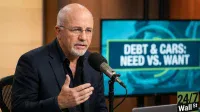
Dave Ramsey didn’t walk through the mechanics of balance transfer fees or promotional rate expiration. He reframed the entire problem, imagining what he would say to his spouse in a similar situation: “This makes me feel the same way as if you brought home a half a pound of cocaine. This is a violation of my values and it terrifies me. And it’s not a matter of the money. It’s a matter of us doing things that are directly a spear point sticking in my arm every time you do this.”
Ramsey pinpoints the real issue in households where one partner is a saver and one is a spender: For the debt-averse partner, debt produces a specific kind of anxiety that does not respond to reassurances about interest rates. The caller confirmed this dynamic: “I think because of how much I make, like he doesn’t see $10,000 or $15,000 as a lot of money.”
Why “It’s 0% Interest” Is a Weaker Argument Than It Sounds
The husband’s defense has surface logic. A 0% promotional balance transfer genuinely costs nothing in interest if paid off before the promotional period ends. But that conditional is doing a lot of work.
Most balance transfer offers charge an upfront fee, typically 3% to 5% of the transferred balance. On a $10,000 transfer, that is $300 to $500 in fees before a single payment is made. If the balance is not fully paid before the promotional window closes, the deferred interest or standard rate, which often runs 20% or higher, applies retroactively on some cards or prospectively on others. Either way, the “free” debt can quickly become expensive debt.
The deeper issue is behavioral. Someone who repeatedly cycles into new 0% offers is not managing debt strategically. They are using the promotional structure to defer the psychological cost of spending. The balance doesn’t disappear; it gets shuffled.
The “Submission” Framework Ramsey Proposes
Ramsey described a model of mutual submission for couples rooted in his own 45-year marriage: “It means I care what you think so much that we’re not going to do something that terrifies you. We’re not going to do things that we’re not aligned on. We do not make large purchases or gifts without the other one being approved.”
Co-host George Kamel added some advice for the caller: instead of lecturing, lead with vulnerability. Open up about what debt does to you emotionally, that it makes you feel unsafe, like someone else is controlling your life, rather than telling your spouse what they did wrong.
Executing this is harder than building a budget spreadsheet. Telling a partner “when you take on debt without telling me, I feel like I have no control over our future” requires more emotional strength than “you spent $12,000 on credit cards.” But it is more likely to produce a real change in behavior because it shifts the conversation from accusation to impact.
What the Breadwinner in This Situation Should Do Next
If you are in a similar situation, here are some practical steps to take. First, get a full accounting of every active buy-now-pay-later obligation and balance transfer, including the promotional expiration date and the rate that kicks in after. Write down the total. Second, calculate what happens to your household cash flow if even one of those promotional rates expires unpaid. Third, have the hard conversation Kamel described: “Here is how this makes me feel and why it matters to our future.”
Ramsey said the money is not the core issue here. But the money still matters, and it clearly impacts the couple’s overall relationship. The mechanics and the emotions both need attention.
Contact [email protected] for any questions or corrections.
Carl Sullivan has been a Flywheel Publishing contributor since 2020, focusing mostly on personal finance, investing and technology. He started his journalism career covering mutual funds, banking and financial regulation in Washington.Carl is a contributing editor at Financial Advisor Magazine and previously served as managing editor at Financial Planning Magazine. He is a long-time manager of editorial teams covering a variety of topics including news, business and politics. He’s currently the North America Managing Editor for Flipboard and worked previously for Microsoft News and Newsweek.Carl loves exploring the world and lived in India for several years. Today, he resides in New York City’s Queens borough, where you can hear hundreds of different languages just by riding the subway.