Thousands of High Earners Are Losing $2,500 Per Year to This Hidden IRA Tax Trap
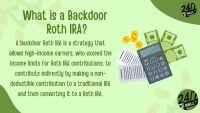
Every year, thousands of high earners follow the same advice: make a non-deductible traditional IRA contribution and immediately convert it to a Roth. The backdoor Roth strategy is legal, well-documented, and genuinely useful. It also fails silently for a large…

This post may contain links from our sponsors and affiliates, and Flywheel Publishing may receive compensation for actions taken through them.

Every year, thousands of high earners follow the same advice: make a non-deductible traditional IRA contribution and immediately convert it to a Roth. The backdoor Roth strategy is legal, well-documented, and genuinely useful. It also fails silently for a large share of the people using it, because of a single IRS rule they never knew existed.
That rule is the pro-rata rule. Your brokerage will not flag it, and the IRS will not warn you in advance. It simply makes your backdoor Roth conversion taxable, often almost entirely so, while you assume everything went through clean.
Who Gets Caught and Why It Feels Like a Trap
Consider a professional in their 40s who earns too much to contribute directly to a Roth IRA. In 2026, single filers can make a full direct Roth contribution only if their modified adjusted gross income (MAGI) falls below $153,000, with contributions phasing out entirely above $168,000. For married couples filing jointly, the phase-out runs from $242,000 to $252,000. A high earner above those thresholds discovers the backdoor strategy, opens a traditional IRA, contributes the 2026 annual limit of $7,500, and converts it to Roth. What they miss is the rollover IRA sitting at the same institution, left over from a 401(k) at a job they left three years ago.
Tax planning forums and CPA practices are full of this exact scenario. Someone rolled a former employer’s 401(k) into a traditional IRA years earlier, then started doing backdoor Roths without realizing the rollover IRA was sitting in the same pool. The pro-rata calculation quietly taxed every conversion, and nobody caught it until a preparer ran the numbers on Form 8606.
- Income: Above Roth IRA direct contribution threshold (phase-out begins at $153,000 single / $242,000 married)
- Goal: Tax-free Roth IRA contribution via backdoor conversion
- After-tax contribution: $7,500 (2026 limit, under age 50)
- Hidden problem: Pre-existing rollover IRA with substantial pre-tax balances
- Result: Conversion is mostly taxable, defeating the strategy entirely
The Single Rule That Breaks the Math
Under IRC Section 408(d)(2), the IRS requires all traditional IRA assets to be treated as a single pool when calculating the taxable portion of any conversion. It does not matter that you opened a separate account, made a separate contribution, or intended to convert only the new after-tax dollars. The IRS sees all your traditional, rollover, SEP, and SIMPLE IRA balances as one combined number on December 31st of the conversion year.
A high earner with a $200,000 rollover IRA who makes a new $7,500 non-deductible contribution has a total IRA pool of $207,500. Only $7,500 of that is after-tax basis, roughly 3.6% of the total. When they convert the $7,500, the IRS taxes it based on the pre-tax share of the whole pool. Approximately 96% of the conversion is taxable, meaning nearly all of the $7,500 is treated as ordinary income, completely defeating the goal of a tax-free conversion.
At a 37% marginal rate (a rate made permanent under the One Big Beautiful Bill Act signed in July 2025), that taxable income costs roughly $2,500 in federal taxes alone, on a contribution the investor believed was going in clean.
The problem scales with rollover IRA size. A physician with a $500,000 rollover IRA who has been doing backdoor Roths for five years without realizing the pro-rata rule applies has been paying ordinary income tax on roughly 98% of each annual conversion. At a 37% rate, the cumulative tax error over those five years approaches $12,000. Worse, they have now accumulated years of non-deductible contributions with no clean way to separate that after-tax basis from the pre-tax pool.
One timing detail catches nearly everyone off guard: the pro-rata calculation uses the IRA balance as of December 31st of the conversion year, not the date of the conversion itself. Contributing and converting in January accomplishes nothing if a large pre-tax rollover IRA still exists at year-end. A zero pre-tax IRA balance on the last day of the tax year is the only path to a clean conversion.
The backdoor Roth itself remains entirely legal as of 2026. The strategy was not touched by SECURE 2.0 and was not restricted by the One Big Beautiful Bill Act, which made TCJA individual tax rates permanent but left retirement conversion rules unchanged. Proposals to eliminate the strategy have surfaced in Congress periodically, but none has been enacted.
Three Paths Forward, Ranked by Effectiveness
- Roll all pre-tax IRA assets into your current employer’s 401(k) before year-end. This is the cleanest fix available. Moving pre-tax IRA assets into a current employer 401(k) removes them from the pro-rata calculation entirely and restores the clean backdoor. Most large employer plans accept incoming rollovers, though plan administrators vary, so confirm eligibility before initiating a transfer. The rollover must be complete by December 31st of the year you intend to convert. When the rollover and conversion both occur in the same tax year, your December 31st IRA balance reflects only the after-tax contribution, and the conversion is clean. This path works best for W-2 employees with a quality employer plan that accepts rollovers.
- Accept the tax cost and track your basis meticulously on Form 8606. When a 401(k) rollover is not available and the pre-tax IRA balance is modest, some people choose to proceed and simply pay the tax on each conversion. The requirement that cannot be skipped: filing IRS Form 8606 every single year to track your cumulative after-tax basis. Missing the form even once can mean paying taxes twice on the same money when you eventually withdraw. The IRS imposes a $50 penalty per missed filing, but the consequences of losing your basis record are far more costly than the penalty itself.
- Address SEP and SIMPLE IRA balances separately if you have self-employment income. A SEP IRA or SIMPLE IRA from self-employment counts toward the pro-rata calculation and must be handled. If a solo 401(k) is available through self-employment, rolling the SEP balance into it removes those assets from the IRA pool. One important caveat applies specifically to SIMPLE IRAs: they must remain open for at least two years before they can be rolled into a 401(k) without triggering a 25% early-withdrawal penalty, rather than the standard 10%. Contributions made in 2024 become eligible for rollover in 2026, so timing matters here. This is an underappreciated fix for freelancers and consultants who assume their side-business retirement accounts are separate from the problem.
What to Do Before Your Next Conversion
Before making any IRA contribution this year, total up every dollar sitting in traditional, rollover, SEP, and SIMPLE IRAs. If that number is zero, the backdoor Roth works exactly as advertised. If it is anything above zero, there is a pro-rata problem to solve before converting.
The most common and costly mistake is converting first and asking questions later. A Roth conversion cannot be undone. Once the taxable event occurs, the only remedy is to fix the underlying IRA structure before the next tax year, which does nothing for the damage already done.
For anyone carrying a rollover IRA, the order of operations is critical: contact your employer plan administrator, confirm they accept incoming rollovers, complete the transfer, and only then make the non-deductible IRA contribution and convert. Reverse that sequence and ordinary income taxes will follow.
One additional 2026 note: the catch-up contribution limit for IRA holders age 50 and older rose to $8,600 this year, up from $8,000 in prior years, reflecting the SECURE 2.0 Act’s new cost-of-living indexing for IRA catch-up amounts. For high earners in that age bracket doing backdoor Roths, the higher contribution means a slightly larger after-tax basis at stake, and a slightly larger potential tax bill if the pro-rata rule is ignored.
Editor’s note: This article was updated to add the $252,000 upper end of the 2026 Roth IRA phase-out range for married couples filing jointly (previously only the $242,000 starting point appeared), to note that the One Big Beautiful Bill Act signed July 4, 2025, made the 37% top marginal rate permanent (relevant to the article’s tax-cost calculations), and to reflect that the 2026 IRA catch-up limit for savers age 50 and older is now $8,600 under SECURE 2.0’s new cost-of-living indexing rules.
Contact [email protected] for any questions or corrections.
Gerelyn Terzo is the author of dividend investing handbook "Dividend Investing Strategies: How to Have Your Cake & Eat It Too." A veteran financial journalist, she covers agri-finance for outlets like Global AgInvesting and the broader stock market and personal finance for 24/7 Wall Street. She began at CNBC and later helped launch Fox Business in New York. Gerelyn currently resides in Woodland Park, Colorado and dabbles in nature photography as a hobby.