He Rolled His Old 401(k) Into His New Job’s Plan Instead of an IRA. That One Choice Is the Only Reason His Backdoor Roth Still Works
Most high earners attempt the backdoor Roth and wind up with a surprise tax bill because of a rule they never saw coming. One rollover decision made during a job change is the only thing standing between a clean conversion…

This post may contain links from our sponsors and affiliates, and Flywheel Publishing may receive compensation for actions taken through them.

If you have a traditional IRA sitting from an old job and you earn too much for a direct Roth IRA contribution, one paperwork choice at your next employer can decide whether the backdoor Roth still works for you.
When you leave a company, you can push your pre-tax 401(k) money into your new employer’s plan instead of into an IRA. That move zeroes out your traditional IRA balance in the IRS’s eyes on December 31, which keeps a clean, tax-free backdoor Roth conversion legal.
Loophole Hiding Inside the Pro-Rata Rule
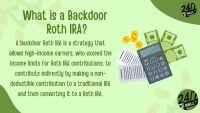
The backdoor Roth is simple on paper. You make a nondeductible contribution to a traditional IRA, then convert it to a Roth. The catch is the pro-rata rule. If you have any other pre-tax IRA money sitting around (an old rollover IRA, a SEP, or a SIMPLE), the IRS treats every one of your IRAs as a single blended pot and taxes the conversion proportionally. Suddenly your “tax-free” conversion is mostly taxable.
The workaround is called a reverse rollover. Qualified employer plans like 401(k)s are not counted in that pot. Move your pre-tax IRA money into a 401(k) and the pot goes to zero. Backdoor Roth stays clean.
Code Section That Makes It Work
The aggregation rule lives in Internal Revenue Code §408(d)(2), which tells the IRS to treat all of your traditional, SEP, and SIMPLE IRAs as one account for conversion math. The statute excludes qualified plan balances, which is where a 401(k) sits. That is the door. Form 8606, where you report the conversion, measures your total IRA balance as of December 31 of the conversion year, not the day you converted.
Who Actually Needs This Move
You need this if your income puts you above the Roth contribution ceiling. For 2026, direct Roth contributions phase out completely at $168,000 for single filers and $242,000 for married filing jointly. Anyone below those cutoffs can fund a Roth directly and skip this whole exercise.
You also need a workplace 401(k) that accepts incoming IRA rollovers. Not every plan does, so read the summary plan description before you touch anything. Self-employed savers with only SEP or SIMPLE IRAs face the same pro-rata trap and can escape only by opening a solo 401(k) that accepts rollovers.
How to Run the Play in 2026
- Confirm your new employer’s 401(k) accepts rollovers from a traditional IRA. Call the plan administrator and get it in writing.
- Isolate the money. Only pre-tax dollars can go into the 401(k). Any nondeductible (after-tax) basis in your IRA has to stay behind, tracked on Form 8606.
- Do a direct trustee-to-trustee transfer from your traditional IRA into the 401(k). Do not take a check yourself.
- Once your traditional, SEP, and SIMPLE IRA balances read $0, make your nondeductible contribution. The 2026 IRA contribution limit is $7,500, or $8,600 if you are 50 or older.
- Convert that contribution to your Roth IRA promptly. Report both steps on Form 8606 for the tax year.
Deadline That Wrecks the Strategy
Here is where people get burned. The pro-rata calculation looks at your combined IRA balance on December 31 of the conversion year, not the day the conversion cleared. Convert $7,500 in March, then roll a $200,000 pre-tax IRA into your 401(k) on January 5 of the following year, and the IRS still sees $200,000 sitting in your IRA on December 31. Almost the entire conversion becomes taxable.
The reverse rollover must finish by December 31 of the same year you convert. Miss that window, and you owe ordinary income tax on the pre-tax slice of the blended balance.
Two smaller traps to know. Start with the one-rollover-per-12-months rule under §408(d)(3)(B): it doesn’t apply to direct trustee-to-trustee transfers, but it does apply the moment a check hits your hands. And if your new 401(k) carries high fees or thin investment options, you are trading a pro-rata problem for a fee problem. The play only pays off if the destination plan is worth living in.
Contact [email protected] for any questions or corrections.
David Beren has been a Flywheel Publishing contributor since 2022. Writing for 24/7 Wall St. since 2023, David loves to write about topics of all shapes and sizes. As a technology expert, David focuses heavily on consumer electronics brands, automobiles, and general technology. He has previously written for LifeWire, formerly About.com. As a part-time freelance writer, David’s “day job” has been working on and leading social media for multiple Fortune 100 brands. David loves the flexibility of this field and its ability to reach customers exactly where they like to spend their time. Additionally, David previously published his own blog, TmoNews.com, which reached 3 million readers in its first year. In addition to freelance and social media work, David loves to spend time with his family and children and relive the glory days of video game consoles by playing any retro game console he can get his hands on.