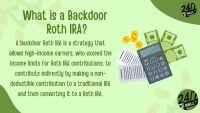
The Backdoor Roth 401(k) Loophole: How High Earners Add $8,600 Tax-Free in 2026
A 58-year-old engineer earning $310,000, with $1.4 million already stacked in a 401(k), asks a familiar question on retirement forums every spring: how do I get money into a Roth IRA when the IRS says my income is too high?…

This post may contain links from our sponsors and affiliates, and Flywheel Publishing may receive compensation for actions taken through them.

A 58-year-old engineer earning $310,000, with $1.4 million already stacked in a 401(k), asks a familiar question on retirement forums every spring: how do I get money into a Roth IRA when the IRS says my income is too high? The answer is a two-step maneuver that personal finance commentators have been championing for more than a decade, and the math in 2026 still works cleanly if you execute it in the right order.
The income cap that locks high earners out
The IRS phases out direct Roth IRA contributions for single filers between $153,000 and $168,000 of modified adjusted gross income in 2026, and for joint filers between $242,000 and $252,000. Above those upper bounds, the door closes entirely. A two-income household earning $290,000 combined cannot put a single dollar into a Roth IRA directly, even though the account remains the most flexible retirement vehicle available: no required minimum distributions during the owner’s lifetime, tax-free withdrawals after age 59.5, tax-free growth, and tax-free inheritance for heirs.
The workaround exploits a gap Congress deliberately left open. There is no income limit on a nondeductible traditional IRA contribution, and there is no income limit on converting a traditional IRA to a Roth. Fund the first account, convert to the second within a week or two, and you have accomplished what the income cap was supposed to prevent. The IRS acknowledged the strategy in congressional committee reports as far back as 2010, and it survived its most serious legislative threat when the 2021 Build Back Better Act, which would have eliminated it, failed to become law.
The $8,600 move, step by step
Open a traditional IRA, contribute the 2026 base limit of $7,500 with after-tax dollars, skip the deduction, and convert that balance to a Roth IRA. Savers aged 50 or older can contribute $8,600 in total, because the catch-up amount rose to $1,100 this year. That increase is the first actual dollar bump above $1,000 that the IRA catch-up has ever seen: under SECURE 2.0, the IRA catch-up was placed on an inflation-indexed track starting in 2024, but the rounding rules ($100 increments) kept the amount flat in 2024 and 2025. The 2026 tax year is when the math finally cleared the rounding threshold. A married couple where both spouses run the strategy can funnel $17,200 of permanent tax-free growth into Roth accounts in a single calendar year, with no income test and no employer plan required.
At a 7% annual return, $8,600 compounded over 15 years grows to roughly $23,700 that will never face another federal tax bill. Run the strategy every year from age 55 to 70, and the accumulated after-tax balance approaches a quarter million dollars. For context, the 10-year Treasury yield climbed to a 20-month high of around 4.75% in mid-August 2026, and any taxable yield at that level is steadily eroded by ordinary income tax inside a standard brokerage account. The Roth conversion sidesteps that drag permanently.
There is also a noteworthy planning window just ahead for the hypothetical 58-year-old in the opening scenario. Beginning at age 60, SECURE 2.0 unlocks a “super catch-up” for 401(k) participants that replaces the standard $8,000 catch-up with a higher $11,250 limit, bringing total 401(k) deferrals to $35,750 for ages 60 through 63. That four-year window, combined with the backdoor IRA conversion, allows unusually aggressive Roth accumulation in the years immediately before retirement.
Starting in 2026, SECURE 2.0 also requires high earners who made more than $150,000 in FICA wages in 2025 to direct all 401(k) catch-up contributions into a Roth account rather than a pre-tax one. That mandate, separate from the IRA backdoor strategy, pushes even more retirement savings for top earners into the Roth ecosystem. The backdoor IRA conversion and the mandatory Roth 401(k) catch-up now work in the same direction for many high-income professionals.
The pro-rata trap that wrecks the strategy
The pro-rata rule is the tripwire. The IRS treats every traditional, SEP, and SIMPLE IRA you own as one combined pool when you execute a Roth conversion. If a $200,000 rollover IRA from a previous employer sits in the background when you add an $8,600 nondeductible contribution, only about 4% of any conversion comes out tax-free. The remaining 96% is taxed as ordinary income, and you end up paying tax twice on the same dollars.
For a single filer in the 32% federal bracket (covering income between $201,775 and $256,225 in 2026, a range made permanent by the One Big Beautiful Bill Act signed on July 4, 2025), converting $8,600 with a $200,000 rollover IRA in the background produces roughly $2,640 in unexpected federal tax rather than zero. That outcome turns a clean tax-free move into an expensive mistake.
What to do this week
- Pull your December 31, 2025 statements for every traditional, SEP, and SIMPLE IRA in your name and add the balances. Anything above zero triggers the pro-rata calculation on a 2026 conversion. Your spouse’s IRAs are calculated separately, so the trap is individual, not household-wide.
- Call your current 401(k) administrator and ask whether the plan accepts incoming IRA rollovers. Most do. Rolling pre-tax IRA money into an employer plan removes it from the pro-rata formula entirely, because 401(k) balances are excluded from that calculation. Get the transfer completed before December 31, 2026.
- Fund the nondeductible IRA in January, convert within a week or two to limit taxable growth inside the traditional account, and file Form 8606 with your 2026 return to document the basis. Skip the form and the IRS will treat those same dollars as fully taxable at withdrawal. The form is two pages long, and it is the complete paper trail that keeps this strategy airtight.
Editor’s note: This article was updated to add context on the SECURE 2.0 “super catch-up” provision for ages 60 through 63 (a $11,250 limit in 2026, compared with the standard $8,000 catch-up), and to clarify that the 2026 IRA catch-up increase to $1,100 is the first actual dollar rise above $1,000 in the catch-up’s history, since the SECURE 2.0 inflation-indexing mechanism was in place since 2024 but the $100 rounding threshold was not cleared until this year.
Contact [email protected] for any questions or corrections.
Marc Guberti is a personal finance writer who has written for US News & World Report, Business Insider, Newsweek and other publications. He also hosts the Breakthrough Success Podcast which teaches listeners how to use content marketing to grow their businesses.