The Roth Tipping Point: Why 98% of Plans Now Offer the Roth Option
The single biggest design shift inside the American 401(k) this decade is about taxes, more than fees, target-date funds, or auto-escalation. According to Vanguard's 2026 How America Saves report, 98% of plans now offer a Roth contribution option, up from…

This post may contain links from our sponsors and affiliates, and Flywheel Publishing may receive compensation for actions taken through them.

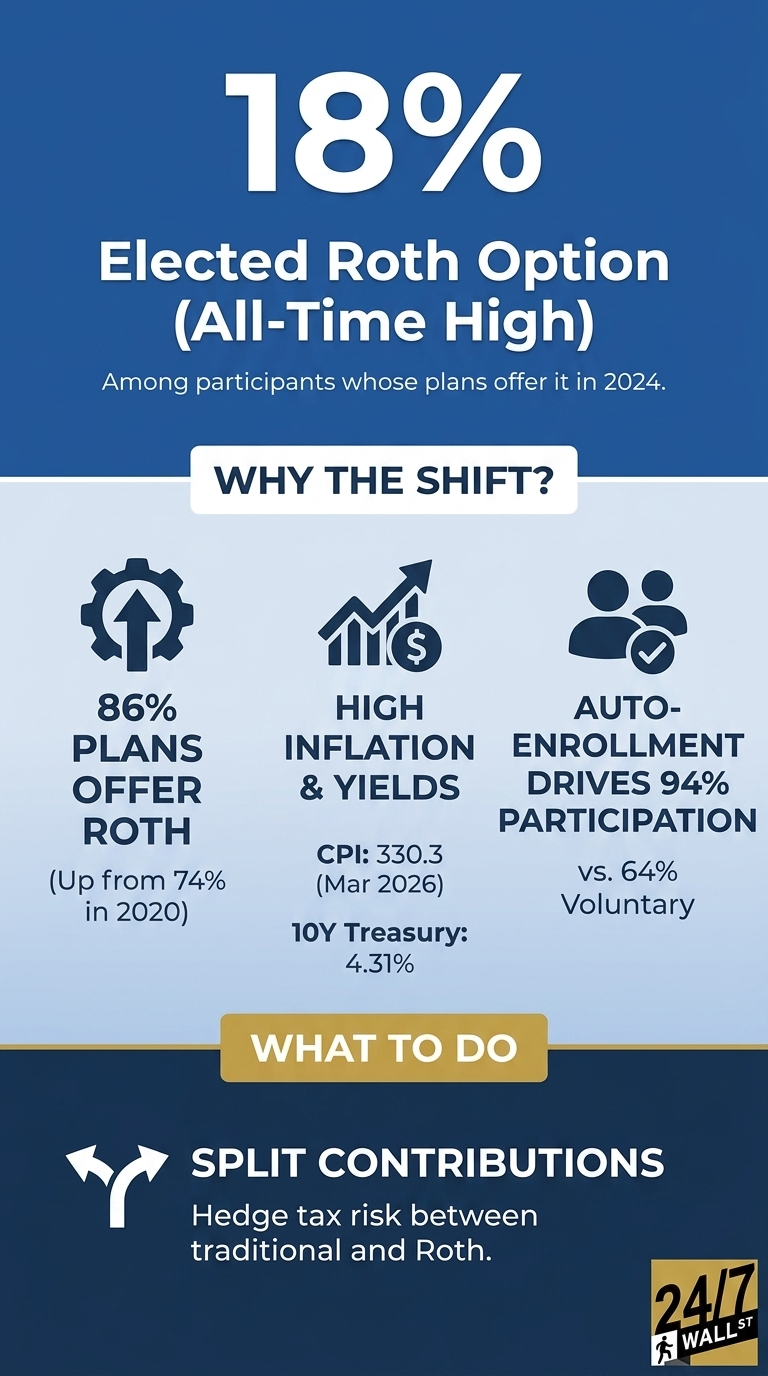
The single biggest design shift inside the American 401(k) this decade is about taxes, not fees, target-date funds, or auto-escalation. According to Vanguard’s 2026 How America Saves report, 98% of plans now offer a Roth contribution option, up from 86% just one year earlier. That 12-point jump is the largest single-year increase in Roth availability on record. Among participants whose plans offered it, 18% elected the Roth option in 2025. The traditional pre-tax 401(k) is no longer the only default, and federal law is actively pushing the remaining holdouts in the same direction.
What “Rothification” Actually Means
A traditional 401(k) lets workers defer income taxes today and pay them in retirement once withdrawals begin. A Roth 401(k) flips that: contributions go in as after-tax dollars, and qualified withdrawals, including all investment growth, come out completely tax-free. The core trade-off is paying a known tax rate now rather than an unknown future rate later.
Vanguard’s data show how quickly that calculus has shifted. At year-end 2025, 98% of plans in Vanguard’s network offered a Roth feature, making it effectively universal across the industry. The six-percentage-point rise in adoption among eligible participants, from 12% in 2019 to 18% in 2025, reflects both broader access and growing awareness of where future tax rates might be headed. Beyond regular contributions, 36% of plans now also offer Roth in-plan conversions, allowing workers to shift existing pre-tax balances into a Roth account within the same plan.
Why the Tax Calculus Is Changing Now
Vanguard’s How America Saves 2026 report, the 25th edition of the series covering nearly 5 million workers, offers a clear-eyed view of household financial health. Hardship withdrawals hit 6% of participants in 2025, up from 5% in 2024 and the highest rate the firm has ever recorded. It marks the sixth straight annual increase, a streak that underscores how many households are treating their retirement accounts as a financial backstop of last resort.
Savings behavior at the plan level moved in the opposite direction. Participants contributed an average of 7.6% of their paychecks in 2025, and 45% of savers raised their deferral rate during the year, either voluntarily or through automatic escalation. Employer matching contributions reached a record 4.7% of pay, pushing the combined average total contribution rate to 12.1%, an all-time high. Average participant account balances also hit a record high of $167,970 at year-end 2025, a 13% gain from the prior year, with the median balance rising 16% to $44,115. That momentum is pushing more workers toward Vanguard’s own recommended 12% to 15% savings target, which makes the tax treatment of every dollar set aside a sharper question than ever.
The regulatory backdrop is adding urgency. Under the SECURE 2.0 Act, beginning January 1, 2026, participants aged 50 and older who earned more than $150,000 in FICA wages from their employer in the prior year must make all catch-up contributions on a Roth basis. The IRS issued final regulations implementing this rule in September 2025. Those regulations formally apply starting in 2027, but plans must operate in good-faith compliance throughout 2026. For plans that do not currently offer a Roth feature, the rule creates a hard choice: add Roth or lose the ability to accept catch-up contributions from higher-earning employees entirely. That compliance pressure is a central reason Roth availability surged 12 points in a single year.
A related SECURE 2.0 provision adds another layer for workers nearing retirement. Those ages 60 to 63 may now contribute up to $11,250 in “super catch-up” contributions, rather than the standard $8,000 available to those 50 and older. Combined with the $24,500 base limit, workers in that age window can set aside as much as $35,750 in a single year. For those who also clear the $150,000 FICA wage threshold, those super catch-up dollars must go into a Roth account.
Plan Design Did Most of the Work
The broader Roth shift happened largely because plan sponsors changed the menu. The jump from 86% to 98% Roth availability in a single year stands as the fastest expansion of the feature since it was introduced. Among plans with at least 1,000 participants, 79% had adopted automatic enrollment by year-end 2025, a record. Automatic enrollment is now in place at 61% of all plans overall, a dramatic rise from just 10% in 2006. Auto-enrollment drives participation rates to 94% in the plans that use it, compared with 64% for voluntary-enrollment plans. When Roth appears as an active contribution option inside a high-participation environment, more workers encounter it as a genuine choice rather than a buried item in an enrollment form.
Who Tends to Choose Roth
The 18% of participants who elected Roth in 2025 skewed younger and higher-income, according to Vanguard’s demographic breakdown. Roth adoption ran at 20% for the 25-to-34 age group and 19% for the 35-to-44 group, the two highest rates of any age band. The pattern fits workers who expect their current tax bracket to be lower than their eventual retirement bracket, or who simply want tax diversification across account types regardless of future rate predictions. That flexibility, holding both pre-tax and Roth balances simultaneously, gives retirees more control over which dollars to draw first and how much ordinary income they report in any given year.
Higher earners also lean toward Roth. In the $100,000 to $149,999 income bracket, 24% of participants elected the option; in the $150,000 and above bracket, 21% did the same. The combination of younger workers prioritizing long tax-free compounding windows and higher earners preparing for the mandatory Roth catch-up rule suggests adoption rates will keep climbing even as availability approaches its practical ceiling.
What to Watch Next
-
The SECURE 2.0 mandatory Roth catch-up rule is now in effect for 2026. Plan sponsors that have not yet added a Roth feature risk losing catch-up eligibility for higher-earning employees, with full regulatory enforcement arriving in 2027.
-
Workers ages 60 to 63 can take advantage of the “super catch-up” contribution limit of $11,250 in 2026, compared with the standard $8,000 for other participants age 50 and older, if their plan has adopted the provision.
-
Many plans allow a split between traditional and Roth contributions, letting participants hedge the tax-rate question without committing entirely to one treatment.
-
Hardship withdrawals now represent 6% of Vanguard participants, a record high and a signal that retirement accounts are doubling as emergency funds for a growing share of American households.
Editor’s note: This version adds the median participant account balance of $44,115 at year-end 2025 (up 16% from year-end 2024) and the combined average total contribution rate of 12.1%, both drawn from Vanguard’s How America Saves 2026 report. The IRS-updated FICA wage threshold of $150,000 for the 2026 mandatory Roth catch-up rule, which the agency raised from $145,000 in November 2025, has also been noted in context.
Contact [email protected] for any questions or corrections.
David Beren has been a Flywheel Publishing contributor since 2022. Writing for 24/7 Wall St. since 2023, David loves to write about topics of all shapes and sizes. As a technology expert, David focuses heavily on consumer electronics brands, automobiles, and general technology. He has previously written for LifeWire, formerly About.com. As a part-time freelance writer, David’s “day job” has been working on and leading social media for multiple Fortune 100 brands. David loves the flexibility of this field and its ability to reach customers exactly where they like to spend their time. Additionally, David previously published his own blog, TmoNews.com, which reached 3 million readers in its first year. In addition to freelance and social media work, David loves to spend time with his family and children and relive the glory days of video game consoles by playing any retro game console he can get his hands on.