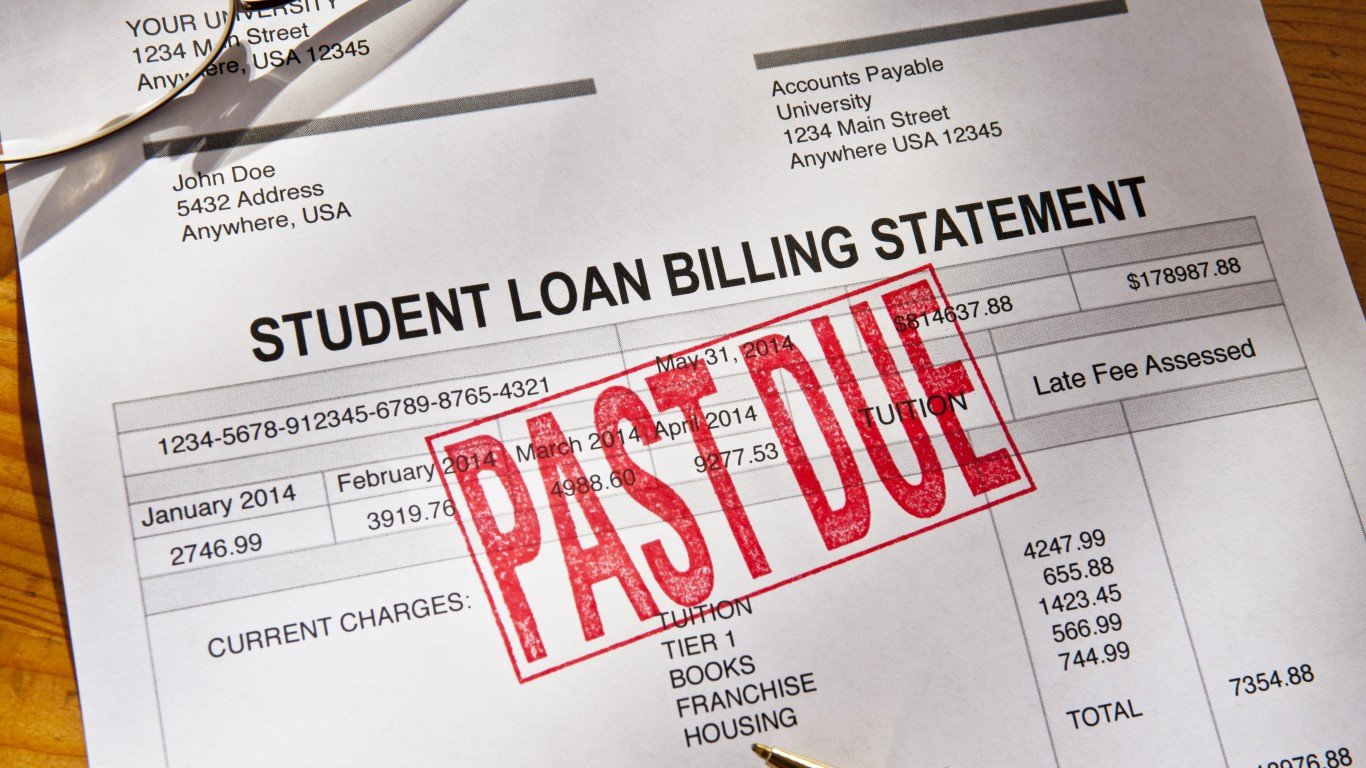
I took out $250,000 in student loans for a social work degree and now make $45,000 a year. Am I trapped?
The Smart Money Happy Hour podcast recently surfaced a Ramsey Show caller whose situation sounds engineered to scare prospective students: a social work degree financed with $250,000 in student loans, followed by a $45,000 annual salary. Co-host George Kamel summed…

This post may contain links from our sponsors and affiliates, and Flywheel Publishing may receive compensation for actions taken through them.

The Smart Money Happy Hour podcast recently surfaced a Ramsey Show caller whose situation sounds engineered to scare prospective students: a social work degree financed with $250,000 in student loans, followed by a $45,000 annual salary. Co-host George Kamel summed it up bluntly: “There’s not a lot of good solutions when the math is that, you know, weighted against you.”
The stakes here are not abstract. If you are sitting on a similar debt-to-income ratio, the wrong repayment choice can cost you a decade of cash flow and still leave you owing more than you borrowed. The right one can cap your monthly payment at a fraction of your income and erase the balance entirely after a fixed number of years. The difference between those two outcomes is six figures.
The verdict: brutal on paper, survivable in practice
Rachel Cruze and Kamel are right that the math looks impossible at first glance. But good solutions exist. Federal borrowers in this exact situation have escape hatches that private borrowers do not. The trap is real for the unaware. For someone who understands income-driven repayment and Public Service Loan Forgiveness, a $250,000 balance against a social work salary is manageable.
Start with the standard 10-year repayment plan. With federal student loan rates anchored to Treasury auctions and the 10-year Treasury yield sitting near 4.6%, recent graduate-school borrowers are locking in some of the highest student loan rates in two decades. A standard amortization on a balance this large produces a monthly payment in the high four-figure range, roughly $2,900 a month at a 7% blended rate. On a $45,000 salary, take-home pay sits near two-thirds of the national per capita disposable income of roughly $69,000. The standard plan is mathematically impossible. That is the version of the math the podcast described.
Now run income-driven repayment. Under IBR and PAYE rules, payments are capped at a fixed percentage of discretionary income, typically 10%. For a single filer at $45,000 with no dependents, that produces a monthly payment in the $150 to $250 range. Interest still accrues on the balance, but monthly cash flow becomes survivable, and the remaining balance is forgiven after 20 to 25 years (taxable as income in some plans, not in others).
Layer Public Service Loan Forgiveness on top. Social work qualifies whenever the employer is a government agency or a 501(c)(3) nonprofit, which captures most of the field. After 120 qualifying monthly payments, roughly 10 years, the remaining balance is wiped tax-free. Ten years of low IBR payments totals a small fraction of the original principal. The rest disappears.
The single variable that decides the outcome
Whether the loans are federal or private. That fact alone determines whether this borrower has a workable path or a genuine trap.
Federal loans qualify for income-driven repayment and PSLF. Private loans do not. A $250,000 private balance at 9% with no income-based cap demands payments above $3,000 a month. On $45,000 of income, that is a default schedule, not a payment plan. And as the podcast hosts correctly noted, student loans cannot be discharged through bankruptcy outside an “undue hardship” standard almost nobody clears.
One more piece of context worth absorbing: the national savings rate has fallen from 6.2% in early 2024 to 4.0% in the first quarter of 2026. Households across the income spectrum are saving less. There is no realistic plan that pays off this debt aggressively while still funding retirement on $45,000. The strategy has to be minimum required payments while still funding retirement savings.
What to actually do
- Inventory the loans. Log in to StudentAid.gov and confirm which are federal Direct Loans (PSLF-eligible), which are FFEL or Perkins (eligible after consolidation), and which are private (not eligible).
- Run the Department of Education Loan Simulator. Enter actual income and family size. Compare standard, IBR, PAYE, and SAVE-successor plans side by side. Pick the lowest qualifying payment.
- File PSLF paperwork immediately. If you work for a government agency or qualifying nonprofit, submit the Employment Certification Form and resubmit annually. The 120 qualifying payments do not count retroactively if employment was never certified.
- Apply the simple screen Cruze hinted at. Divide expected starting salary by total projected debt. If the ratio is below 1.0, the degree only pencils out under forgiveness, not under standard repayment.
- For private loans, refinance only when rates drop and income rises. There is no forgiveness path on private debt, so the only lever is interest rate.
The caller has a way out, and the exit is paperwork.
Contact [email protected] for any questions or corrections.
Don Lair writes about options income, dividend strategy, and the kind of boring-but-durable investing that actually funds retirement. He's the founder of FITools.com, an independent contributor to 24/7 Wall St., and a former writer for The Motley Fool.