





A 50-year-old woman planning to retire at 70 on the equivalent of $80,000 in today’s purchasing power is actually targeting a much larger nominal income figure. Assuming long-run inflation averages 3% annually, maintaining that same lifestyle 20 years from now would require roughly $144,500 per year in nominal dollars. That is the income her portfolio needs to generate in the first year of retirement, and the amount must continue rising over time to keep pace with inflation.
Recent inflation data supports using a more conservative planning assumption. The Consumer Price Index stood at 332.4 in April 2026, up from 320.6 in May 2025, remaining above the Federal Reserve’s long-term 2% inflation target. Against that backdrop, planning around a 3% inflation rate remains a cautious interpretation of recent economic conditions.
The Capital Required at Each Yield Tier
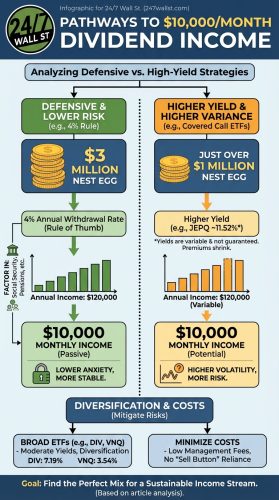
Every tier below targets the same future income: $144,500 in year-20 dollars. The capital needed is simply that figure divided by the portfolio’s blended yield.
Conservative tier (3% to 4% yield). Broad dividend-growth equities and quality blue chips. To produce $144,500 at 4%, the portfolio needs $3,612,500. The tradeoff: the biggest capital requirement, but the dividend stream itself grows. This is where Dividend Kings live. Johnson & Johnson (NYSE:JNJ | JNJ Price Prediction) raised its quarterly payout to $1.34 in Q1 2026, extending a 64-year streak, and yields about 2.2%. Procter & Gamble (NYSE:PG) has paid dividends every year since 1890 and just lifted its quarterly to $1.09. Coca-Cola (NYSE:KO) yields 2.5% on a quarterly dividend that climbed from $0.16 in 1999 to $0.53 in 2026.
Moderate tier (5% to 7% yield). High-dividend equity funds, REITs, preferred shares, covered-call strategies. At 5%, the capital required drops to $2,890,000; at 6%, to $2,408,000. The tradeoff is that dividend growth slows materially. Covered-call funds cap upside in exchange for premium. REIT distributions track rents, which can lag CPI in a tight cycle.
Aggressive tier (8% to 14% yield). Business development companies, mortgage REITs, leveraged covered-call ETFs, high-yield bond funds. At 10%, the same $144,500 needs only about $1.45 million. The catch is brutal for a 20-year planner: principal often erodes, distributions get cut in stress periods, and the income stream rarely keeps pace with inflation over a full retirement. This tier funds a shorter spend-down rather than a full multi-decade retirement.
Why Dividend Growth Beats Static High Yield
One of the most overlooked concepts in dividend investing is yield-on-cost. Johnson & Johnson increased its annual dividend from $3.15 per share in 2016 to $5.14 in 2025 while the stock itself appreciated substantially over the same period. Coca-Cola has also delivered strong long-term appreciation while continuing to raise its dividend annually. Investors who bought these companies a decade ago are now earning materially higher effective yields on their original purchase prices than the headline yields available today.
That compounding effect becomes more powerful over longer timelines. A portfolio starting at a 3.5% yield that grows income by 7% to 8% annually can roughly double its income stream within a decade and potentially triple it over twenty years. By contrast, a static 10% distribution may generate more cash immediately but gradually loses purchasing power if the payout never grows. For investors with long retirement runways, the compounding path often produces stronger inflation-adjusted income over time, even if it requires more upfront capital.
Three Steps to Get These Results
- Model the target in nominal dollars rather than today’s dollars. The honest planning number is closer to $144,500 than $80,000, and the gap widens every year inflation runs above 2%.
- Compare 20-year total return and dividend-growth history of a quality dividend-growth ETF against a high-yield covered-call fund. The yield-on-cost difference at year 20 is usually the deciding number.
- Prioritize Roth and tax-advantaged account location for the dividend-growth sleeve. With a 20-year compounding window, the tax drag on reinvested dividends inside a taxable account is the single largest controllable cost.













 Top Gaining Stocks
 Top Losing Stocks