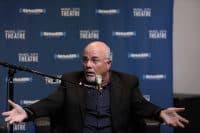
‘Don’t Blame Your Stupidity on Christianity’: Dave Ramsey’s Blunt Advice to a Bride Whose Fiancé Refuses to Save
A Philadelphia bride named Nicole called The Ramsey Show with a problem most couples never address before the wedding. "I'm about to get married to my fiancé, and we're looking over our budget because we want to be on the…

This post may contain links from our sponsors and affiliates, and Flywheel Publishing may receive compensation for actions taken through them.

A Philadelphia bride named Nicole called The Ramsey Show with a problem most couples never face before the wedding. “I’m about to get married to my fiancé, and we’re looking over our budget because we want to be on the same page financially, and I’m realizing that he really prioritizes giving, which is something that I agree with, but it’s getting to the point where he doesn’t want to put anything in savings because he wants to trust in the Lord’s provision in our lives.” She wanted to know how to decide what to tithe versus save, and when generosity crosses into recklessness.
The question reaches far beyond Nicole’s household. According to Bankrate’s 2026 Annual Emergency Savings Report, nearly 1 in 4 Americans have zero emergency savings at all. A U.S. News 2026 Financial Wellness Survey found that 43% of respondents could not cover a $1,000 emergency expense from their savings. A household with zero savings and a generous giving habit is one transmission, one ER copay, or one job gap away from credit card debt at rates that now average around 21% APR on all accounts, per Federal Reserve data, and run higher for those who carry a balance. That dollar given on Sunday becomes a finance charge by Friday. Nicole is trying to spot this trap before signing the marriage license.
The verdict: Ramsey is right, and the math agrees
Dave Ramsey has built a weekly audience of more than 20 million combined listeners on his self-titled show, in large part because he delivers exactly this kind of verdict without softening it. He praised Nicole’s fiancé’s heart, then corrected the theology directly. “He just needs to fine-tune his doctrinal understanding a little bit because he’s off biblically.” He pointed to Proverbs: “In the house of the wise are stores of choice food and oil. Wise people save money.” Then came the harder line: “The Bible also says that if you don’t first take care of your own household, you’re worse than an unbeliever. So when you’re generous to the point that your own household is at risk, that’s not biblical.”
And the line that cuts deepest: “Don’t be an idiot and call yourself a Christian. That’s dumb. God gave you a brain, use it. And don’t blame your stupidity on Christianity. It makes those of us that use our brain that are Christians ashamed of you.” Ramsey made clear the fiancé had not crossed that line yet, but said he would revise that assessment if the pattern continued.
The math supports Ramsey’s position. Consider a household earning $6,000 a month after taxes. A 10% tithe is $600. Ramsey’s Baby Step 1 calls for a $1,000 starter emergency fund, achievable in under two months at $500 a month. A fully funded three-month emergency reserve, based on $5,000 in monthly expenses, comes to $15,000. At $500 a month set aside, that goal is reachable in roughly two and a half years, all while still giving $600 every month. Giving and saving are not in competition.
Now run the opposite scenario. Same household, zero savings, full giving. One $4,000 car repair lands on a credit card charging 24% APR. At $200 a month in payments, the household carries that balance for more than two years and pays well over $1,000 in interest. Skipping savings funded the bank instead of the church.
The variable that decides everything: attitude, not amount
To name the real test, Ramsey drew on a framework from the late Larry Burkett, a Christian financial author and radio host whose work on biblical money management influenced a generation of personal finance teachers. The distinction Ramsey borrowed: “The only difference in saving and hoarding is attitude. It’s not an amount. It’s why are you doing it?” A $15,000 emergency fund earmarked for medical bills, car repairs, and a job loss is stewardship. A $250,000 cash pile sitting untouched while the saver refuses to help anyone is hoarding. Same dollars, entirely different posture.
The practical version, in Ramsey’s words: “We certainly have to have needs covered, and that includes saving. We don’t give away a million dollars and mom drives a ’93 Camry.” Co-host Rachel Cruze added the common-sense check: “Living at the edge of a cliff month to month probably isn’t the wisest thing overall when it comes to our levels of stress and anxiety. God gives us a brain too, Nicole.” She also offered this: “When it just doesn’t make sense, it’s okay to plug in your common sense and your reason to say, ‘Huh, that feels a little bit off.'”
It is a point backed up by the broader data. WalletHub’s 2026 emergency savings survey found that 64% of Americans say their income hinders their ability to save, and 2 in 3 say the affordability crisis has already eroded whatever cushion they had. Couples who treat savings as optional are not making a faith-based choice; they are making a fragility-based one.
What Nicole and any couple in this spot should do
The path forward is not complicated, but it does require writing things down and agreeing on them before the wedding date.
- Write the budget together before the wedding. Put giving, saving, and fixed bills on the same page. If the numbers do not add up, the disagreement is data, not drama.
- Set the starter emergency fund as a non-negotiable. $1,000 in a separate savings account, funded before any optional spending. Keep tithing while building it.
- Define what “at risk” means in writing. Agree on the minimum cash cushion below which giving gets paused, not cancelled. Three months of essential expenses is a common floor.
- Revisit quarterly. Giving levels can rise as income and savings rise. The plan is not static.
You can be generous and prepared at the same time. Refusing to save is a budgeting choice with a bill attached.
Editor’s note: This article was updated to include 2026 emergency savings data from Bankrate and U.S. News, showing that 43% of Americans cannot cover a $1,000 emergency from savings and nearly 1 in 4 have no emergency savings at all. The average credit card APR figure was refreshed to reflect the Federal Reserve’s May 2026 reading of approximately 21% across all accounts. Context on The Ramsey Show’s audience of more than 20 million combined weekly listeners and background on Larry Burkett as a Christian financial author were also added.
Contact [email protected] for any questions or corrections.
I am a long time investor and student of business, and believe finding good companies that can become great investments is the best game on earth. After 20 years of writing and researching the public markets it is clear that individuals have never had more tools and information to take control of their financial lives. From ETFs and $0 commissions to cryptos and prediction markets there has never been a greater democratization of access to investing.
I write to help people understand the investments available to them so they can make the best choice for their portfolio, whether they're starting out or looking for income in retirement.