Is Your Bicentennial Quarter Worth $19,200 or 25 Cents? Here’s How to Tell in 10 Seconds
A Bicentennial quarter sold for over $19,000 at auction, and somewhere in America someone probably has one sitting in a junk drawer. One glance at a single spot on the coin tells you whether yours has any chance of being…

This post may contain links from our sponsors and affiliates, and Flywheel Publishing may receive compensation for actions taken through them.
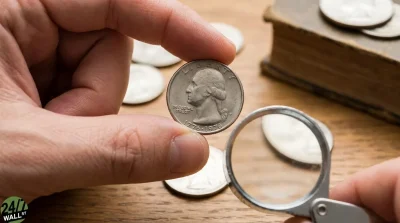
A 1776-1976 quarter really did sell for $19,200. Here is how to tell in about 10 seconds whether the one in your drawer could be worth that. Spoiler: almost certainly not, and the check takes one glance.
The 10-Second Test
Look at the front of the coin, the side with George Washington. Find the space just to the right of his ponytail, below the words “IN GOD WE TRUST.” That is where you will find a tiny letter called a mintmark, and it tells you almost everything you need to know.
-
No letter, or a D: That is a Philadelphia or Denver clad quarter. It is one of roughly 1.67 billion made for circulation, described by PCGS as “very common in circulated grades.” It is worth 25 cents. Stop here. This is nearly everyone.
-
An S: Keep going, but first consider where the coin came from. If you pulled it from change, a register, or a bank roll, it is almost certainly not the valuable version. The 40% silver “S” issues were sold only in special three-coin collector sets (blue envelope for uncirculated, red box for proof). A coin found in circulation cannot be the silver one.
-
A soft secondary check (the edge): If you found an “S,” turn the coin on its side and look at the edge. A bright orange-copper stripe means you have a copper-nickel clad coin. The 40% silver coin is also a clad sandwich, but its edge is a subtler gray rather than pure white. Use the edge as a hint, and rest the decision on the mintmark.
What Actually Sold for $19,200
The record sale was a 1976-S 40% silver quarter graded MS69, sold June 9, 2019 at Heritage Auctions for $19,200. It is one of seven coins PCGS has ever graded at that level. That same coin had previously crossed the block at a 2007 Heritage auction, when only two MS69 examples existed, and it brought $5,888 at that earlier sale.
The table below shows the PCGS population for the 1976-S silver, out of an 11,000,000 mintage, alongside what those grades have actually fetched at auction:
| Grade | Population | Recorded Auction Sales |
| MS69 | 7 | 3 sales, $5,060 to $19,200 |
| MS68 | 2,495 | 17 sales, $55 to $153 |
| MS67 | 7,193 | 4 sales, $15 to $372 |
| MS66 | 4,470 | 1 sale, $25 |
| MS65 | 1,773 | Minimal auction history |
The real story is the cliff between MS68 and MS69. One grade apart, the same coin jumps from roughly $100 to five figures. PCGS describes the situation plainly: “In MS69 condition it is really scarce with less than a handful of examples known and none existing in higher condition.”
The Price Did Not Hold
Only three MS69 sales are recorded in PCGS data. The second, at Heritage in December 2021, brought $6,600, and a third has since sold for $5,060. The single $19,200 transaction describes one of seven coins at a price neither of the other two sales came close to matching. “Worth nearly $20,000” is technically accurate for one moment in time, but the fuller picture puts the realistic range for this grade at roughly $5,000 to $6,600.
What Your Coin Is Actually Worth
-
Circulated clad (no mintmark, or D): 25 cents. Millions upon millions exist.
-
Uncirculated clad from a mint set: Still common; millions survive in mint state.
-
1976-S 40% silver, circulated or low grade: Worth its silver content. With spot silver trading around $63 to $64 per ounce in mid-September 2026, the roughly 0.0739 troy oz of silver in the coin carries a theoretical melt value of about $4.70. Silver moves daily, and a dealer’s buy price on a worn coin will be lower than spot.
-
1976-S silver in MS67 to MS68: $15 to $153 in recorded sales.
Before You Pay to Have It Graded
Grading costs money and takes weeks. A circulated Bicentennial quarter will not come back MS68, and paying to grade a pocket-change coin costs more than the coin will ever be worth. For context, the Denver clad auction record stands at $6,462 for an MS68 sold at Heritage’s January 2017 Mile High Collection sale, and that coin looked as though it had never been touched.
One more trap worth knowing: eBay asking prices reflect what sellers hope to get, not what buyers actually pay. Listings for already-graded Bicentennial quarters run roughly $19.99 to $198, but those are wishes on a screen. Every figure in this article is a completed auction sale from PCGS’s own records. Check the mintmark, put the coin back, and move on.
Editor’s note: This article was updated to reflect current silver spot prices of approximately $63 to $64 per ounce as of mid-September 2026, which revises the coin’s silver melt value to roughly $4.70, down from the prior $4.80 estimate. Context was also added on the 2007 Heritage Auctions sale of the same MS69 coin for $5,888, an earlier data point in its auction history that preceded the 2019 record.
Contact [email protected] for any questions or corrections.
Don Lair writes about options income, dividend strategy, and the kind of boring-but-durable investing that actually funds retirement. He's the founder of FITools.com, an independent contributor to 24/7 Wall St., and a former writer for The Motley Fool.