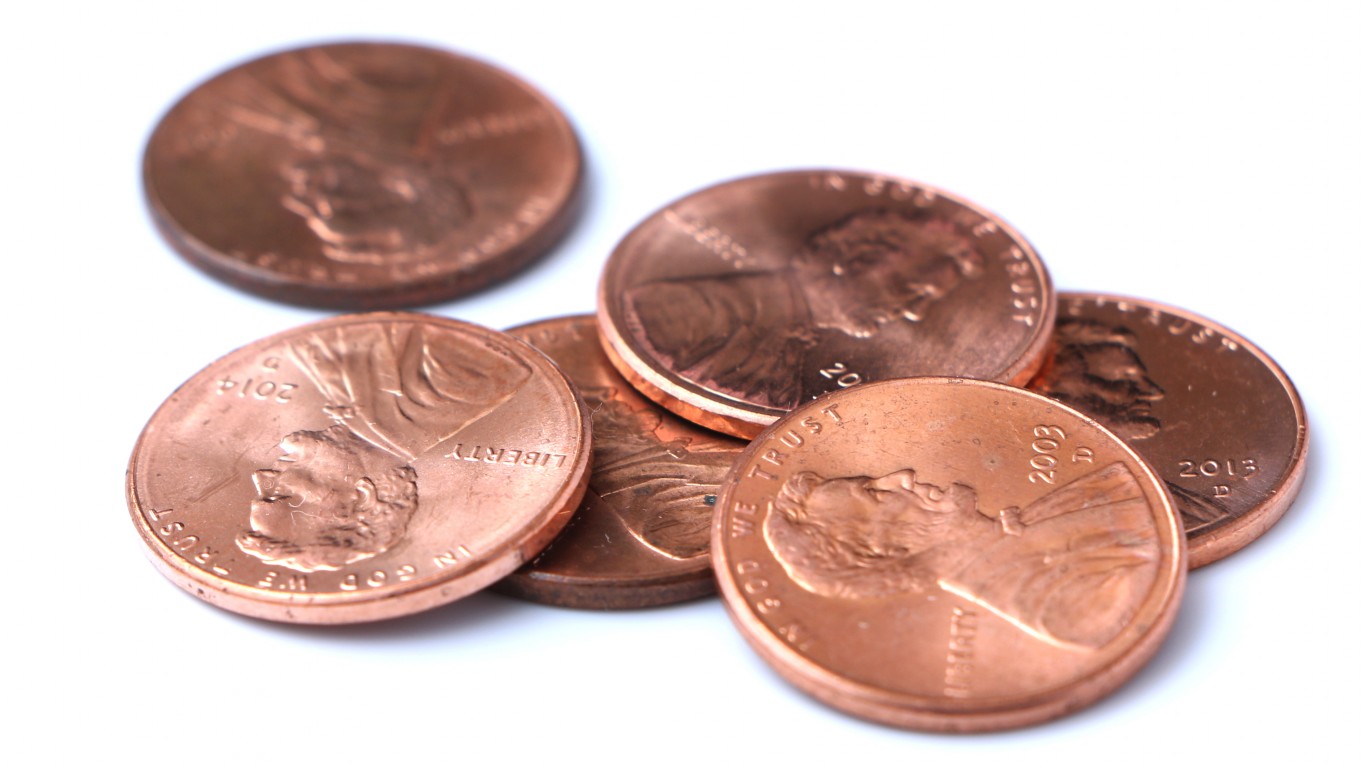
The Last Pennies Ever Minted Sold for $16.76 Million. Here Are the Dates in Your Coin Jar Worth More Than One Cent

This post may contain links from our sponsors and affiliates, and Flywheel Publishing may receive compensation for actions taken through them.

The penny ended its run as a circulating coin at a price far above one cent. AP News reported that the last U.S. cents sold at auction for $16.76 million in December 2025. According to AP’s reporting, the U.S. Mint sold sets of the final cents at an auction hosted by Stack’s Bowers Galleries (AP News).
Over the same years, an ordinary cent has bought less and less. The Consumer Price Index rose from 242.026 in November 2016[1] to 337.476 in October 2026, and the latest annual reading was +4.1%. Most pennies in a coin jar are worth exactly face value. A handful of dates and errors are worth thousands or millions, and if you sell one, the profit is taxed under a separate set of rules.
Penny Dates Worth Far More Than One Cent
This list only includes coins whose value comes from a named source. They are ranked by the reported figure.
1. Final U.S. Cents: $16.76 Million, Per AP News
Being last made these coins valuable. Coins that close out a series attract collectors for the same reasons that make any coin rare: few were made, they mark a moment in history and the record of where they came from is clean. AP News put the auction total for the last U.S. cents at $16.76 million. For most families, that sale matters more for what it signals than as a price they can match. Collector interest in the cent as a whole is now higher, and that could send more people digging through old jars.
2. 1943-D Lincoln Bronze Wheat Penny: Up to $2.3 Million, Per PennLive
In 1943, the U.S. Mint struck cents in zinc-coated steel so copper could go to the war effort. A few cents were struck on leftover bronze blanks instead, and the Denver Mint’s “D” mark makes this version especially scarce. PennLive reports that a 1943-D Lincoln bronze wheat penny is worth up to $2.3 million[2]. To check whether a 1943 cent is bronze, try a magnet: a steel cent sticks and a bronze one does not. A coin worth this much should still be authenticated by a professional grading service, because altered and fake 1943 cents are common.
Traits That Push a Penny Past Face Value
Look for four things before deciding a coin jar is just spare change:
- Mint mark. The small letter under the date shows where the coin was struck. “D” stands for Denver, “S” for San Francisco, and coins with no letter generally came from Philadelphia. Mints that made fewer coins in a given year produce rarer dates.
- Errors, including doubled dies. A doubled die happens when the die that stamps the coin picks up a doubled image. The letters and numbers then look clearly duplicated. Off-center strikes and coins struck on the wrong blank, like the bronze 1943-D, can also carry big premiums.
- Metal composition. The cent has been made from bronze, steel and later copper-plated zinc. A coin struck in the wrong metal for its year is one of the most valuable mistakes.
- Condition and grading. Professional services grade coins on a numeric scale. Coins with sharp detail, original luster and no wear sell for much more than the same date in worn condition. Cleaning a coin usually lowers its value.
What the IRS Sees When You Sell a Valuable Coin
A rare penny is treated very differently from a stock for tax purposes. Under 26 U.S.C. § 1(h)(5)(A)[3], “collectibles gain” means gain from the sale or exchange of “a collectible (as defined in section 408(m) without regard to paragraph (3) thereof) which is a capital asset held for more than 1 year.”[3] Section 408(m) lists “any stamp or coin” as a collectible under 26 U.S.C. § 408(m)(2)(D).
That affects the rate you pay. IRS Publication 550 for tax year 2025 lists a maximum rate of 28% on collectibles gain. For most other long-term gains, the top rate is 20%, and that rate applies only when taxable income reaches $600,051 or more if married filing jointly or $533,401 or more if single. The 28% figure is a maximum rate that applies only to higher-bracket taxpayers. The tax year 2024 edition of Publication 550 says that when your regular rate is below 28%, “the 28% rate does not apply.” Coins held one year or less produce short-term gain, which is taxed at ordinary income rates. Sales are reported on Form 8949 and Schedule D (Publication 550).
Precious Metal Coins Follow a Separate IRA Rule
Retirement accounts add another layer. Under 26 U.S.C. § 408(m)(1), when an IRA buys a collectible, the cost is treated as a distribution from the account. Section 408(m)(3) makes exceptions for certain gold, silver and platinum coins described in 31 U.S.C. 5112, for “a coin issued under the laws of any State,” and for bullion that satisfies the fineness standards of a contract market and is held by a qualifying trustee. Because § 1(h)(5)(A) defines collectibles “without regard to paragraph (3),”[3] those same exempt coins are still treated as collectibles when sold from a taxable account.
Inherited Coin Collections
Heirs face their own paperwork. In IRS estate tax data for returns filed in 2024, 1,296 returns[4] reported assets in a broad “Art” category, which does not list coins separately. Appraisals, purchase records and grading certificates make it easier for executors to value a collection and for heirs to support the cost basis they report when they sell.
For retirees, a large coin sale also raises adjusted gross income. That can affect the taxable portion of your Social Security benefits and whether you pay Medicare premium surcharges, so check the current limits before you sell. IRMAA surcharges tied to income from two years ago are one of several Medicare traps we mapped in a free guide. The coin in the jar might be worth millions, and keeping good records will make the tax side easier to handle.
Contact [email protected] for any questions or corrections.
Jake has been been working in financial media for almost 15 years. He focuses on all things personal finance for 24/7 Wall St. with high hopes to educate and entertain. Most recently, Jake spent 12 years working various roles at The Motley Fool. He started copy editing fool.com content, worked on premium and marketing campaigns, and helped launch The Ascent, a personal finance brand.
His work has been featured on platforms like MSN, Yahoo Finance, USA Today, and more. He's written about credit cards, social security, ETFs, savings accounts, and just about anything else you can imagine when thinking about money. Jake love to cook, play golf, and tell people he's never had a cavity. (It's true!)