15 Rare Banknotes That Sold for Serious Money (One Sold for Over $3 Million)
Some of these banknotes look completely unremarkable, yet collectors have paid staggering sums to own them. The reasons involve printing accidents, survival stories stranger than fiction, and denominations most people never knew existed.

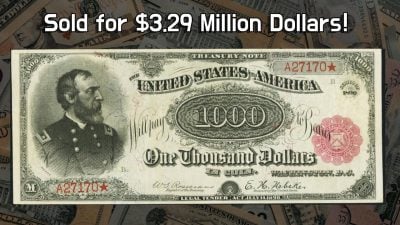
Most old paper money is interesting to look at, but it is not necessarily worth much more than its face value. Then there are the exceptions. A rare serial number, printing mistake, unusual denomination, tiny surviving population, or simply being one of the best-known examples can turn an old banknote into something collectors are willing to spend hundreds of thousands, or even millions, to own.
And some of these bills do not look nearly as extraordinary as their auction prices suggest. The list includes historic American notes, incredibly rare foreign currency, and even a $20 bill with one of the strangest printing errors ever discovered. These 15 paper bills have all crossed the $100,000 mark at documented sales, and some have climbed far beyond that. We’re starting with the least expensive of the group and working our way up to a banknote that sold for more than $3 million.
China’s 1909 Ooi-Long 1 Yuan Note: About $125,000
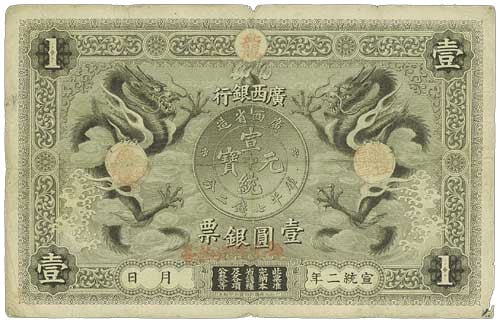
At first glance, the denomination is just 1 yuan. The collector market saw something entirely different. The Kwangsi Bank’s 1909 “Ooi-Long” or “Black Dragon” note sold for roughly $125,000 in a Spink auction more than a decade ago, according to the later Stack’s Bowers catalog description of the same rarity.
The face shows two black dragons flanking a Kwangsi silver dollar, giving the note its famous nickname. Stack’s Bowers said the issue circulated for only about two years before being recalled and described the offered example as the only one then graded by PMG. A surviving note like this is valuable because of rarity and history, not because a one-yuan denomination suddenly became valuable. A public-domain image of the design is available through Wikimedia Commons.
Palestine 1927 £100 Note: $219,600
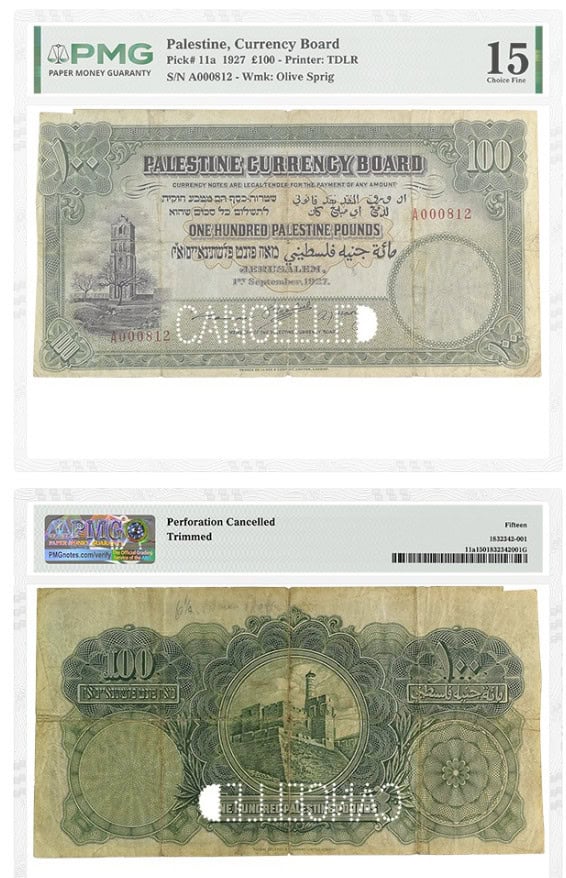
A rare 1927 Palestine Currency Board £100 note set a new benchmark when it realized $219,600 at a Stack’s Bowers Galleries auction on May 6, 2026. The Prefix A note was graded PMG Choice Fine 15 and came from the Olive Sprig Collection.
Its survival story is extraordinary. PMG reported that the note had been discovered in an anonymous donation to an Oxfam charity store in England in 2020. By 2026, PMG described it as only the fourth known example of the denomination in private hands and the only one in its Population Report. It had previously sold in 2022, but the 2026 result is the newer verified sale used here. Rarity, provenance and exact issue all matter far more than the printed £100 denomination.
China 1951 5,000 Yuan Shepherd Note: About $232,500
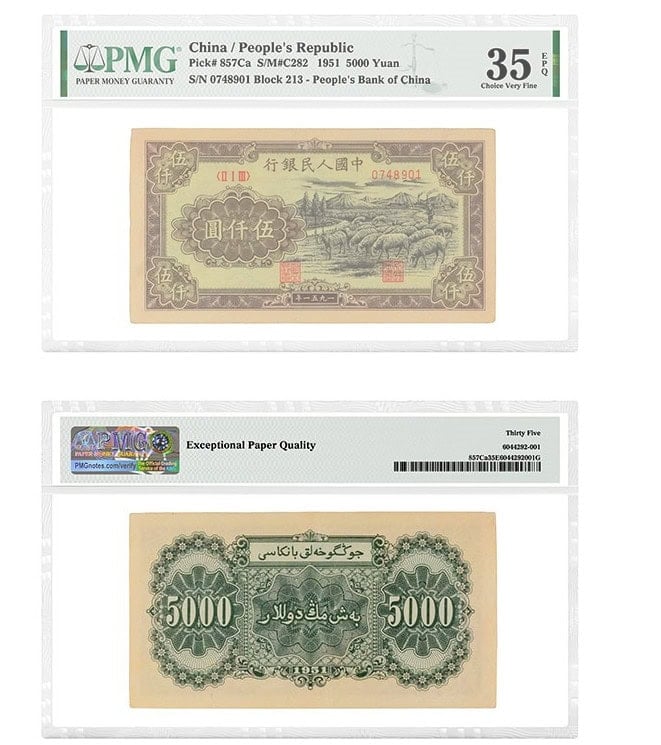
A rural scene of a shepherd and his flock helped make this one of the standout banknotes in a 2022 Spink sale. The People’s Republic of China 1951 5,000 Yuan note, graded PMG Choice Very Fine 35 EPQ, realized more than HK$1.8 million, about $232,500 at the exchange rate cited by PMG.
Condition played an unusually important role. PMG said this note was the only example with its catalog number to receive the Exceptional Paper Quality designation among 85 issues then recorded in its Population Report. High-denomination First Series Renminbi notes are heavily collected, but the six-figure result belongs to this particular variety and grade. A similar-looking 5,000-yuan note in a different condition can have a dramatically different market value.
Zanzibar 1920 500 Rupees: $288,000
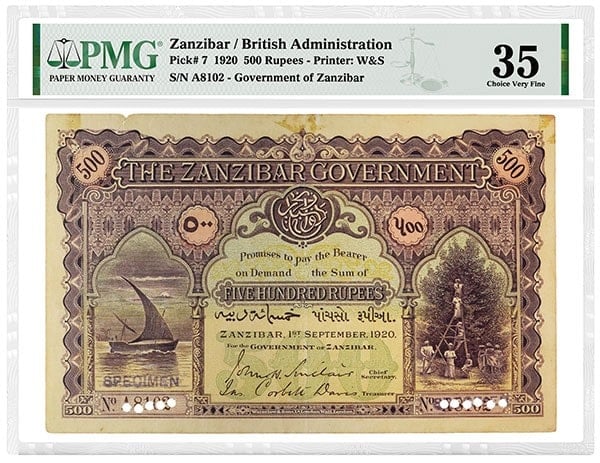
Zanzibar’s old paper money is so scarce that a complete group of seven denominations can become the centerpiece of a major world-banknote auction. In January 2022, a 1920 Zanzibar 500 Rupees note graded PMG Choice Very Fine 35 realized $288,000 in a Spink sale.
The 500-rupee note was the largest denomination in the Zanzibar Rupee series, which PMG says was issued by the British protectorate from 1908 until 1935. The design is also instantly recognizable, with a dhow on the water and clove harvesters. The auction result includes buyer’s premium and belongs to this specific graded example. Old foreign notes can vary enormously in price depending on issue, denomination, survival rate and condition.
Canada’s 1911 $500 Queen Mary Note: $322,000
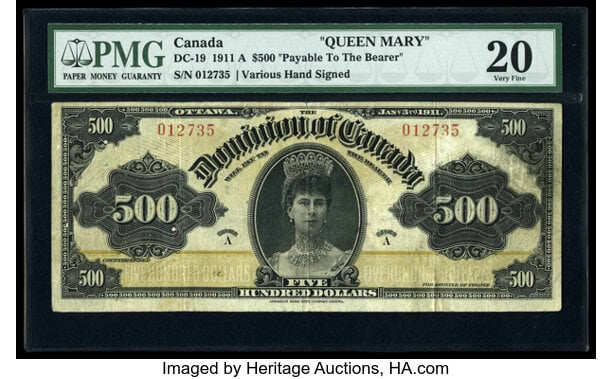
One of Canada’s rarest issued notes was nearly lost in a pile of old papers. A 1911 Dominion of Canada $500 note featuring Queen Mary sold for $322,000 at Heritage Auctions on September 17, 2008. The DC-19 note was graded PMG Very Fine 20.
Heritage said only three issued examples were known at the time. The consignor had found this one tucked inside an old book years earlier, then later rediscovered it among papers that were waiting to be shredded. That backstory is almost as remarkable as the price. The issued Queen Mary note should not be confused with specimen versions, which have appeared at much lower prices. For rare currency, tiny differences in status can mean hundreds of thousands of dollars.
1996 $20 Del Monte Error Note: $396,000
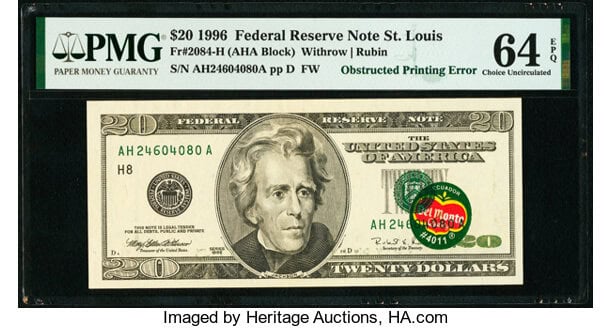
This $20 bill is proof that a valuable paper-money find does not have to be 100 years old. The famous 1996 “Del Monte Note” sold for $396,000 at Heritage Auctions on January 22, 2021. It was graded PMG Choice Uncirculated 64 EPQ.
A Del Monte Ecuador banana sticker became stuck to the note before the final printing stage, so part of the Treasury seal and a serial number were printed over the sticker. Even stranger, the note made it through the Federal Reserve system and into circulation. Heritage said it was received by a college student as part of an ATM withdrawal in 2004. The huge price comes from this one spectacular retained-obstruction error, not from ordinary 1996 $20 bills.
1928 $10,000 Federal Reserve Note: $504,000
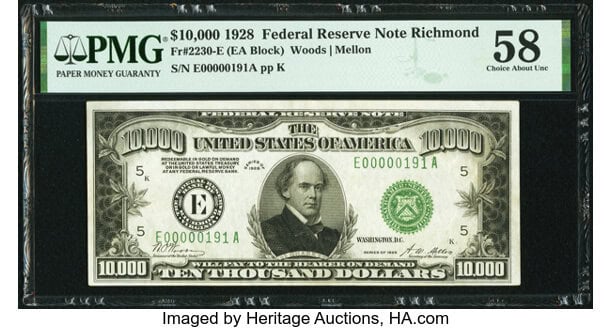
The $10,000 bill was a real U.S. denomination, and collectors can still legally own surviving examples. A Series 1928 Richmond Federal Reserve Note, Fr. 2230-E and graded PMG Choice About Uncirculated 58, sold for $504,000 at Heritage Auctions in October 2022.
Heritage reported only 10 documented Series 1928 $10,000 notes across all Federal Reserve districts at the time, with two in museum collections and eight available to collectors. That scarcity is much greater than it is for the better-known Series 1934 $10,000 notes. The half-million-dollar sale should still be read as a specimen-specific result. Grade, district, series and the note’s individual history all help determine what a surviving high-denomination bill can bring.
1878 $100 Silver Certificate: $540,000
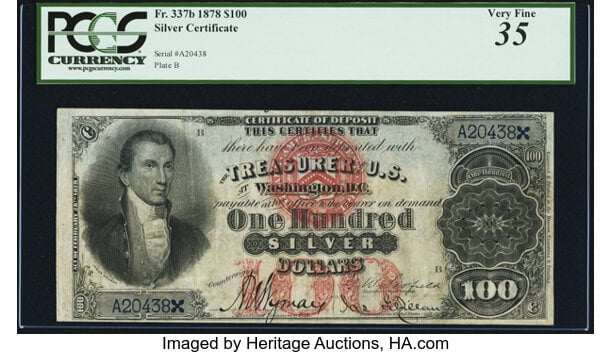
A $100 Silver Certificate from 1878 sold for $540,000 at Heritage Auctions on January 11, 2019. The Fr. 337b note was graded PCGS Very Fine 35, and Heritage called it the finest of the four examples of that Friedberg number known at the time.
Two of those four were already in government hands, including one at the Smithsonian and another at the Federal Reserve Bank of San Francisco. Heritage also noted that the auctioned piece had restoration in the lower-right corner. Even with that qualification, its rarity and pedigree drove a half-million-dollar result. This is another case where the exact catalog variety matters far more than the denomination or date alone.
1928 $5,000 Federal Reserve Note: $780,000
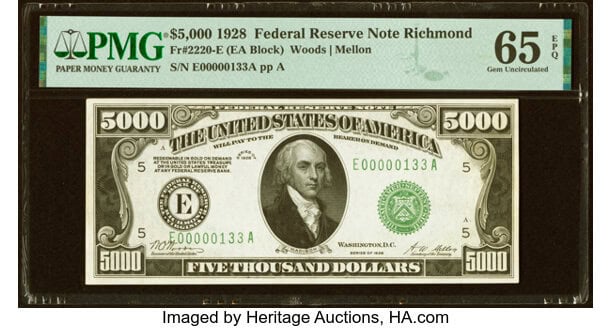
High-denomination U.S. currency is collectible in almost any form, but this Richmond $5,000 note sits in another category. The Series 1928 Fr. 2220-E, graded PMG Gem Uncirculated 65 EPQ, sold for $780,000 at Heritage Auctions on September 13, 2024.
The grade was a major part of the story. At the time of the sale, Heritage said PMG had graded 22 Series 1928 $5,000 notes across all districts and this was the sole finest example in its population report. That makes the $780,000 figure a result for an extraordinary specimen, not a blanket price for every surviving $5,000 bill. District, series, condition and originality are all crucial when these notes are valued.
1878 $5,000 Legal Tender Specimen: $805,000
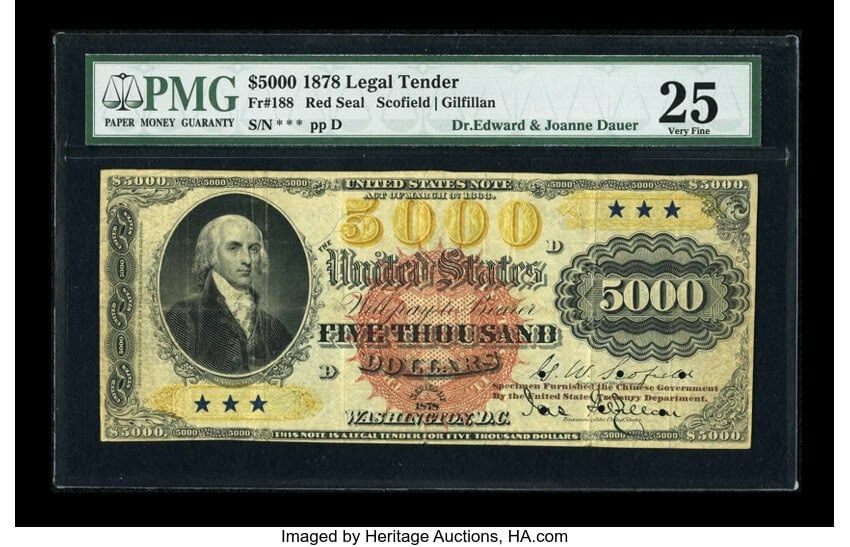
This is not a normal circulated $5,000 bill. It is an 1878 Legal Tender specimen that was furnished to the Chinese government, and Heritage Auctions sold it for $805,000 in September 2007. The note, cataloged as Fr. 188, was graded PMG Very Fine 25.
Its unusual status is exactly why the details matter. Heritage described it as the only surviving example of the design and the only large-size $5,000 note of any issue available to collectors. It was printed on genuine currency paper and on both sides, but stars occupy the serial-number spaces and the note carries presentation markings. So while the price is spectacular, this should not be presented as the value of an ordinary $5,000 bill from the era.
1882 $500 Gold Certificate: $1.41 Million
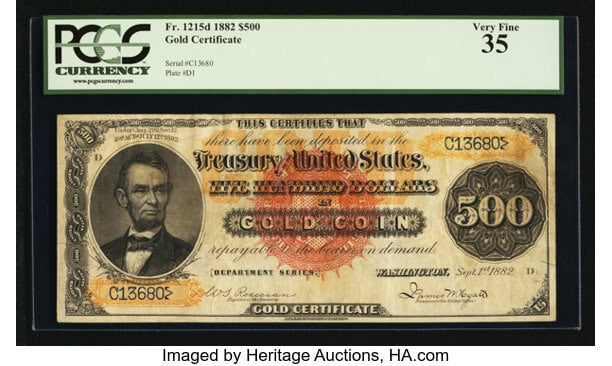
This 1882 $500 Gold Certificate went from a piece of old federal currency to a $1.41 million auction lot when it crossed the block at Heritage on January 10, 2014. The Fr. 1215d note was graded PCGS Very Fine 35 and still showed the bold red seal that helps make the design so distinctive.
Heritage described the piece as unique in collector hands at the time. Before its discovery, the only known example of this Friedberg number was held in a Federal Reserve collection. That is why simply finding an old $500 Gold Certificate is not enough to assume a seven-figure value. Signature combination, catalog number, grade, originality and the number of surviving examples can completely change the market result.
Australia’s 1913 Number One Ten-Shilling Note: $1.909 Million
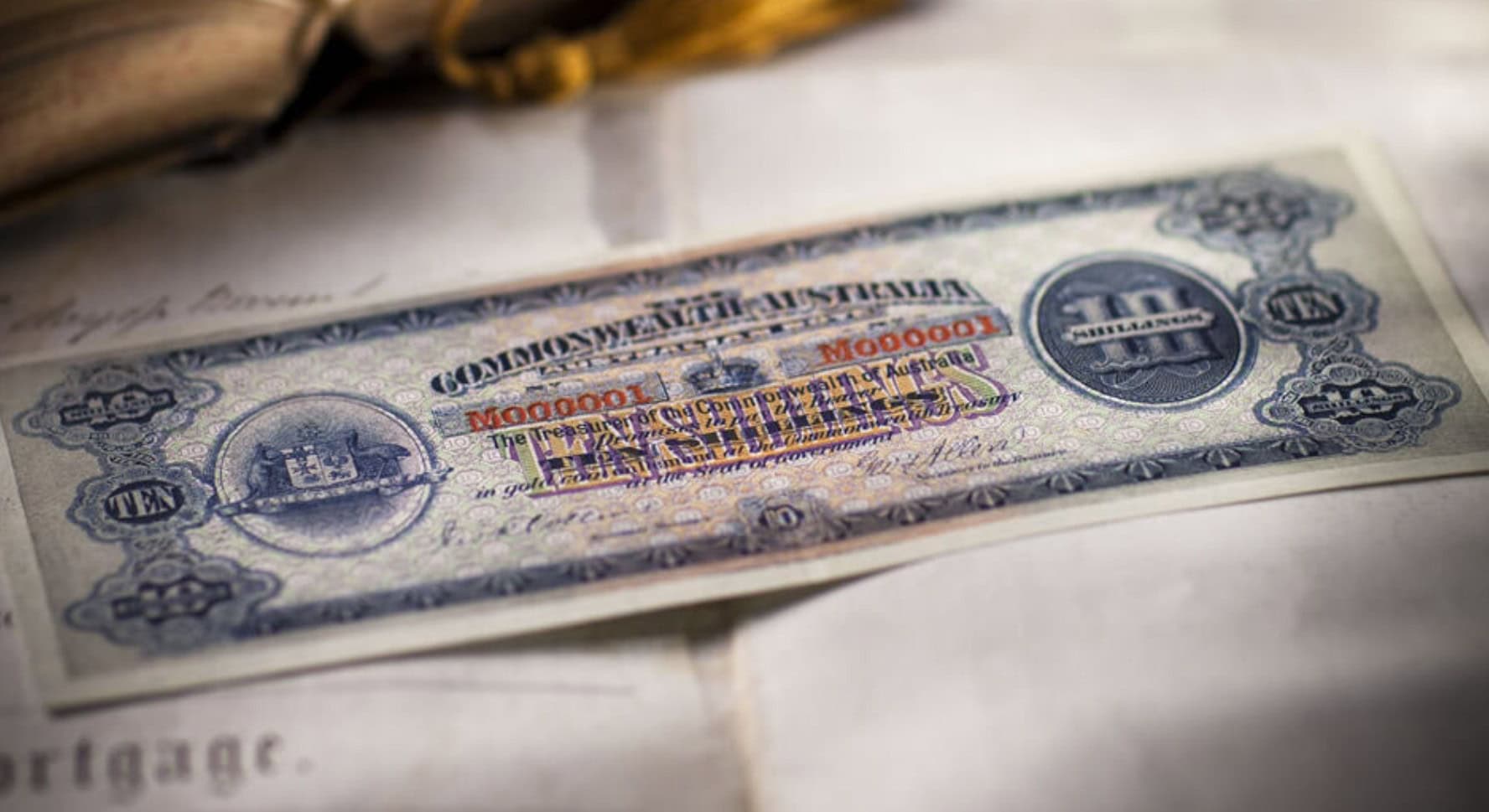
Australia’s first Commonwealth banknote carries a serial number that could hardly be more memorable: M000001. The 10-shilling note was hand-numbered during an official ceremony on May 1, 1913, by Judith Denman, the five-year-old daughter of Governor-General Lord Denman. In 2008, it sold for A$1.909 million, a record price for Australian numismatics at the time.
The note resurfaced in England in 1999 among Judith Denman’s effects, decades after it had been presented to her. Its value is not simply about being an old Australian note. It is the first numbered Commonwealth banknote, tied directly to the country’s monetary history and backed by unusually strong provenance. Later private transactions should not be confused with the documented 2008 auction result used here.
1863 $100 Gold Certificate: $2.115 Million
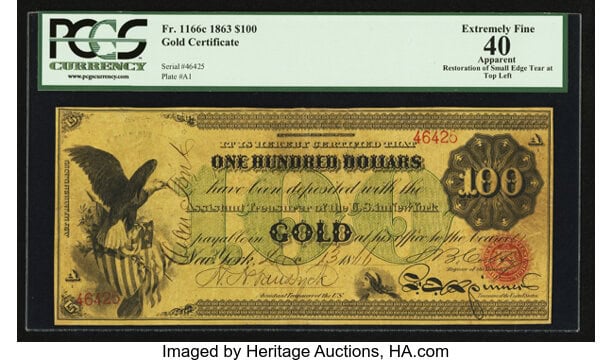
A $100 bill from the Civil War era became a multimillion-dollar collectible when this 1863 Gold Certificate sold for $2.115 million at Heritage Auctions on April 26, 2013. The note, cataloged as Fr. 1166c, was graded PCGS Apparent Extremely Fine 40.
The story behind the price is extreme rarity. Heritage said three examples were known at the time, with two held by the Smithsonian Institution. That left the auctioned note as the only example in private hands. It also carried a note about a small repaired edge tear, showing that rarity can outweigh condition at this level of collecting. The seven-figure result belongs to this exact survivor, not to 1863 currency in general.
1891 $1,000 Treasury Note: $2.585 Million
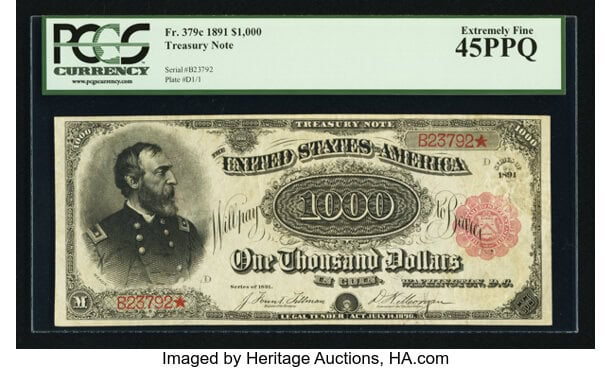
The 1891 $1,000 Treasury Note does not have the famous watermelon-style back, but it is actually scarcer than its better-known cousin. Heritage Auctions sold this Fr. 379c example for $2.585 million on April 26, 2013. It was graded PCGS Extremely Fine 45 PPQ.
At the time of the auction, Heritage reported only two examples of this design type were known, with the other one outside the reach of private collectors. That made the note offered in 2013 effectively a once-in-a-generation opportunity. The sale price is tied to that exact note, grade, rarity and pedigree, which is an important distinction when looking at high-dollar paper money results.
1890 $1,000 Grand Watermelon Treasury Note: $3.29 Million
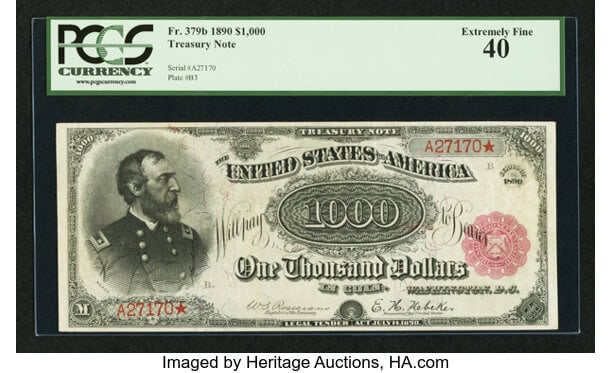
It is hard to imagine a piece of paper with a $1,000 face value selling for more than $3 million, but this one did. Heritage Auctions sold the 1890 $1,000 Treasury Note known as the “Grand Watermelon” for $3.29 million on January 10, 2014. Guinness World Records still lists that result as the record auction price for a banknote.
The nickname comes from the three huge green zeros on the back, which collectors thought looked like watermelons. This exact Fr. 379b note was graded PCGS Extremely Fine 40 and was described by Heritage as unique in collector hands at the time of the sale. That distinction matters: the $3.29 million result applies to this exceptionally rare variety and specimen, not to every old $1,000 bill.
Contact [email protected] for any questions or corrections.