The Helicopter Is the Fastest Way to the ER. The 20% Medicare Leaves Behind Is the Priciest Part of the Ride.
Medicare covers the helicopter, but a single rotor-wing evacuation can leave a retiree staring at a bill larger than a month of Social Security, and Original Medicare has no ceiling to stop it from happening again.

This post may contain links from our sponsors and affiliates, and Flywheel Publishing may receive compensation for actions taken through them.
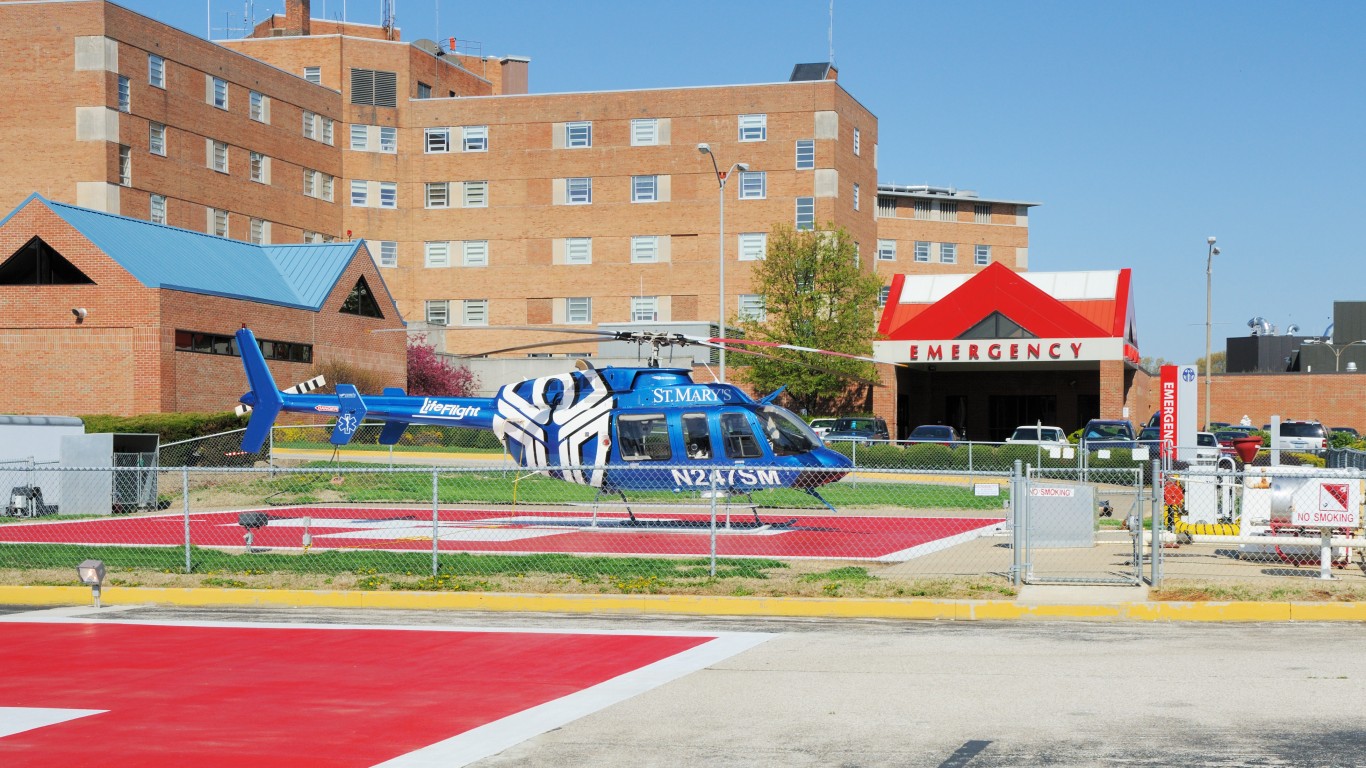
A retiree hikes a rural trail, breaks a hip, and gets flown by helicopter to the nearest trauma center. Six weeks later, an air ambulance bill arrives with a five-figure number on it. Medicare processed the claim. The bill is what Medicare did not pay.
That remaining share, the 20% coinsurance on Part B services, is the coverage gap most enrollees never picture until it lands in the mailbox. On a $100 Medicare-approved office service, it means $20. On a rotor-wing evacuation, it can mean thousands, and under Original Medicare there is no annual ceiling to catch it.
What Medicare Actually Pays for the Flight
Medicare Part B covers medically necessary air ambulance transport at 80% of the Medicare-approved amount after the annual Part B deductible, which is $283 in 2026. Ambulance suppliers are required to accept Medicare assignment, so they cannot balance-bill a beneficiary above that approved amount on a covered claim. That protection is real. It prevents an air ambulance provider from passing its full sticker price through to the Medicare beneficiary.
The trap is the residual. Federal auditors have reported that the median charge for a helicopter transport ran roughly $36,000 in the most recent GAO review, and Medicare’s approved amount for rotor-wing service, while lower, still routinely lands in the mid four figures once mileage is added. The 20% coinsurance on a five-figure charge is the piece Original Medicare walks away from, and unlike an employer plan or a Medicare Advantage plan, Original Medicare attaches no out-of-pocket maximum to it. A single helicopter ride can leave a beneficiary owing $1,500 to $3,000. Two flights in one benefit year double it. Nothing stops the meter.
The Bigger Trap: “Not Medically Necessary”
Beyond the coinsurance, the coverage decision itself is a risk. Medicare pays for air ambulance only when the patient needs immediate and rapid transport that ground transportation cannot provide. If Medicare later determines that the flight did not meet that standard, the claim may be denied and the beneficiary could owe far more than the usual 20%. But the full billed charge does not automatically become the patient’s responsibility; liability can depend on the circumstances, Medicare’s notice rules, and the outcome of any appeal.
This matters more for older beneficiaries living on fixed income. The 2026 Social Security cost-of-living adjustment (COLA) came in at 2.8%, and household credit stress is already elevated, with credit card delinquencies at 2.92% as of January 2026. A $2,000 surprise bill for a single ride is a real cash-flow event for a household drawing Social Security plus a modest RMD.
The Two Fixes Worth Naming
Medigap Plan G. After the beneficiary meets the Part B deductible, Plan G pays the 20% coinsurance on covered Part B services, including air ambulance. It also covers the Part A hospital deductible of $1,736 in 2026 and the daily skilled nursing coinsurance of $217 per day for days 21 through 100. Plan G premiums vary by state and age, but $150 to $250 per month is a common range for a 65-year-old. That premium is what buys the cap on air ambulance exposure that Original Medicare will not provide.
Medicare Advantage in-network out-of-pocket maximum. Advantage plans cap annual cost sharing for covered Medicare services, which can limit air ambulance exposure. Emergency and urgent care remain covered outside the plan’s network, so a helicopter dispatched to an accident scene should not hinge on network status or prior authorization. The bigger questions are the plan’s air ambulance cost share and how that expense counts toward its annual maximum. Prior authorization becomes more relevant for non-emergency transfers.
What to Do Before the Helicopter Ever Takes Off
If enrollment in Part B began within the last six months, the federal Medigap open enrollment window is still open, and Plan G can be purchased without medical underwriting. That window closes once and does not reopen at the federal level in most states. Do not let it lapse assuming a supplement can be added later.
If the window has already closed, pull the current Advantage plan’s Evidence of Coverage and read the ambulance and prior-authorization sections directly. The relevant numbers are the in-network out-of-pocket maximum and the specific cost share for emergency air transport.
If income and resources are limited, apply for a Medicare Savings Program through the state Medicaid office. In 2026, the federal Qualified Medicare Beneficiary (QMB) income limit is $1,350 per month for an individual and $1,824 for a married couple, although some states use more generous limits. QMB pays the Part B premium and protects beneficiaries from deductibles, coinsurance, and copayments on Medicare-covered services, including the ride.
The 20% Medicare leaves behind is small on a doctor visit and quiet on a lab draw. On a helicopter, it is the whole point of buying a supplement.
Contact [email protected] for any questions or corrections.
Gerelyn Terzo is the author of dividend investing handbook "Dividend Investing Strategies: How to Have Your Cake & Eat It Too." A veteran financial journalist, she covers agri-finance for outlets like Global AgInvesting and the broader stock market and personal finance for 24/7 Wall Street. She began at CNBC and later helped launch Fox Business in New York. Gerelyn currently resides in Woodland Park, Colorado and dabbles in nature photography as a hobby.