The Real Cost of Retiring in Sun City, Arizona, on Social Security and a Small Pension
Sun City looks affordable on paper, but the homes hiding behind those low price tags carry a decades-old secret that can quietly drain a retirement portfolio dry before year fifteen even arrives.

This post may contain links from our sponsors and affiliates, and Flywheel Publishing may receive compensation for actions taken through them.

A couple in their early sixties has a paid-off house somewhere colder, Social Security coming, a small pension from a school district or utility or hospital, and maybe a modest IRA. They want to know whether a low-slung stucco house in Sun City, Arizona, with a pool and no heating bill actually pencils out. It deserves a real answer instead of a national average.
What Sun City Actually Costs a Retired Couple
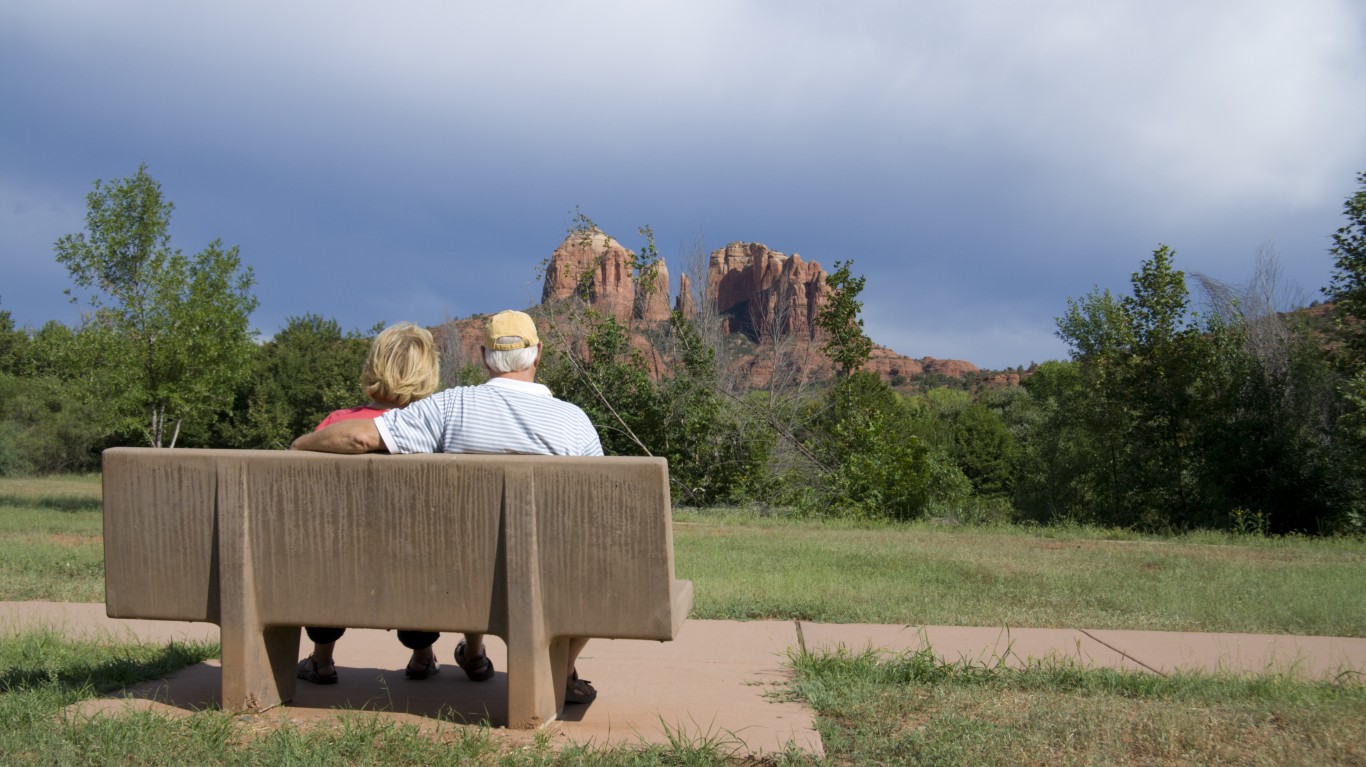
Sun City, the original Del Webb development in the northwest Valley, runs cheaper than Phoenix proper and meaningfully cheaper than Scottsdale. A modest two-bedroom, two-bath block home in decent shape trades in the low-to-mid $300,000s. Arizona carries a cost-of-living index of 100.677, essentially the national average, but Sun City’s sub-market skews lower on housing and higher on cooling and healthcare.
A realistic annual budget for a couple who owns their Sun City home outright:
- Property taxes and home insurance: about $2,800. Maricopa County property tax is light, but Arizona home insurance has climbed with construction costs.
- Recreation Centers of Sun City (RCSC) fee: about $1,100 for two owners, mandatory for ownership.
- Utilities, heavy on summer electric: about $3,600. Air conditioning runs from April into October.
- Home maintenance and reserves: about $4,500.
- Two vehicles, insurance, fuel, replacement reserve: about $6,500, with gasoline currently running around $4.00 a gallon nationally.
- Groceries and household: about $9,600, tracking the USDA Low-Cost plan for two adults 60-plus.
- Healthcare on Medicare: about $8,400 for the couple, covering the $202.90 monthly Part B premium each, a Medigap plan, Part D, and out-of-pocket dental and vision.
- Dining, hobbies, gifts, travel: about $6,000.
- Federal income tax on withdrawals and pension: about $1,500.
That totals roughly $44,000 a year in current dollars for a couple who owns their home free and clear.
The Income Side and the Math
Two retirees claiming near full retirement age with average work histories pull in roughly $3,800 a month combined in Social Security, or about $45,600 a year, and the 2026 COLA of 2.8% is already baked in. Add a small pension of $12,000 a year and gross income lands at $57,600.
Arizona does not tax Social Security. The state’s flat individual income tax is 2.5%, and its individual income tax structure ranks 8th in the country for competitiveness. On $12,000 of pension income, the state bite is negligible. Federal tax on the combined income, given the senior standard deduction, is modest.
Subtract the $44,000 budget from $57,600 of income and there is a $13,600 annual cushion. That cushion absorbs miscellaneous shocks a fixed budget does not see coming. If you want that cushion from a portfolio instead, dividing $13,600 by a 4% withdrawal rate implies about $340,000 in invested assets. A more conservative 3.5% rate pushes the target to roughly $390,000.
The Line Item Most Sun City Buyers Underprice
The average Sun City home was built between 1960 and 1978. Over a twenty-five-year retirement, you are almost certainly replacing the HVAC system twice, the roof once, the water heater twice, and probably the main sewer line and some galvanized plumbing. Arizona’s cooling load shortens HVAC life compared with milder climates, and a full heat-pump replacement in the Valley now runs $12,000 to $18,000 installed.
Roll those known replacements across the horizon and you are looking at $60,000 to $90,000 of near-certain capital spending on a Sun City house, on top of routine maintenance. That is why the reserves line is $4,500 and not $2,000. Treat it as lower and the roof will remind you.
The Case-Shiller national index at 332.7 reflects sustained housing wealth, but Sun City’s deed-restricted, age-restricted resale market moves on its own schedule. Do not assume you can tap home equity on the timeline national headlines suggest.
What It Actually Takes
For a couple who arrives in Sun City with the house bought outright, a combined Social Security benefit near the national average, and a pension of roughly $1,000 a month, the scenario works on about $340,000 to $400,000 of invested assets alongside a dedicated $60,000 to $80,000 house-reserve bucket, drawn at a 3.5% to 4% rate. Underfund the reserve and the portfolio becomes the reserve, which is how comfortable retirements quietly turn tight around year twelve.
Contact [email protected] for any questions or corrections.
I am a long time investor and student of business, and believe finding good companies that can become great investments is the best game on earth. After 20 years of writing and researching the public markets it is clear that individuals have never had more tools and information to take control of their financial lives. From ETFs and $0 commissions to cryptos and prediction markets there has never been a greater democratization of access to investing.
I write to help people understand the investments available to them so they can make the best choice for their portfolio, whether they're starting out or looking for income in retirement.