The Real Cost of Retiring in Sedona, Arizona, Where No One Bothers You
Sedona's red-rock silence costs far more than most retirement calculators reveal, and the single biggest expense is one almost every buyer completely ignores until it is too late.

This post may contain links from our sponsors and affiliates, and Flywheel Publishing may receive compensation for actions taken through them.
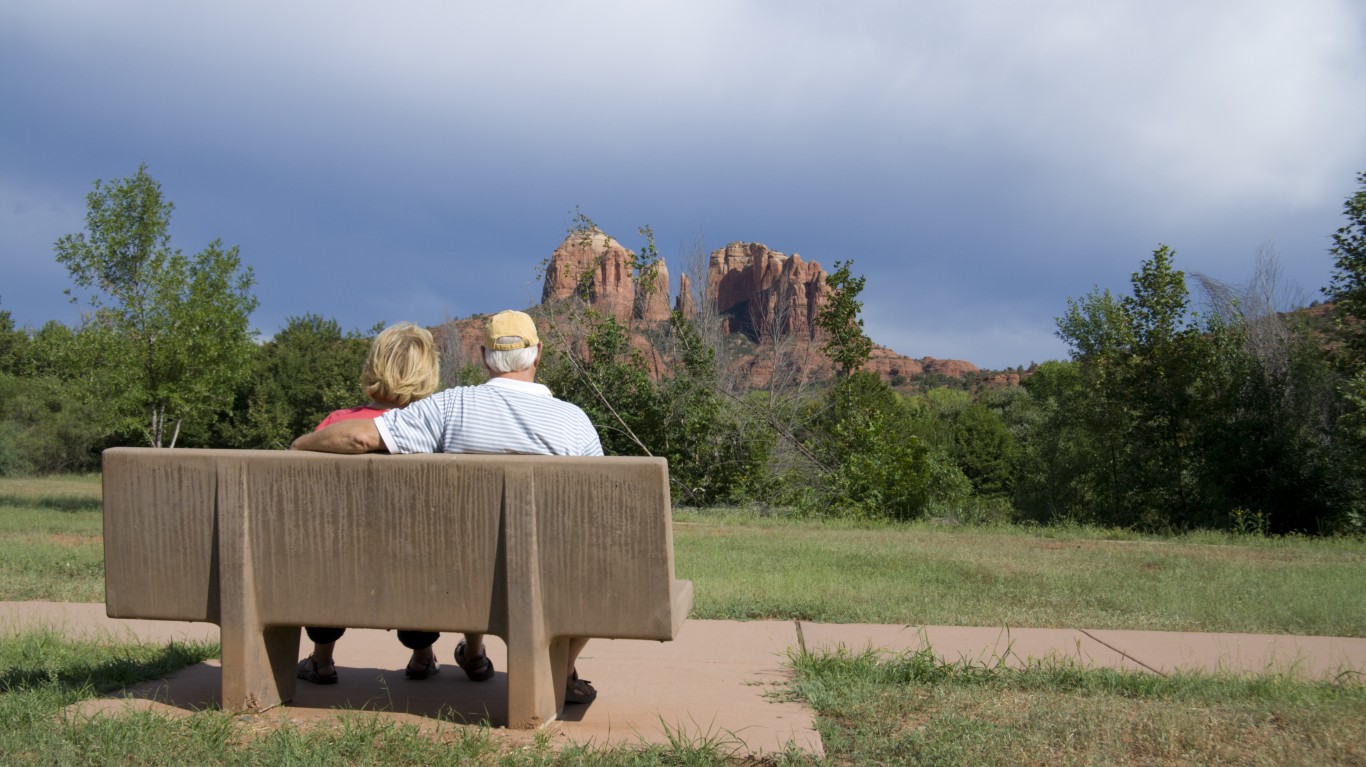
Plenty of people in their late fifties has spent enough weekends in Sedona to picture the rest of their life there, and they want to know what the number actually is. They want the Sedona answer, with the privacy the headline promises, the red-rock quiet, and enough runway that the plan holds up thirty years in. Here is what it really takes.
The Sedona Premium Sits On Top of an Already Elevated Market
Arizona looks moderate-cost on paper. The state’s cost-of-living index runs at 100.677, essentially the national average. Sedona is a resort town wrapped inside a national forest, with tight building envelopes, no room to sprawl, and buyers arriving from California and Colorado with cash.
National home prices sit at the 90th percentile of the Case-Shiller history, with the index at 332.7 as of April 2026. Sedona sits well above that baseline. A modest three-bedroom in West Sedona typically prints in the $800,000 to $1 million range. For the privacy the headline promises, you buy acreage in the Village of Oak Creek, out toward Red Rock Loop, or one canyon over in Cornville or Page Springs, where a private lot with buffer runs $1.1 to $1.5 million. Sedona’s inventory is thin enough that leverage evaporates on any listing with a view.
Building the Annual Budget for a Couple Living Quietly
Assume a paid-off house purchased outright, a couple aged 65, and Medicare in force. The 2026 Part B premium at standard income is $202.90 per month per person, with the Part A hospital deductible at $1,736. Add a Medigap plan and Part D and you are around $9,000 a year for the couple before any dental or vision.
A realistic annual budget:
- Property taxes, insurance, HOA where applicable: $9,000. Arizona’s property tax burden ranks 13th nationally on the property tax component, but wildfire insurance in the red-rock wildland urban interface keeps rising.
- Home maintenance and reserves on a $1.2 million property: $15,000. Roofs, HVAC, wells, septic on rural parcels, xeriscape upkeep.
- Healthcare, all-in: $12,000. Premiums, deductibles, dental, out-of-pocket.
- Food and household: $14,000. Sedona’s grocery pricing sits above the consumer expenditure survey baseline of $78,535 annually in 2024.
- Utilities, internet, phones: $5,500. Propane is common outside city limits.
- Transportation: $8,500. Two vehicles, replacement reserves, and Arizona gas near the national average of $3.85 per gallon. Specialist care means real miles to Flagstaff or Phoenix.
- Discretionary, travel, gifts: $12,000.
- State and federal taxes on withdrawals: $10,000.
That lands near $95,000 a year in current dollars for a quiet, comfortable Sedona retirement.
The Portfolio Math
Social Security is the ballast. The 2026 COLA came in at 2.8%, keeping benefits roughly in line with inflation. A dual-earner couple claiming at full retirement age can reasonably expect around $58,000 combined. Delaying to 70 adds roughly 8% per year and pushes that closer to $72,000, the single most powerful lever most Sedona candidates leave on the table. Arizona does not tax Social Security, and its flat individual income tax ranks 8th nationally for competitiveness, so the retirement-income treatment is genuinely friendly.
If Social Security covers $65,000 at a blended claim strategy, the portfolio has to fund roughly $30,000 in real spending plus cover the house. At a 4% withdrawal rate, that is $750,000 in invested assets on top of the $1.2 million home. At a more conservative 3.5% rate, appropriate if either spouse retires before 65 or has longevity in the family, it is closer to $860,000. Call the whole package $2 million: house free and clear, and roughly $800,000 in a mix of index funds, a short treasury ladder for the first five years of withdrawals, and a dividend-oriented sleeve to smooth income. (For readers stress-testing the withdrawal side specifically, our team has written about why the traditional 4% figure needs revisiting in the current environment.)
What Most Sedona Analyses Miss: The Privacy and Wildfire Premium
The headline says no one bothers you. Sedona proper does not deliver that. It draws millions of visitors a year, and the trails behind West Sedona homes are packed by 8 a.m. To get isolation, you buy acreage, and acreage in this landscape means wildland urban interface. Wildfire insurance has been the fastest-growing line item in Northern Arizona budgets. Carriers have been non-renewing policies in the red-rock zone, and the surplus-lines coverage that replaces them can run $6,000 to $12,000 a year on a rural home, sometimes more with a wood-shake roof or heavy tree cover.
That single line item, compounded across a 30-year retirement, can consume $250,000 in real dollars. It is the number buyers almost never model. If you want the quiet, budget for it explicitly, harden the property with defensible space and a metal roof, and shop the insurance market before you shop the house.
What This Actually Takes
A Sedona retirement where no one bothers you, funded realistically, looks like this: roughly $2 million in total assets at age 65, split as a $1.2 million paid-off home on a private lot and $800,000 in a diversified portfolio. Delay at least one Social Security claim to 70 to lift the guaranteed income floor to around $70,000. Plan on $95,000 a year in current-dollar spending, hold the portfolio withdrawal to 3.5% to 4%, and treat wildfire insurance as a permanent, growing line item. Do that, and the red rocks are yours for as long as you want them. Skip the insurance math and pick a house in the trees, and Sedona will find a way to bother you after all.
Contact [email protected] for any questions or corrections.
I am a long time investor and student of business, and believe finding good companies that can become great investments is the best game on earth. After 20 years of writing and researching the public markets it is clear that individuals have never had more tools and information to take control of their financial lives. From ETFs and $0 commissions to cryptos and prediction markets there has never been a greater democratization of access to investing.
I write to help people understand the investments available to them so they can make the best choice for their portfolio, whether they're starting out or looking for income in retirement.