What It Takes to Retire in Sicily at 60 on $800,000 and Keep Your Principal
A Sicilian hill town, a modest portfolio, and a tax regime most retirees never find could change the math entirely, but the entire scenario hinges on a single population number most people overlook.

This post may contain links from our sponsors and affiliates, and Flywheel Publishing may receive compensation for actions taken through them.
What Sicily Actually Costs
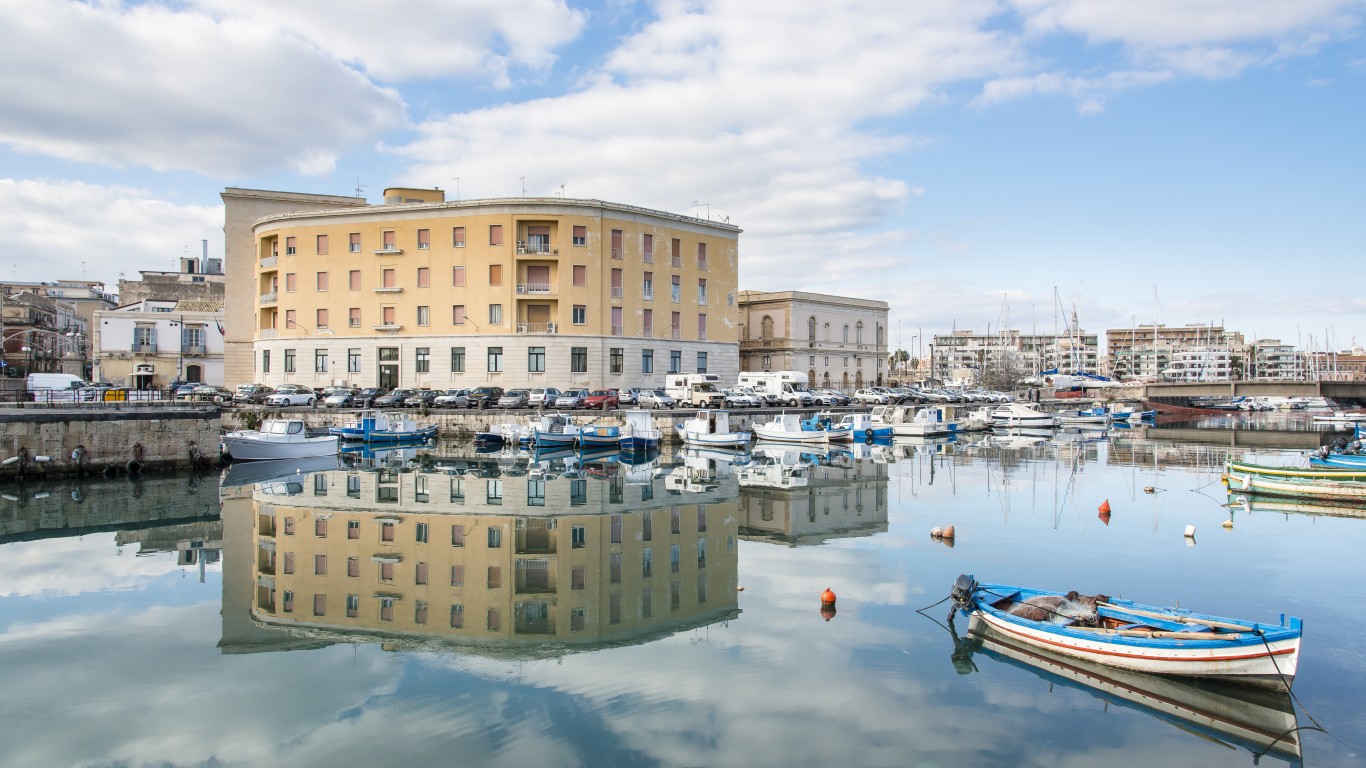
Sicily contains distinct submarkets. Inland towns in Enna or Caltanissetta differ vastly from coastal Taormina or Siracusa, and tax incentives push retirees toward the cheaper interior anyway. Long-term rentals in inland towns run in the low hundreds of euros monthly for a small apartment; coastal equivalents cost several times more. Habitable homes in the interior often list for tens of thousands of euros. Utilities, groceries, and local transport sit below Italian and US averages. Confirm the specific comune before committing, as the range is wide.
The dollar conversion is a meaningful input to the budget. One US dollar buys about 0.86 euros, so every $1,000 of portfolio income lands as roughly 860 euros in a Sicilian bank account. Build the budget in euros first, then translate back.
Italy’s 7% Flat Tax Regime for Southern Retirees
Italy’s flat tax regime for foreign pensioners moving to qualifying southern municipalities is the central financial argument for Sicily over Portugal, Spain, or Mexico. The rate is 7% on all foreign-source income, applied for a defined period, available in communities below a population threshold of a few thousand residents, and conditional on not having been an Italian tax resident during a prior lookback period. Sicily qualifies. The regime covers pension income and, in practice, some structured foreign retirement distributions, though the treatment of investment income and capital gains is more contested. Terms have been adjusted in successive budget laws, so confirm current conditions with an Italian commercialista before committing. If the regime applies, tax drag drops enough that a mid-six-figure portfolio becomes plausible.
Bridging Healthcare and Social Security Before 62
At 60, there is no Medicare, and Medicare does not cover care abroad. Social Security cannot start until 62 at the earliest, and early claiming permanently reduces the benefit. The entire budget in the first years rests on portfolio income alone.
Italy’s national health service is available to non-EU residents through voluntary registration once residency is established. The annual contribution is income-based, recently set with a floor in the low four figures of euros per year for retirees, with private international health insurance as an alternative or supplement. Price both against your age and pre-existing conditions. Plan the repatriation case: if you return to the US, Part B enrollment timing and late penalties depend on whether you had qualifying coverage abroad. The standard 2026 Part B premium is $202.90 per month before any IRMAA surcharge, with a Part A inpatient deductible of $1,736.
Elective Residency Visa and Portfolio Math
The relevant visa is Italy’s elective residency category, designed for retirees with stable passive income and no intention to work. Consular practice generally requires passive income of around 31,000 euros per year for a single applicant, higher for couples, documented from pensions, annuities, rental income, or investment distributions. Remote work for a US employer is prohibited. The requirement for passive, stable income directly supports the keep-your-principal framing: consulates want recurring cash flow, not a brokerage statement of assets that could theoretically be sold.
US tax filing continues regardless of residence. Worldwide income is reportable; FBAR and FATCA disclosures apply to Italian accounts above thresholds. The US-Italy tax treaty prevents double taxation, though its application to the Italian flat tax regime is nuanced and requires a preparer experienced in this area.
For the portfolio math, keeping principal means living on yield (the same premise behind our free guide on building a dividend ladder that never touches the principal). At current market levels, a 52-week Treasury bill yields about 4.04%, a 10-year Treasury about 4.73%, and a 30-year Treasury about 5.22%. The FDIC national average 12-month CD sits at 1.71%, with guidance noting that top online banks pay several times that. A diversified income portfolio blending intermediate Treasuries, laddered bills, investment-grade corporates, and dividend index funds can plausibly generate a mid-4% yield on $800,000 without touching principal. Translate that at today’s exchange rate and subtract the 7% Italian flat tax if it applies. The euro income covers a modest inland Sicilian lifestyle with margin for SSN contributions, private insurance, and family visits. It does not cover a coastal villa, multiple cars, or frequent business-class transatlantic flights. The scenario works at the interior, austere, community-integrated end of Sicilian life rather than the postcard coastal version.
Inflation is the quiet risk. Core PCE reached an index value of 130.66 in July 2026, the highest recent reading, and Italian inflation runs on its own track. Yield today does not guarantee purchasing power in fifteen years, so the plan needs equity growth exposure alongside the income sleeve, even under a keep-principal mandate.
What It Actually Takes
The direct answer: $800,000 supports this scenario only under specific conditions. Establish residence in a qualifying small comune for the 7% flat tax, build a budget around inland Sicilian prices, generate a mid-4% yield through Treasuries in the 4.34% to 5.22% band and dividend equity, register for SSN baseline healthcare with a private policy layered on top, and bridge two years to age 62 on portfolio yield alone. Delay claiming Social Security if yield covers the budget; every year of delay raises the eventual benefit and margin. If any condition slips (the flat tax does not apply, the location is coastal, or yield retreats), the scenario stops working without a larger portfolio or willingness to spend principal. Most people miss the population threshold on the tax regime. That threshold is the entire financial premise. Pick the comune first, then the house.
Contact [email protected] for any questions or corrections.
David Beren has been a Flywheel Publishing contributor since 2022. Writing for 24/7 Wall St. since 2023, David loves to write about topics of all shapes and sizes. As a technology expert, David focuses heavily on consumer electronics brands, automobiles, and general technology. He has previously written for LifeWire, formerly About.com. As a part-time freelance writer, David’s “day job” has been working on and leading social media for multiple Fortune 100 brands. David loves the flexibility of this field and its ability to reach customers exactly where they like to spend their time. Additionally, David previously published his own blog, TmoNews.com, which reached 3 million readers in its first year. In addition to freelance and social media work, David loves to spend time with his family and children and relive the glory days of video game consoles by playing any retro game console he can get his hands on.