What It Takes to Retire on the Italian Riviera at 60 on $1.1 Million and Keep Your Principal
Retiring on the Ligurian coast at 60 sounds like a fantasy until you run the actual numbers, and the biggest landmines have nothing to do with the cost of pasta or Vermentino.

This post may contain links from our sponsors and affiliates, and Flywheel Publishing may receive compensation for actions taken through them.

The idea shows up in retirement mood boards: sell the house, land in a pastel village on the Ligurian coast, spend your days walking to the market and drinking Vermentino at lunch. When someone asks whether $1.1 million is enough to do that at 60 without touching principal, they usually picture Portofino and quote a national average for Italian living costs. Those two facts do not belong in the same sentence. Here is what the scenario actually requires.
What the Riviera Really Costs
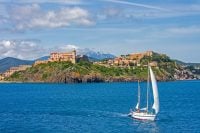
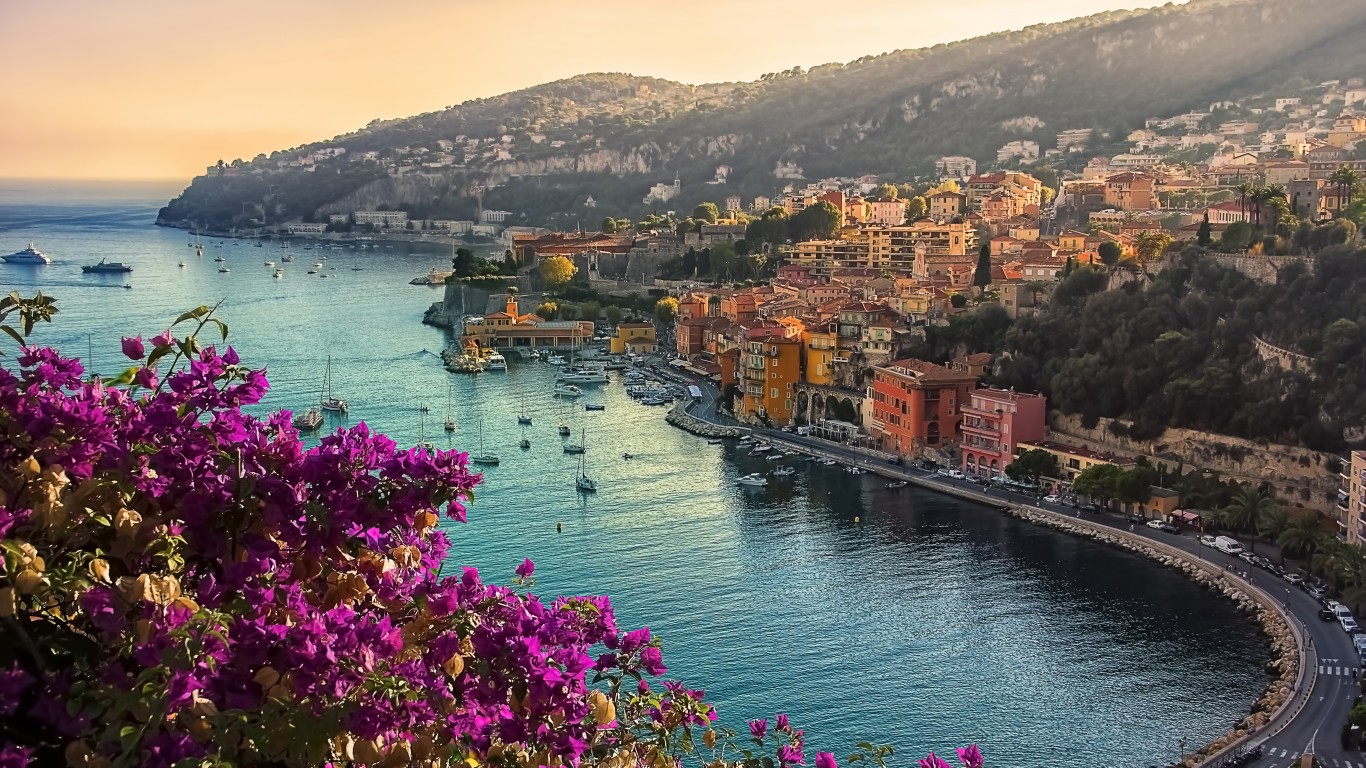
The Italian Riviera is Liguria, and Liguria is a barbell. Portofino, Santa Margherita, and the Cinque Terre villages are priced for people who fly in. The livable Riviera is the western arc: Imperia, Sanremo, Bordighera, Diano Marina, and inland towns above them, plus La Spezia and Lerici on the eastern side. A furnished one-bedroom runs roughly €700 to €950 a month on long-term contracts, with a modest two-bedroom around €1,100. Utilities, including gas heat in winter, come to roughly €220 a month averaged across the year.
A workable annual budget for a single retiree looks like this:
- Rent: €10,200
- Utilities and internet: €2,700
- Food: €6,000
- Healthcare (voluntary SSN enrollment plus private supplemental policy): €3,800
- Transport: €2,800
- Travel, gifts, personal: €4,500
- Home maintenance and reserves: €2,000
That is roughly €32,000 net of tax, or about $36,900 in today’s dollars. A couple sharing the apartment adds roughly €7,000 mostly in food, healthcare, and travel. Buying instead of renting swings the math: entry-level apartments in Imperia or La Spezia start around €180,000, but building condominio fees and Ligurian humidity swallow the rent savings.
The Tax Trap
Italy offers a well-known 7% flat tax on foreign-source pension and retirement income for new residents, but it applies only to towns under 20,000 residents in southern regions: Sicily, Calabria, Sardinia, Campania, Basilicata, Abruzzo, Molise, and Puglia. Liguria is not on the list. If you retire on the Riviera, you pay ordinary Italian IRPEF on worldwide income at graduated rates starting at 23% and reaching 43% above €50,000, plus regional and municipal surcharges of roughly 2% to 3%.
Two more line items land on top. IVAFE, the wealth tax on foreign financial accounts, runs 0.2% annually on the balance, roughly €1,900 a year on a $1.1M brokerage account. Italy does not recognize Roth IRAs as tax-free; withdrawals are treated as ordinary income to a resident.
To net €32,000 in Liguria, you need to gross withdraw roughly $46,000 to $48,000 a year once IRPEF, IVAFE, and US filing costs are layered in.
The Bridge From 60 to Social Security
At 60, you have a seven-year gap before full retirement age at 67, or a five-year gap to a reduced claim at 62. Claiming at 62 costs up to a 30% reduction versus full retirement age, while every year of delay past FRA adds roughly 8% up to age 70. For a worker with an average earnings history, that means roughly $1,700 a month at 62 or about $2,450 at 67. 2.8% 2026 COLA Waiting to 67 is almost always the right call because Italian IRPEF applies either way, so you want the larger inflation-linked euro-equivalent check for life.
Running the arithmetic on a $1.1M portfolio: at a 3.5% withdrawal rate, the portfolio supports about $38,500 a year gross. That is short of the $46,000 needed. At 4%, it supports $44,000. Still short. At 4.25%, it clears $46,750, which works, but 4.25% for a 30-plus year horizon starting at 60 functions as a moderate depletion rate that likely leaves something behind if markets cooperate.
Once Social Security starts at 67, roughly $29,400 a year of gross income arrives from outside the portfolio. The portfolio only has to produce about $17,000 gross annually from that point forward, a 1.5% draw on the original principal and a rate at which principal reliably grows. The whole problem is the bridge years.
Building the Bridge Without Bleeding the Base
The current rate environment helps. The 10-year Treasury sits at 4.63%, and I-bonds are paying a 4.26% composite rate with a 0.9% fixed component locked for the life of the bond. A seven-year Treasury ladder holding roughly $320,000 covers the bridge withdrawals with certainty, throws off coupon income along the way, and leaves the remaining $780,000 to grow in a globally diversified index-fund and dividend-ETF sleeve. Core PCE at the 90th percentile of its 12-month range and CPI still elevated near the 80th percentile argue for keeping meaningful inflation protection in the growth sleeve rather than parking everything in cash.
Healthcare at 60 is another underappreciated win. Italy’s Servizio Sanitario Nazionale accepts elective residence visa holders through voluntary enrollment, with the annual contribution capped in the low thousands of euros. That eliminates the ACA bridge conversation entirely, which for a US early retiree would otherwise run $9,000 to $14,000 a year in premiums and out-of-pocket costs before Medicare eligibility.
What It Actually Takes
The scenario works, but only with tight assumptions. You need to live in the affordable half of Liguria, meaning the western arc and inland towns rather than the coastal postcard villages. You need a real 3.75% to 4% withdrawal rate through the bridge years backed by a Treasury ladder that removes sequence risk from those specific years. You need Social Security claimed at 67 to hand the portfolio back to a sub-2% draw for the rest of your life. And you need to price Italian taxes correctly: IRPEF on all withdrawals, IVAFE on the account, and no relief from the 7% southern flat regime because the Riviera is in the wrong region.
Do all of that, and $1.1 million produces the roughly $46,000 a year gross the scenario needs, holds principal roughly flat in real terms across the bridge, and grows the base once Social Security takes over. Skip the tax analysis or plant yourself in a Portofino-adjacent postcode, and the same $1.1 million becomes a fifteen-year plan dressed up as a forever one.
Contact [email protected] for any questions or corrections.
I am a long time investor and student of business, and believe finding good companies that can become great investments is the best game on earth. After 20 years of writing and researching the public markets it is clear that individuals have never had more tools and information to take control of their financial lives. From ETFs and $0 commissions to cryptos and prediction markets there has never been a greater democratization of access to investing.
I write to help people understand the investments available to them so they can make the best choice for their portfolio, whether they're starting out or looking for income in retirement.