The Villages Home Values Are Falling for a Third Straight Year. The Culprit Isn’t the Market. It’s the Developer.
Home values in The Villages keep slipping even as the community's population soars, and the explanation has nothing to do with Florida's broader real estate market. The culprit is hiding in plain sight for anyone trying to sell.

This post may contain links from our sponsors and affiliates, and Flywheel Publishing may receive compensation for actions taken through them.
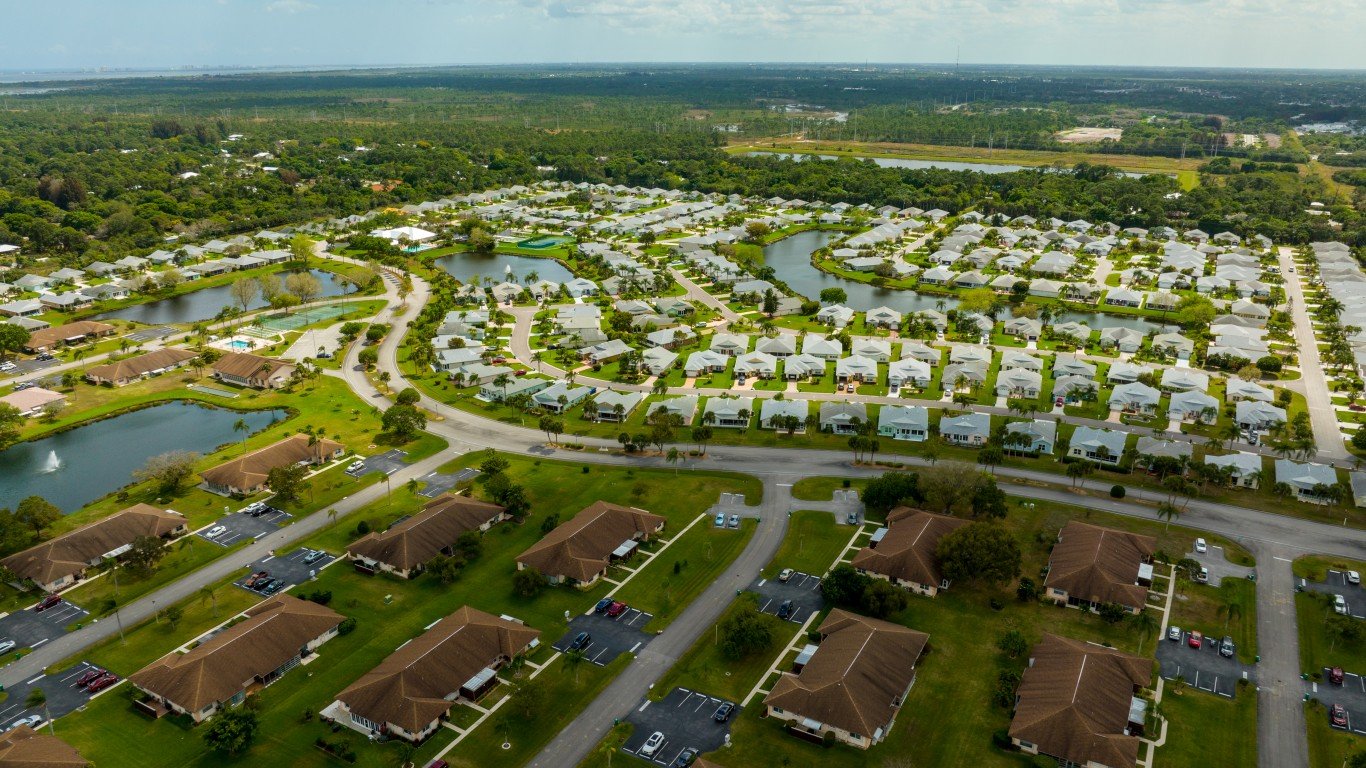
Home values in The Villages, Florida’s sprawling retirement community, have softened across three consecutive stretches: full-year 2024, full-year 2025, and 2026 to date. The counterintuitive part is that the community itself keeps growing. The softness reflects a competition problem baked into how the community is built and sold, even as demand for the lifestyle remains intact.
A geographic caveat belongs at the top. Sumter County is used here as a proxy for The Villages, but the community also spans Lake and Marion counties, so county-level readings should not be read as Villages-only figures.
Per Reventure App and Reventure News, Sumter County home value growth ran +31.9% in 2021 during the pandemic surge, decelerated to +1.7% in 2023, then turned negative: -2.2% in 2024 and -1.4% year over year in 2025. Momentum Realty, drawing on MLS data as of Aug. 9, 2026, puts the current median sale price at $289,000, down 4.4% year over year.
What the Numbers Show
Three data sources tell the same directional story, though they differ in methodology and magnitude. Redfin (NASDAQ:RDFN) places the average price at $330K, down 10.1% year over year, with a three-month median of $355K, off 2.3%. Zillow (NASDAQ:ZG | ZG Price Prediction) puts the average home value at $392,945, down 1.8% year over year as of June 30, 2026. Momentum Realty’s MLS-based median sits at $289,000, down 4.4%. The wide spread between those figures is itself informative: each platform measures different things on different methodologies, which makes this market unusually hard to pin down with a single number.
The inventory picture reinforces the pressure. Sumter County has 695 homes listed, with 34.5% of them carrying price cuts and an average of 71 days sitting on market before going under contract. That pace of absorption points to a market clearing slowly, with sellers taking multiple price reductions to compete for buyers’ attention.
A Local Story With Local Causes
National data puts The Villages’ decline in sharper relief. The National Association of Realtors reported that existing-home sales fell 1.7% month over month in July 2026 to a seasonally adjusted annual rate of 4.06 million units, though sales remained 0.7% above year-ago levels, suggesting the broader market has at least stabilized. The S&P Cotality Case-Shiller national home price index posted a 1.5% annual gain in June 2026, up from a 1.2% gain in May. Nationally, prices are still nudging higher. The Villages is moving the other way. The 10-year Treasury sat at 4.73% on Aug. 28, 2026, near the top of its trailing-year range. A soft rate environment compounds a local, structural problem rather than causing it.
Competing Against the Developer’s Own Sales Force
Our earlier reporting laid this out in detail: David Beren, “The Villages Resale Problem Nobody Warns You About Until You Try to Sell,” 24/7 Wall St., Aug. 27, 2026. The mechanism is structural and persistent.
Villages resale sellers compete directly against the developer’s own active new-construction sections. Those sections come with a full-time sales force, staged model homes, fresh floor plans, and in-house financing. An individual homeowner cannot replicate that apparatus. When the developer opens a new section, resale inventory in older sections tends to sit unsold unless priced competitively against the new product. The developer is always opening new sections.
Bond Balances Most Buyers Never Hear About
Every home in The Villages carries a bond balance: the seller’s share of infrastructure financing (roads, utilities, drainage) for their specific district, which transfers with the property at closing. Two homes listed at identical prices can carry meaningfully different total carrying costs depending on how much of that bond remains. Buyers who understand this dynamic negotiate on it. Buyers who do not tend to find out only at the closing table.
How Sellers Are Feeling It
With 34.5% of Sumter County listings having already absorbed at least one price cut and the average home sitting on market for 71 days, sellers are taking the second or third reduction to get their homes in front of buyers who are weighing new construction as an alternative. That is the central dynamic: not a demand problem, but a competition problem that forces existing homeowners to discount to clear the market.
Who Runs the Community
The community is developed and controlled by Holding Company of The Villages, Inc. Harold Schwartz, a Michigan businessman, founded the original development and brought his son H. Gary Morse into the business in 1983. Morse built The Villages into one of the largest retirement communities in the world before his death on Oct. 29, 2014. Control then passed to his three children: Mark Morse, Jennifer Parr, and Tracy Morse, each of whom own and work for the company. A developer still building and selling new sections will, by design, compete with resales in older sections.
A Correction Working Through Market Structure
The population case for The Villages remains intact. The Wildwood-The Villages metro area ranked as the nation’s fastest-growing metro from 2022 to 2023, with its population rising nearly 5% to reach 151,565, according to U.S. Census Bureau data. Over the decade from 2010 to 2020, the community’s population grew by 39%, making it the fastest-growing metro area in the country for that period as well. The developer’s own count put the community above 150,000 residents as of Dec. 31, 2023.
Reventure’s overvaluation reading for Sumter County sits at a modest 3.7%, which points to a correction working through a specific market structure rather than a bubble bursting across the board. For a seller, the practical takeaway is to price against current new-construction sections, disclose the bond balance clearly, and plan for roughly 71 days on market. For a buyer, the bond balance is the first question to ask before signing anything.
Editor’s note: This update corrects the Case-Shiller national home price index description to the confirmed 1.5% annual gain for June 2026 (up from 1.2% in May), adds the NAR finding that July 2026 existing-home sales were 0.7% above year-ago levels, incorporates Census Bureau data confirming the Wildwood-The Villages metro reached 151,565 residents to rank as the nation’s fastest-growing metro from 2022 to 2023, and notes that H. Gary Morse’s three children (Mark Morse, Jennifer Parr, and Tracy Morse) each own and work for the Holding Company of The Villages.
Contact [email protected] for any questions or corrections.
AJ spent 10 years writing about financial markets at The Motley Fool. His coverage centers on technology stocks and the broader macroeconomic trends, from interest rates to geopolitics, that shape where markets are headed next. AJ is drawn to the stories where big-picture economics and individual companies collide.