Here’s What a $300,000 Budget Actually Buys You in The Villages, Florida
The patio bars in The Villages all echo the same number, but the price on the listing is only the beginning of what moving here actually costs. With the Villages median listing now at $377,784 and the 10-year Treasury near…

This post may contain links from our sponsors and affiliates, and Flywheel Publishing may receive compensation for actions taken through them.
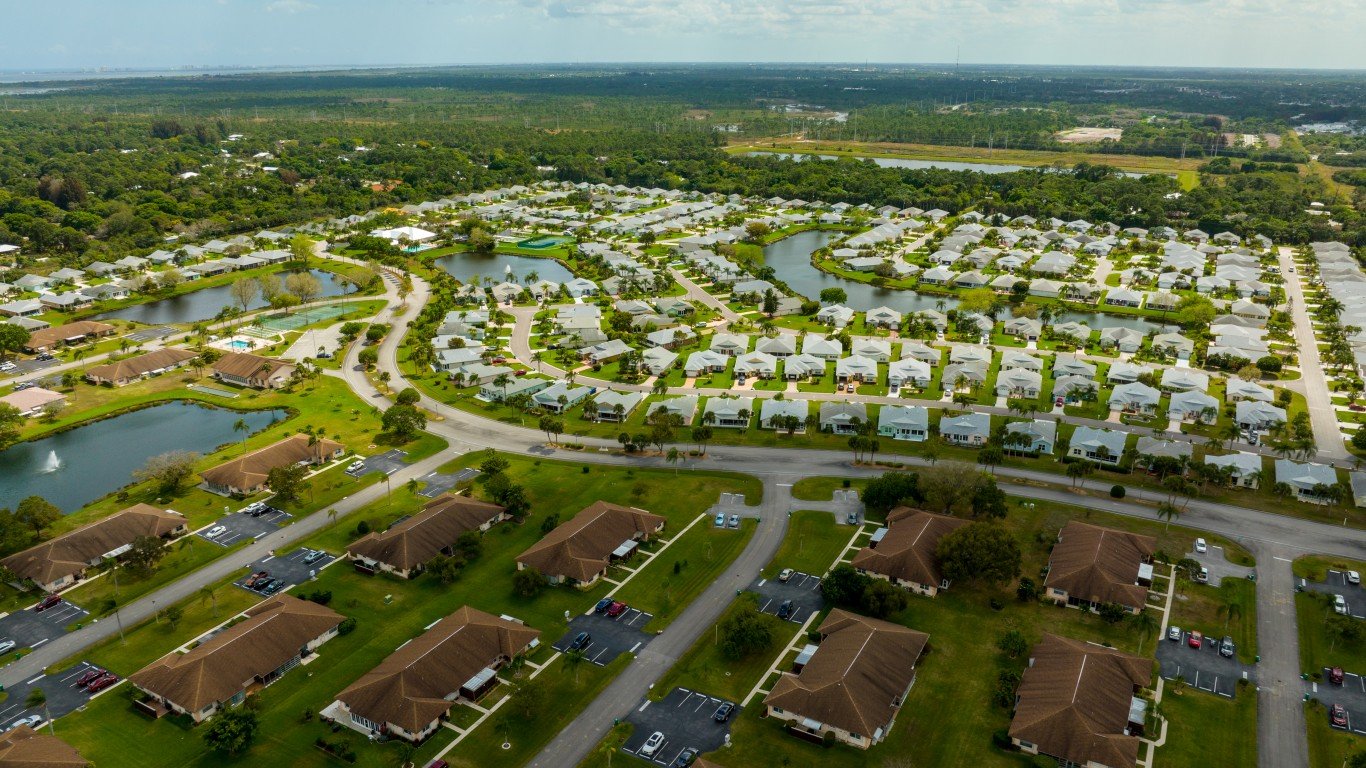
Ask around any patio bar in The Villages and someone will tell you they got in for “about three hundred grand.” That number has become the folk benchmark for buying into Florida’s most famous retirement community. The real question is what that budget actually buys once you factor in the bond, amenity fee, golf cart, insurance, and annual lifestyle costs. Here is what the math actually looks like.
What $300,000 Gets You on the Ground
At the entry level of the current Villages resale market, $300,000 lands you in patio villa territory or an older courtyard villa in established sections like Santo Domingo, Belvedere, or Hemingway. Expect roughly 1,150 to 1,400 square feet, two bedrooms, two baths, a one-car garage, and a small screened lanai. Designer homes and freestanding three-bedroom builds with two-car garages start well above that price in resale, and even higher for new construction.
The broader market backdrop is worth understanding before you sign anything. The median listing price for a home in The Villages stood at $377,784 as of August 2026, a nearly 2% decrease from $385,316 in August 2025. That slide is part of a longer correction: the median listing peaked at $436,850 in 2022 and has drifted lower every year since. Meanwhile, homes now sit on the market for about 60 days, double the 30-day median listing time in 2022. The national backdrop confirms the soft tone. The Case-Shiller National Home Price Index stood at 335.1 as of May 2026, up from 333.0 the prior reading, while existing home sales fell 2% month over month in August to a 3.98 million annual rate, down 1.2% year over year. Villages resale sellers are negotiating more than they were two years ago, especially on older patio villas with dated kitchens. A patient buyer willing to wait out a seller can push list prices down.
The Line Items Nobody Puts in the Listing
Every home in The Villages carries a bond, the developer’s infrastructure debt assigned to that specific lot. On a resale patio villa, the remaining balance can range from a few thousand dollars to $15,000 or more. Newer construction routinely carries bonds of $20,000 to $60,000. You can pay it off at closing or amortize it as an annual line item on your property tax bill, and most resale buyers leave it in place.
The recurring costs accumulate quickly beyond the purchase price:
- Amenity fee: around $200 monthly, CPI-adjusted each year
- CDD maintenance assessment: several hundred to a couple thousand annually depending on the district
- Fire district assessment and property taxes: Florida carries no state income tax and no estate tax, which draws retirees, but the offsetting costs are real
- Homeowners insurance: $4,500 to $6,500 annually for a modest inland villa, though statewide Florida averages run considerably higher
- Golf cart: $12,000 to $20,000 new, plus batteries, tires, insurance, and trail fees over time
The Annual Budget and the Portfolio Behind It
For a couple who bought a $300,000 villa outright, working in current dollars, the carrying cost picture looks like this:
- Property taxes and bond amortization: $4,500
- Insurance: $5,500
- Amenity and CDD fees: $3,600
- Utilities and internet: $3,600
- HOA-adjacent maintenance and lawn: $2,400
- Groceries (USDA moderate-cost plan): $10,000
- Dining and entertainment: $6,000
- Transportation and golf cart: $3,500
- Healthcare (Medicare Part B, Medigap, Part D, dental): $19,000 combined
- Travel and gifts: $6,000
- Maintenance and replacement reserve: $6,000
Total: $73,000 to $76,000 annually, before income taxes on portfolio withdrawals.
The healthcare line deserves particular attention. The standard monthly Medicare Part B premium was set at $202.90 in 2026, an increase of $17.90, or just under 10%, from the 2025 premium of $185.00. That premium jump, paired with Medigap and Part D costs, explains why healthcare runs so high in the retirement budget. The Part B increase alone eats up over a quarter of Social Security’s 2.8% cost-of-living adjustment for 2026.
Social Security provides a cushion, but not a full one. Based on the increase in the Consumer Price Index for Urban Wage Earners and Clerical Workers from the third quarter of 2024 through the third quarter of 2025, Social Security beneficiaries received a 2.8% COLA for 2026. A two-earner couple claiming at or near full retirement age can reasonably expect $48,000 to $55,000 combined annually. That leaves a gap of roughly $20,000 to $28,000 to pull from a portfolio each year.
At a 4% withdrawal rate, covering that gap requires $500,000 to $700,000 in investable assets on top of the paid-off house. At a more conservative 3.5%, the requirement rises to roughly $575,000 to $800,000. With the 10-year Treasury now yielding close to 5%, the U.S. Treasury yield curve as of September 22, 2026 showed the 10-year at 4.96%, which makes a Treasury ladder paired with a broad equity index sleeve more defensible than it was a year ago.
The Consideration Most Buyers Underprice
Florida’s tax profile is the primary reason people move here. No state income tax, no tax on Social Security, and no estate tax. The offset is insurance and infrastructure. The bond, CDD, and amenity structure functions as a private tax that escalates with CPI for the community’s entire life.
Florida homeowners insurance has been the single most volatile line in a Villages budget in recent years, though 2026 brought the first meaningful relief in over a decade. Citizens Property Insurance, the state’s insurer of last resort, cut standard HO-3 rates by an average of 8.7% statewide under rates approved by the Office of Insurance Regulation in March 2026, effective July 1, 2026 for new policies and at renewal for existing ones. That competition from Citizens has pulled private carriers along with it. Florida remains the most expensive state in the country for homeowners insurance in 2026, but the gap narrowed this year for the first time since 2019. Even with that improvement, underwriting this budget with a flat insurance line is still a mistake. Central Florida sits in a sinkhole and hurricane zone, and rebuild costs continue to rise.
The number that actually makes this work: a $300,000 all-cash home purchase, roughly $650,000 in an invested portfolio drawn at 3.5% to 4%, two Social Security streams claimed at or near full retirement age, and a live insurance budget that tracks actual renewal notices rather than general inflation. That is what a $300,000 budget in The Villages actually buys: not just the house, but the full and ongoing cost of the life inside the gates.
Editor’s note: This article was updated to reflect the most current available data, including the Case-Shiller National Home Price Index reading of 335.1 for May 2026, the August 2026 existing home sales pace of 3.98 million annualized units, the 10-year Treasury yield of approximately 4.97% as of late September 2026 (up from the previously cited 4.63%), the Villages median listing price of $377,784 as of August 2026, and the Citizens Property Insurance 8.7% statewide rate reduction effective July 1, 2026. The standard Medicare Part B premium of $202.90 for 2026 and the 2.8% Social Security COLA were also confirmed against official SSA and CMS sources.
Contact [email protected] for any questions or corrections.
I am a long time investor and student of business, and believe finding good companies that can become great investments is the best game on earth. After 20 years of writing and researching the public markets it is clear that individuals have never had more tools and information to take control of their financial lives. From ETFs and $0 commissions to cryptos and prediction markets there has never been a greater democratization of access to investing.
I write to help people understand the investments available to them so they can make the best choice for their portfolio, whether they're starting out or looking for income in retirement.