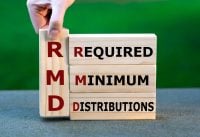
A Couple Who Retires at 59 With $520,000 Between a TSP and a 401(k) and Lives on His Military Pension for 14 Years Will Meet About $39,000 of RMDs at 73, the First Taxable Dollar Either Account Has Ever Paid Out
A military pension paid every bill for 14 years, so two retirement accounts sat completely untouched, and now the IRS gets to decide what happens next.

This post may contain links from our sponsors and affiliates, and Flywheel Publishing may receive compensation for actions taken through them.

Let’s assume that a military retiree and his spouse stop working at 59 with $520,000 split between a Thrift Savings Plan (TSP) account and a 401(k). His pension pays the bills, so neither account pays out anything for 14 years.
Then federal required minimum distribution (RMD) rules kick in, and the first forced withdrawal at age 73 comes to about $39,000. That check is the first taxable dollar either account has ever produced. Its size depends mostly on how long the money sat untouched.
Two Typical Balances Add Up Fast
The $520,000 starting point is less unusual than it sounds. Fidelity’s Q4 2025 data puts the average 401(k) balance at $270,800 for baby boomers, and $222,100 for Gen X. If you combine these two accounts, you end up right near those averages, putting a couple right in this range.
Averages make the typical saver look better off than they are, because a few big accounts pull the number up. If 10 people have $5,000 each and one walks in with $5 million, the median stays put, but the mean jumps far higher.
Vanguard’s How America Saves reports an average balance of $148,153 but a median of only $38,176. Against the median, this couple is far ahead of most savers. That head start is the reason their RMDs end up large.
Fourteen Untouched Years Nearly Double the Balance
Assume a 5% annual return, close to the 10-year Treasury yield of 5.1% as of October 15, 2026. Left alone for 14 years, the $520,000 starting balance will grow to about $1.03 million. Best of all, the couple added no new money. The pension removed any reason to take it, so compounding did the work, and every dollar of growth stayed tax-deferred.
How the IRS Turns $1 Million Into a $39,000 Withdrawal
The RMD formula takes the prior year-end balance and divides it by a factor from the IRS Uniform Lifetime Table. At 73, that factor is 26.5, which works out to about 3.8% of the account. Dividing $1.03 million by that factor gives $38,851. Unlike IRAs, which you can combine for this purpose, employer plans each calculate their own RMD. The TSP and the 401(k) will each send a separate check.
Under the timing rules, the first RMD can wait until April 1 of the year after the owner turns 73. If it does, IRS Publication 560 says two distributions come due in that one year. Falling short of the required amount can trigger a 25% excise tax on the amount you don’t take.
Every Dollar Lands on Top of the Pension
RMDs from traditional balances are taxed as ordinary income. The military pension is taxable too, and it has already used up the $32,200 standard deduction for married couples in 2026 and filled the lowest brackets. So the RMD gets taxed at whatever rate applies to the next dollar of income.
Under 2025 brackets, joint filers pay 12% on taxable income up to $96,950 and 22% above that. If the whole $38,851 falls in the lower bracket, the federal bill runs about $4,662. If the pension and Social Security already push the couple past that line, the bill rises to roughly $8,547.
Born Later, the First Check Gets Bigger
The age-73 rule only covers people who reach 73 before 2033. Under the tax code as amended by SECURE 2.0, anyone who turns 74 after December 31, 2032, starts RMDs at 75. A couple turning 59 today falls under that later rule.
The extra years at 5% push the balance to about $1.14 million. With that age’s factor of 24.6, the first RMD comes to about $46,142.
What the 14-Year Window Is Worth
The years between retirement and the first RMD are the only stretch when this couple decides when these accounts get taxed. A few moves follow from that.
- Use the low-income years. Partial withdrawals or Roth conversions that fill the 12% bracket in their 60s reduce the balance that later gets divided by 26.5. According to the TSP, Roth balances are no longer subject to RMDs while the owner is alive.
- Take the first RMD in the year they turn 73. Waiting until April 1 of the next year puts two taxable distributions in the same tax year.
- Track each account on its own schedule. The TSP and the 401(k) each have to pay out their own required amount.
The pension is what made it possible to leave $520,000 alone for 14 years. That same choice turned two ordinary accounts into roughly $1 million in tax-deferred money, now on an IRS-set withdrawal schedule. A couple that plans for the $39,000 check before 73 can influence how much of it gets taxed and at what rate. A couple that waits has the RMD formula make those decisions.
Contact [email protected] for any questions or corrections.
David Beren has been a Flywheel Publishing contributor since 2022. Writing for 24/7 Wall St. since 2023, David loves to write about topics of all shapes and sizes. As a technology expert, David focuses heavily on consumer electronics brands, automobiles, and general technology. He has previously written for LifeWire, formerly About.com. As a part-time freelance writer, David’s “day job” has been working on and leading social media for multiple Fortune 100 brands. David loves the flexibility of this field and its ability to reach customers exactly where they like to spend their time. Additionally, David previously published his own blog, TmoNews.com, which reached 3 million readers in its first year. In addition to freelance and social media work, David loves to spend time with his family and children and relive the glory days of video game consoles by playing any retro game console he can get his hands on.