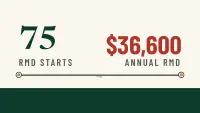
Why a $900,000 401(k) Left Untouched From 62 to 75 Becomes a $69,000 Withdrawal the IRS Orders, With More to Follow
Leaving a large 401(k) untouched for over a decade feels like a smart move until the IRS steps in at 75 and hands you a withdrawal you never planned for, triggering tax consequences that reach far beyond the account itself.

This post may contain links from our sponsors and affiliates, and Flywheel Publishing may receive compensation for actions taken through them.
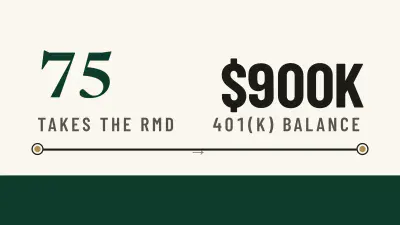
A 62-year-old with $900,000 in a traditional 401(k) has enough income elsewhere to cover the bills. Leaving that money untouched sounds like a good plan, but by 75, the account could nearly double, leaving the IRS to dictate a withdrawal approaching $69,000.
Kiplinger recently featured a 75-year-old reader wondering whether it was too late for Roth conversions. The question is worth asking years earlier, before mandatory withdrawals kick in.
What 13 Years of Untouched Compounding Builds
The SECURE 2.0 retirement law, passed in 2022, raised the age for required minimum distributions (RMDs) to 75 for anyone born in 1960 or later.
This saver turns 74 in 2038, so the first required withdrawal falls in 2039.
Assume a 5% annual return from the end of 2025 through the end of 2038.
Over those 13 years, $900,000 grows to about $1.7 million. The account nearly doubles without another dollar going in.
Run your own balance and timeline through the math here:
How $1.7 Million Becomes a $69,000 IRS Order
Each RMD is based on the account balance on December 31 of the prior year (IRS Publication 590-B). For the 2039 withdrawal, that means the balance at the end of 2038.
Divide it by the Uniform Lifetime Table factor for age 75, which is 24.6, and the required withdrawal comes to about $69,000.
You can delay your first RMD until April 1 of the following year. The catch is that you’ll have two required withdrawals in the same tax year. Missing an RMD can trigger a 25% penalty on the shortfall, reduced to 10% if corrected in time.
Why the Tax Hit Grows Faster Than the Withdrawal
Take a married couple filing jointly under 2026 tax brackets, with $60,000 from Social Security plus $40,000 of pension and interest income. Before the RMD, $28,100 of their benefits is taxable.
After the standard deduction and the age-65 additions, about $32,600 is taxable. That puts them in the 12% bracket.
Now add the $69,000 RMD. The taxable portion of benefits rises to the 85% cap of $51,000, so taxable income goes up by about $91,900, which is more than the withdrawal itself.
Federal tax rises by about $13,400, close to 19% of the RMD. Income also moves into the 22% bracket, which starts above $100,800.
While benefits are still being phased into taxable income, every extra 401(k) dollar makes another 85 cents from Social Security taxable. In the 12% bracket, that creates an effective marginal rate of 22.2%. Once 85% of their benefits are taxable, the extra tax effect stops.
The joint-filer thresholds that trigger this tax, $32,000 and $44,000, are set in the law with no inflation adjustment. Tax brackets rise with inflation every year. These lines stay put, so the pressure gets tighter each year between now and 2039.
Medicare Premiums Ride on the Same Income
The couple’s modified adjusted gross income (the income figure Medicare uses) of about $160,000 stays under the joint IRMAA (income-related monthly adjustment amount, Medicare’s income-based premium surcharge) threshold of $218,000. Single filers face a line of $109,000. That makes a surviving spouse the most exposed. Crossing the first tier costs a couple about $2,300 a year in Part B and Part D surcharges.
Medicare sets each year’s premiums from your tax return two years earlier. The RMD you take at 75 shows up in your premiums at 77.
Three Paths That Change the $69,000
- Leave it untouched. This path produces the full $69,000 first withdrawal. At 75, the RMD is about 4% of the balance, so a 5% return could keep the account growing. Future withdrawals depend on investment performance and the IRS divisor.
- Take gradual pretax withdrawals. Steady withdrawals starting at 62 shrink the 2038 balance and the RMD with it. Each dollar is taxed as ordinary income in the year you take it, and the money withdrawn no longer grows tax-deferred inside the 401(k).
- Convert to Roth each year. Moving money into a Roth before RMDs begin can offset future taxable withdrawals. Filling the 12% bracket may be attractive if your tax rate is higher later. Converting at 62 also avoids affecting Medicare premiums at 65, which generally use income from age 63.
Those low-tax years between 62 and the first required withdrawal are the whole subject of a free guide we wrote on the Roth conversion window, which you can grab here.
Your Move Before the Window Closes
- Estimate your December 31 balance for the year you turn 74, then divide it by 24.6. That’s your first RMD.
- Each year from 62 on, check how much room you have in your tax bracket before deciding how much to convert. Starting at 63, factor in the Medicare surcharge threshold, too.
- If your expected RMD plus Social Security would push joint income past $218,000, it’s worth paying a fee-only advisor to model a multiyear conversion plan.
After the first $69,000 withdrawal, the amount changes every year with your balance and your age, so redo the math each January.
Contact [email protected] for any questions or corrections.
Gerelyn Terzo is the author of dividend investing handbook "Dividend Investing Strategies: How to Have Your Cake & Eat It Too." A veteran financial journalist, she covers agri-finance for outlets like Global AgInvesting and the broader stock market and personal finance for 24/7 Wall Street. She began at CNBC and later helped launch Fox Business in New York. Gerelyn currently resides in Woodland Park, Colorado and dabbles in nature photography as a hobby.