56% of Workers Say Health Care Costs Are Cutting Into What They Can Save for Retirement
Rising health care costs are quietly draining retirement savings for a majority of workers, and the damage doesn't stop at the office door. One tax-advantaged account could bridge the gap, but most workers overlook it during open enrollment.

This post may contain links from our sponsors and affiliates, and Flywheel Publishing may receive compensation for actions taken through them.

For most people with job-based coverage, the health insurance premium comes out of the paycheck before anything else. When that deduction keeps rising and the 401(k) contribution stays the same, retirement savings fall a little each year. In the Employee Benefit Research Institute and Greenwald Research 2025 Retirement Confidence Survey, 56% of workers said health care costs are hurting their ability to save for retirement.
The pressure doesn’t stop once people leave work, as the same 2025 survey found that 38% of retirees say their health care expenses have been higher than they expected. Inflation adds to it, with 70% of workers saying they worry they’ll have to make cuts because of rising prices. The three readings cover household budgets both during a career and after it.
Why Health Costs Keep Eating Into Retirement Savings
Employer coverage is usually split between the company and the worker. The worker’s share shows up as a premium, the fixed amount taken from each paycheck. Then there’s the deductible, which is what a person pays out of pocket before the plan covers most bills. Industry tracking of employer plans has found that a growing share of covered workers have carried higher deductibles over the past ten years. When premiums and deductibles both rise, the money has to come from somewhere, and a retirement contribution is one of the few line items a worker can lower on their own.
Retirement doesn’t make those bills go away. Medicare’s standard Part B premium, which covers doctor visits and outpatient care, is $202.90 a month in 2026, up from $185. The average retired worker’s Social Security check is $2,071 a month after the 2026 cost-of-living adjustment. A recent 24/7 Wall St. look at the health care gap facing a 65-year-old retiree walks through what a full retirement health budget can include, and we mapped out the surcharges and coverage gaps that catch retirees off guard in a free Medicare guide.
An Account That Works Before and After Retirement
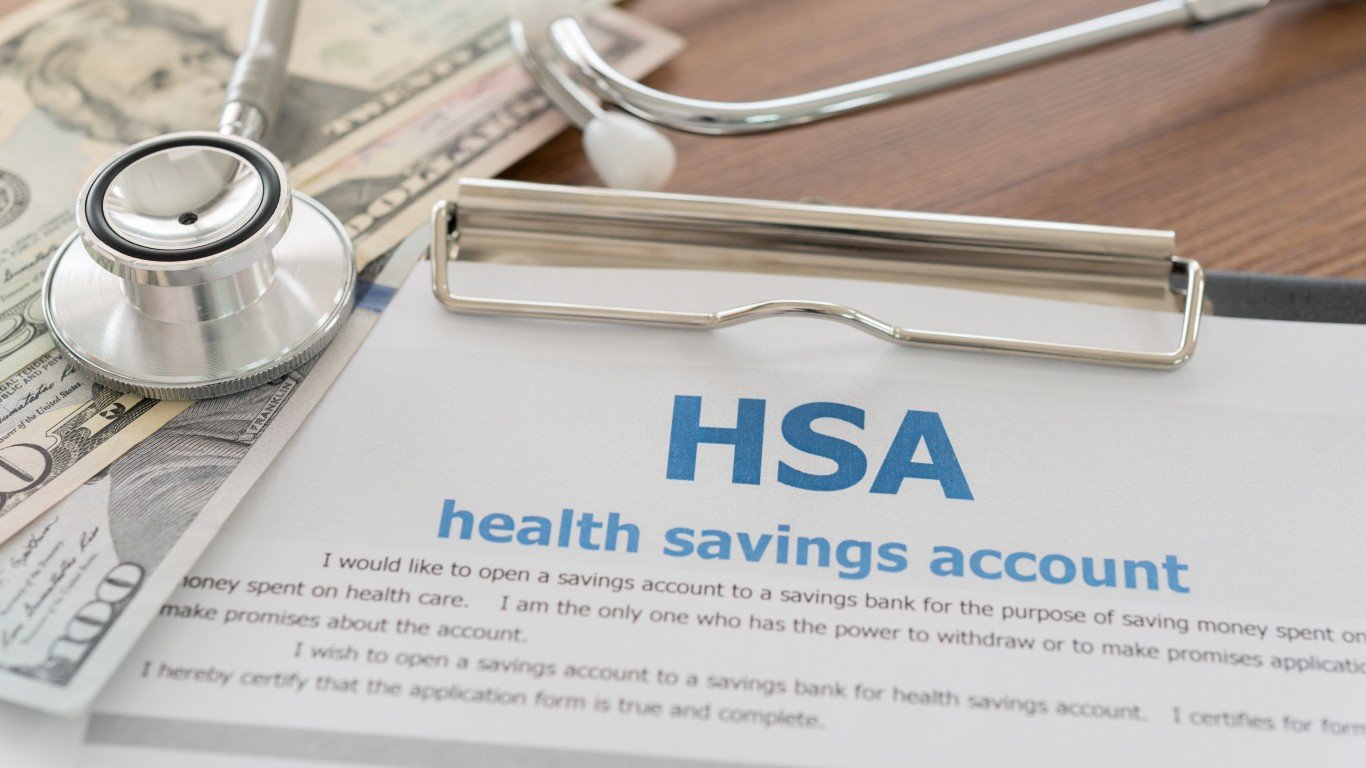
An HSA, or health savings account, is a tax-advantaged account set aside for medical costs. To contribute, a person has to be covered by a high-deductible health plan, can’t have other disqualifying coverage, can’t be enrolled in Medicare, and can’t be claimed as someone else’s dependent, according to IRS Publication 969. For 2027, a plan counts as high-deductible if its deductible is at least $1,750 for self-only coverage or $3,500 for family coverage.
The 2027 contribution limits, set by IRS Revenue Procedure 2026-24, are $4,500 for self-only coverage and $9,000 for family coverage. Account holders who reach age 55 by year-end can add an extra $1,000 under federal law. Those 2027 figures are the relevant ones right now, since elections made during this fall’s open enrollment apply to next year’s plan.
People mean the tax treatment when they talk about a triple tax advantage. Contributions are deductible, and employer contributions aren’t counted as income; the account’s growth isn’t taxed, and withdrawals for qualified medical expenses aren’t taxed either (IRS Publication 969). You don’t have to spend the balance each year.
You can invest it and carry it into retirement, and after reaching Medicare age it can pay health insurance premiums, including Medicare premiums, though not Medigap policies (26 U.S.C. § 223(d)(2)(C)(iv)). Qualified long-term care insurance premiums are also eligible (26 U.S.C. § 223(d)(2)(C)(ii)), a point covered in a recent 24/7 Wall St. piece on paying long-term care premiums from an HSA.
What a Modest HSA Contribution Could Grow Into
One example uses a simple set of assumptions. A worker who puts $2,000 a year into an HSA for 25 years, invests it, and earns an average annual return of 6% would end up with about $109,729.
Contributions over that stretch total $50,000, and the rest comes from investment growth. Actual returns vary from year to year, and any money pulled out along the way for current medical bills would lower the ending balance.
Other Open Enrollment Choices That Affect Savings
Workers without an HSA-eligible plan often have access to a health flexible spending account, or FSA. The 2026 FSA limit is $3,400, and plans that allow carryovers can roll up to $680 into the next year. Because unused FSA money is mostly lost, the account tends to cover near-term costs rather than build a retirement balance.
Comparing plan options at open enrollment generally means weighing premiums against deductibles and out-of-pocket limits based on how much care a household expects to use. Many workers also check whether their 401(k) contribution is still high enough to capture the full employer match after a premium increase, since a smaller contribution can mean leaving matching dollars unclaimed.
One Choice on This Year’s Open Enrollment Form
Among the decisions on the enrollment form, the plan election relates to both the worker and retiree EBRI findings. Choosing an HSA-eligible plan and funding the account determines whether part of a household’s health care money stays available to grow for retirement or gets spent within the year. For workers whose expected medical use fits a high-deductible plan, the 2027 limits of $4,500 and $9,000 set the ceiling on how much they can set aside next year.
Contact [email protected] for any questions or corrections.
David Beren has been a Flywheel Publishing contributor since 2022. Writing for 24/7 Wall St. since 2023, David loves to write about topics of all shapes and sizes. As a technology expert, David focuses heavily on consumer electronics brands, automobiles, and general technology. He has previously written for LifeWire, formerly About.com. As a part-time freelance writer, David’s “day job” has been working on and leading social media for multiple Fortune 100 brands. David loves the flexibility of this field and its ability to reach customers exactly where they like to spend their time. Additionally, David previously published his own blog, TmoNews.com, which reached 3 million readers in its first year. In addition to freelance and social media work, David loves to spend time with his family and children and relive the glory days of video game consoles by playing any retro game console he can get his hands on.