Starting in 2026, a Married Couple Who Takes the Standard Deduction Can Still Deduct Up to $2,000 of Cash Gifts to Charity
A quiet tax change in 2026 gives millions of couples who stopped itemizing a new way to cut their federal bill just by writing checks to the causes they already support, but the rules on which gifts qualify and which…

This post may contain links from our sponsors and affiliates, and Flywheel Publishing may receive compensation for actions taken through them.
Plenty of married couples give or donate each year, including to their church, a food bank, or a local school, yet they haven’t gotten anything back on their federal taxes since they stopped itemizing. That changes starting with the 2026 tax year.
A new rule lets people who take the standard deduction also deduct part of their cash gifts to charity. Understanding these key points matters because they explain how much you can deduct, which gifts count, what changes for itemizers, what the deduction is worth, and how it compares with giving straight from an IRA.
Why Many Regular Givers Got No Tax Break Before 2026
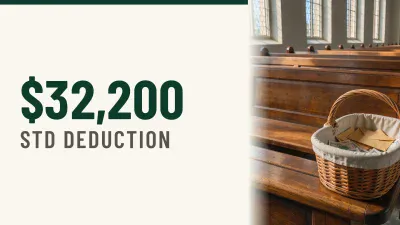
Until now, a charitable gift reduced a taxpayer’s federal tax only if the taxpayer itemized. Itemizing means listing deductions such as mortgage interest and donations one by one, instead of taking the flat standard deduction. The IRS says the standard deduction for married couples filing jointly is $32,200 for tax year 2026. For couples whose itemized deductions don’t add up to that much, taking the standard amount means their donations don’t affect their tax bill.
How the New Deduction Works and Who Qualifies
A new section of the tax code lets someone who doesn’t itemize deduct up to $1,000 of qualifying gifts, or $2,000 on a joint return. It starts in 2026. Under the law, a married couple filing jointly can deduct up to $2,000.
To qualify, a gift has to be made in cash, meaning money, not clothing, household goods, or stock. It must also go to an eligible charitable organization, such as a church, school, or hospital. The law leaves out gifts to supporting organizations and money used to open or add to a donor-advised fund. A donor-advised fund is an account you fund now and distribute to charities later, and most private foundations also fall outside the rule because it covers only the public charities listed in section 170(b)(1)(A).
What a $2,000 Gift Actually Saves a Couple
A deduction cuts the income you’re taxed on, so what it saves you depends on your tax bracket. For 2026, a married couple pays 12% on taxable income over $24,800 and 22% on income over $100,800.
If a couple in the lower bracket gives at least $2,000 in cash, the deduction saves them $240. A couple in the higher bracket saves $440. For couples who previously received no federal tax benefit from their giving, the deduction reduced the tax they owe, and overstating the deduction also comes with a higher penalty than before. If a taxpayer overstates this deduction and underpays, the penalty on that underpayment is 50%, up from the usual 20%.
New Limits for People Who Still Itemize
People who itemize face a new minimum. Their gifts count only for the part of the year’s giving above 0.5% of the taxpayer’s contribution base. For most people, the contribution base is about the same as adjusted gross income. The $2,000 deduction for non-itemizers is figured without that minimum.
Top earners face a second limit. The IRS says the new law caps the tax benefit of itemized deductions for people in the 37% bracket. The tax code does this by cutting itemized deductions by 2/37 of the itemized total or the income above where the 37% bracket starts, whichever is smaller.
When Giving From an IRA Can Work Better
Older savers have another way to give: a qualified charitable distribution, or QCD. That’s money sent straight from an IRA to a charity. Donors have to be at least age 70½. The annual limit is $111,000 in 2026, up from $108,000 in 2025. When a couple files jointly, each spouse can give up to the limit from their own IRA. The money never shows up as taxable income, and it doesn’t count toward any required minimum distribution, the amount retirees must take out each year.
The same dollars can’t get two tax breaks. IRS guidance says you can’t claim a charitable contribution deduction for any QCD not included in your income. You can still use both, though, as long as they’re different gifts. A retired person might send money to one charity from an IRA and write a check from checking to another. That check could count toward the $2,000 deduction if it meets the cash and public-charity rules.
For people with traditional IRAs who’ve reached 70½, a QCD can keep more out of taxable income. For younger givers, or anyone giving from a checking account, the new deduction is what applies. Each option has its own angle. We walked through the full set of tax-smart giving moves for QCDs, appreciated-stock gifts, and donor-advised funds in a free guide here.
Receipts You’ll Need for Every Cash Gift
The law sets specific paperwork rules. To deduct any cash gift, check, or other money, you need a bank record or written communication from the donee (the charity). That record has to show the charity’s name, the date, and the amount. For any single gift of $250 or more, you also need a written receipt from the charity, and you must have it on hand when you file.
Gifts made in 2026 will show up on tax returns filed in 2027. Couples taking the standard deduction need records. The deduction depends on having a record for each cash gift, from a weekly offering to a larger check at the end of the year.
Contact [email protected] for any questions or corrections.
David Beren has been a Flywheel Publishing contributor since 2022. Writing for 24/7 Wall St. since 2023, David loves to write about topics of all shapes and sizes. As a technology expert, David focuses heavily on consumer electronics brands, automobiles, and general technology. He has previously written for LifeWire, formerly About.com. As a part-time freelance writer, David’s “day job” has been working on and leading social media for multiple Fortune 100 brands. David loves the flexibility of this field and its ability to reach customers exactly where they like to spend their time. Additionally, David previously published his own blog, TmoNews.com, which reached 3 million readers in its first year. In addition to freelance and social media work, David loves to spend time with his family and children and relive the glory days of video game consoles by playing any retro game console he can get his hands on.