At 66 He’ll Move to Mexico and Keep Paying for Medicare Part B. It Won’t Cover a Doctor’s Visit in Guadalajara
A retiree in Guadalajara hands over his Medicare card and gets it handed right back. Before he cancels the premium that seems so useless, he should know what quietly builds against him every year he stays away.

This post may contain links from our sponsors and affiliates, and Flywheel Publishing may receive compensation for actions taken through them.
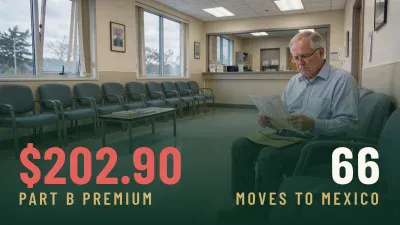
He’s 66, sitting in a small clinic in Guadalajara with a sinus infection that won’t quit. He slides his Medicare card across the counter. The receptionist smiles, hands it back, and tells him the price in pesos. He pays cash.
A lot of Americans who retire to Mexico have this same moment. They paid into Medicare for decades. They’re still paying $202.90 a month for Part B in 2026, the part of Medicare that covers doctors and outpatient care. And the card does almost nothing south of the border. Plenty of people get stuck on this one. MarketWatch took a reader question on it: whether to skip signing up for Medicare while living abroad.
What Medicare Pays for in Guadalajara
Ultimately, Medicare pays for very little outside the U.S. Medicare’s own fact sheet says, “In most situations, Medicare won’t pay for health care or supplies you get outside the U.S.” It does list 3 situations where it may cover care in a foreign hospital. Among these situations, it will cover an emergency in the U.S. or while driving through Canada between Alaska and the lower 48, or if you live in the U.S. and a foreign hospital is closer than any U.S. one that can treat you. A retiree living in Jalisco matches none of them. Medicare drug plans also “can’t cover drugs you buy outside the U.S.”
Medigap, the private add-on policy that fills Original Medicare’s gaps, has a small travel benefit. Plans C through G, M, and N pay 80% of the cost of emergency care abroad after a deductible of no more than $250, with a lifetime cap of $50,000. It covers only emergencies that start within the first 60 days of a trip. It won’t pay for a checkup in the city where you live. Medicare Advantage plans are built around U.S. doctor networks, so they won’t work as everyday insurance in Mexico either.
Why He Should Keep Paying for Part B Anyway
Say this individual drops Part B and moves back later. Medicare adds “an extra 10% for each year you could have signed up for Part B, but didn’t.” That penalty gets added to your monthly premium, and Medicare says, “For most people, that’s a lifetime penalty.”
The usual way out is a Special Enrollment Period. Medicare gives that window only to people covered by a group health plan through their own or a spouse’s current job. A retiree’s Mexican health policy is unlikely to clear that bar.
Running the Numbers on Part B Versus the Penalty
At the standard premium, Part B costs him $2,434.80 a year. That’s about 3,784 pesos a month. Higher earners pay more: single taxpayers over $109,000 in income pay surcharges on top.
Now say he drops it, spends a decade in Mexico, and comes home in his mid-70s. At a rough rate, he’d have saved around $24,348. Ten years away means a penalty equal to the whole premium, so his monthly bill doubles to $405.80 at 2026 prices. After about a decade back home, the penalty has eaten everything he saved, and every year after that he’s losing money.
It gets worse because the penalty is a percentage, and it rises every time the premium does. Part B went from $185 to $202.90 in a single year. He’d also lose his coverage on trips home, and people who move back are often moving back because they’re sick.
Unless he knows for certain he’ll never live in the U.S. again, keeping Part B is the wiser move.
Building Real Coverage on the Mexican Side
Part B covers him in the U.S., but he still needs a plan for Mexico. Most American retirees combine three things: cash for regular visits, private Mexican insurance for big bills and, once they’re legal residents, Mexico’s public IMSS system. A 2026 Rio Times guide to expat coverage describes private premiums as an age story, so it pays to lock in a policy early, before new health conditions get excluded.
Social Security and Taxes Follow Him South
Social Security says that as a U.S. citizen, “you may receive your Social Security payments outside the U.S. as long as you are eligible for them.” The agency’s international direct deposit program reaches banks in 30+ countries, and many retirees keep their U.S. account. Either way, Part B premiums remain payable while he lives abroad.
The IRS also comes along, as U.S. citizens must report foreign income “whether you reside inside or outside the United States.” The U.S.-Mexico income tax treaty, dating to 1992, keeps him from paying tax twice on the same income. If he becomes a Mexican tax resident while drawing from U.S. retirement accounts, hiring a cross-border tax preparer is worth it, because retirees often make expensive mistakes when navigating two tax systems.
One Calculation to Make Before Moving
Write down two numbers. The first is $2,434.80, which is what Part B costs in 2026. The second is what his monthly premium would be if he came back after five, 10, or 15 years, with an extra 10% added for each year away, for life.
For anyone who can’t promise they’ll never move home, the first number is cheaper. The clinic in Guadalajara won’t take the card, but that premium buys the right to come home without paying a surcharge for the rest of his life.
Contact [email protected] for any questions or corrections.
David Beren has been a Flywheel Publishing contributor since 2022. Writing for 24/7 Wall St. since 2023, David loves to write about topics of all shapes and sizes. As a technology expert, David focuses heavily on consumer electronics brands, automobiles, and general technology. He has previously written for LifeWire, formerly About.com. As a part-time freelance writer, David’s “day job” has been working on and leading social media for multiple Fortune 100 brands. David loves the flexibility of this field and its ability to reach customers exactly where they like to spend their time. Additionally, David previously published his own blog, TmoNews.com, which reached 3 million readers in its first year. In addition to freelance and social media work, David loves to spend time with his family and children and relive the glory days of video game consoles by playing any retro game console he can get his hands on.