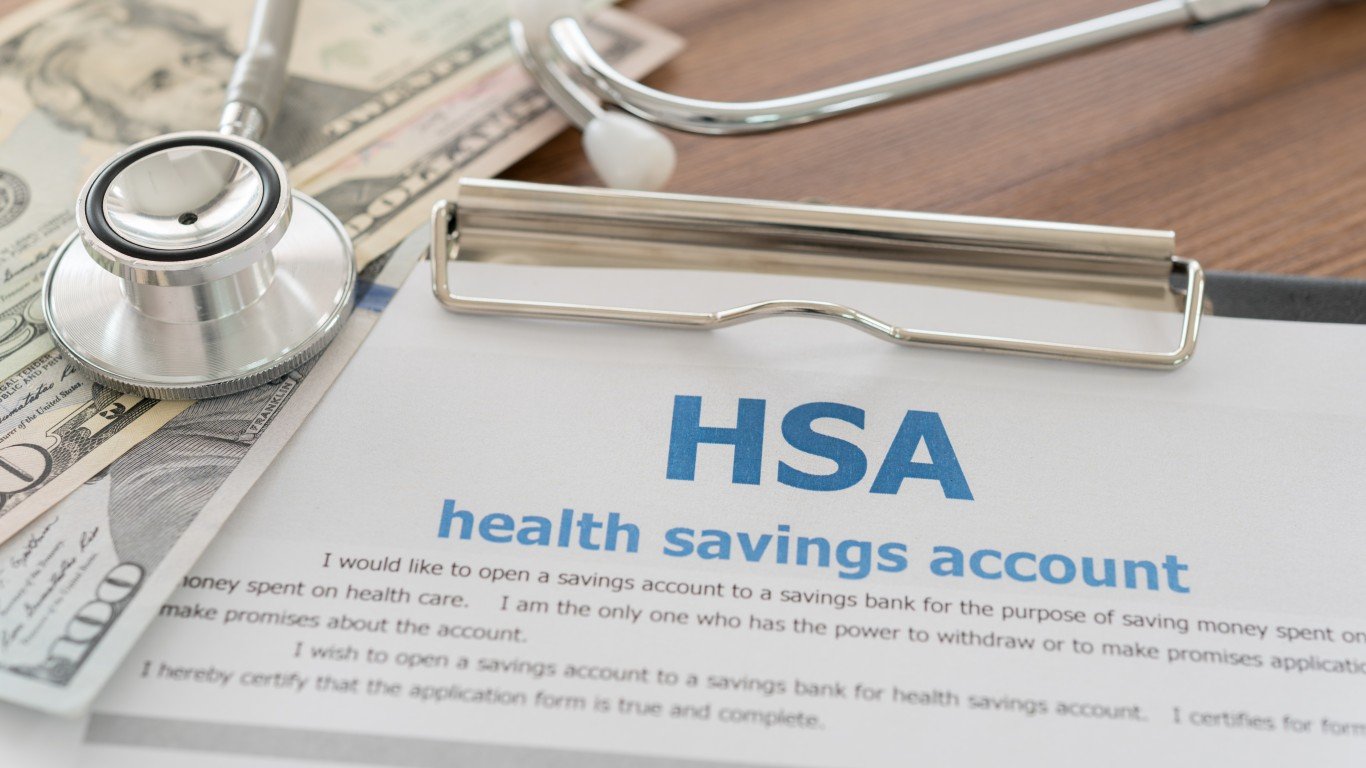
Retirees Can Pay Medicare Premiums Straight From an HSA, Tax-Free. The Average One Pays From Checking.
Medicare premiums quietly drain thousands from retirees each year, and most pay from the worst possible source without realizing a tax-free alternative has been sitting in their account the whole time.

This post may contain links from our sponsors and affiliates, and Flywheel Publishing may receive compensation for actions taken through them.

Editor’s note: A previous version of this article stated that the penalty on non-qualified HSA withdrawals is 10%. That rate applied prior to 2011; the Affordable Care Act raised it to 20% for tax years 2011 and later (Public Law 111-148, §9004(a)). The article has been corrected below.
Medicare’s Part B premium quietly became one of the most consequential recurring bills in retirement. In 2026, the standard monthly amount climbed to $202.90, up from $185 in 2025. Multiply that by 12, add Part D and Medigap, and a retired couple can easily see $6,000 to $10,000 a year flow out for premiums alone. Most of them pay that bill the ordinary way, from a checking account funded with already-taxed dollars. The IRS offers a cleaner option that most eligible retirees never use: pull Medicare premiums straight from a Health Savings Account, tax-free.
What the Tax Code Actually Says
Medicare Part B, Part D, and Medicare Advantage premiums count as qualified medical expenses under IRS rules for account holders 65 and older. Medigap premiums do not. That distinction matters because Part B alone accounts for most of what retirees write checks for. Reimbursing yourself from the HSA turns each $202.90 premium into a pre-tax payment.
Why Checking Wins by Default
The scale of what is being missed matters. Healthcare services spending across the economy reached $3,741 billion at a seasonally adjusted annual rate in June 2026, up from $3,537.7 billion a year earlier. Retirees are absorbing a disproportionate share of that increase on relatively fixed incomes. The 2027 Social Security COLA is currently tracking at 3.1%, while the Part B premium jumped by roughly 10% year over year.
Running the Numbers on One Year
Consider a retiree in the 22% federal bracket paying the standard $202.90 Part B premium plus a $50 Part D plan. That is roughly $3,035 in annual premiums. Paid from checking, every dollar was already taxed. Reimbursed from an HSA, the same premiums come out pre-tax, saving several hundred dollars a year in taxes. Over a 20-year retirement, the compounded value of that habit runs into five figures.
The alternative to that tax-free withdrawal is often worse than it looks. National savings are thin, with the personal savings rate at 2.8% in the second quarter of 2026, down from 3.9% in the first quarter. When a checking account cannot absorb a premium spike, retirees reach for revolving credit. The average credit card APR sat at roughly 21% as of May 2026, so the premium paid on plastic and carried costs is multiple times what an HSA reimbursement would be.
Rules Worth Knowing Before You Move
Three details trip people up. First, you cannot contribute to an HSA once enrolled in any part of Medicare, but you can keep spending from an existing balance indefinitely. Second, higher earners face a stiffer premium ceiling: Part B totals reach $689.90 a month for individuals with modified adjusted gross income of $500,000 or more. Those IRMAA surcharges are one of several Medicare traps we mapped in a free guide to Medicare’s hidden bills. HSA reimbursement covers those higher premiums the same way it covers the standard amount. Third, keep documentation. The IRS wants a paper trail matching each HSA withdrawal to a qualifying premium.
Steps Some Retirees Are Taking This Month
- Many retirees are checking whether their HSA custodian allows reimbursements for Medicare premiums paid via Social Security deduction. Most do, but the process is manual.
- Some pull a 12-month statement showing every Part B and Part D premium withheld, then submit a single reimbursement request against the HSA to recapture those dollars pre-tax.
- Others set a recurring calendar reminder each January to reimburse the prior year’s Medicare premiums. The $283 Part B deductible and $1,736 Part A hospital deductible for 2026 are eligible too.
Reimbursing Medicare premiums from an HSA converts each payment into a pre-tax withdrawal, and the paperwork is a single form.
Contact [email protected] for any questions or corrections.
David Beren has been a Flywheel Publishing contributor since 2022. Writing for 24/7 Wall St. since 2023, David loves to write about topics of all shapes and sizes. As a technology expert, David focuses heavily on consumer electronics brands, automobiles, and general technology. He has previously written for LifeWire, formerly About.com. As a part-time freelance writer, David’s “day job” has been working on and leading social media for multiple Fortune 100 brands. David loves the flexibility of this field and its ability to reach customers exactly where they like to spend their time. Additionally, David previously published his own blog, TmoNews.com, which reached 3 million readers in its first year. In addition to freelance and social media work, David loves to spend time with his family and children and relive the glory days of video game consoles by playing any retro game console he can get his hands on.