At 68 With $1 Million, She’ll Inherit Her Older Sister’s IRA. Because She’s Less Than 10 Years Younger, She Doesn’t Have to Empty It Within 10 Years

This post may contain links from our sponsors and affiliates, and Flywheel Publishing may receive compensation for actions taken through them.
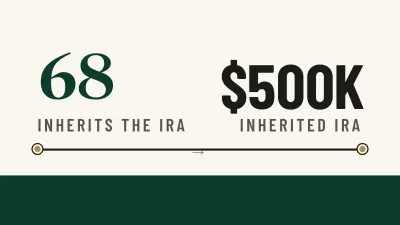
Take a 68-year-old retiree with about $1 million saved, most of it in her own traditional IRA. Her older sister dies at 72 and names her as the beneficiary of a $500,000 traditional IRA. Friends warn her that inherited IRAs have to be emptied within 10 years. For her, that warning is wrong, and getting the rules right will shape her taxes and Medicare costs for the next two decades.
Inheriting from a sibling is common, and many people get it wrong. In a similar question on JustAnswer’s estate-law forum, an expert explained that eligible designated beneficiaries who inherit from a non-spouse older than themselves “can use the lifetime distribution option.”
Why Being Less Than 10 Years Younger Changes the Rules
The SECURE Act of 2019 requires most non-spouse heirs to empty an inherited account within 10 years. Internal Revenue Code Section 401(a)(9) makes an exception for an eligible designated beneficiary, which includes “an individual… who is not more than 10 years younger than the employee”[1]. IRS Publication 590-B applies the same exception to IRA owners. Our retiree is four years younger than her sister, so she qualifies and can spread withdrawals over her own life expectancy.
There is one paperwork catch. Because she isn’t a spouse, she can’t treat the inherited IRA as her own. That means no contributions and no rollovers into her own IRA. Assets can move only by trustee-to-trustee transfer into an account set up and maintained in the name of the deceased IRA owner for her benefit as beneficiary.
How Her Annual Withdrawal Is Figured
She looks up her age in the IRS Single Life Expectancy Table for the year after her sister’s death. If her sister died in 2026, she would have been 69 in 2027, when the divisor is 19.6. Assuming a $500,000 year-end balance, her first required withdrawal would be about $25,510.
After that, she reduces the divisor by one each year, so the required percentage slowly rises. Every dollar withdrawn counts as ordinary income, since beneficiaries “must include in their gross income any taxable distributions they receive”.
Combined Income Creates the Real Risk
Her biggest challenge is managing her total income, since she has decades left to withdraw. Born in 1958, she starts her own mandatory withdrawals in 2031. From then on, two sets of required withdrawals land on the same tax return.
That matters for Medicare. A single filer with income up to $109,000[2] pays the standard Part B premium of about $203 a month. One dollar above that, the premium jumps to about $284[2], plus a roughly $15 Part D surcharge. Above $500,000[2], Part B reaches about $690 a month. These surcharges, called IRMAA, are based on the tax return from two years earlier.
Suppose she has $70,000 of other income. Adding the stretch minimum puts her near $94,500, below the line. Spreading the account equally over 10 years means about $50,000 a year before growth, which brings her to around $120,000 and into the first surcharge level.
Three Paths, and Only One Fits Most Heirs
- Lump sum. Cashing out puts $500,000 of ordinary income on one return, sends a large share to the IRS at top rates, and sets off the highest Medicare surcharge two years later. For nearly everyone, this is the worst choice.
- 10-year option. She can choose this only if her sister died before reaching their required beginning date. Under it, “no distribution is required for any year before the 10th year”. That flexibility often leads people to put off withdrawals and then face a huge tax bill in the final year. If her sister had already started her own RMDs, this option is off the table.
- Life-expectancy stretch, front-loaded. For most people in her position, this path works best. The annual minimum sets only a floor. From 68 through 72, before her own RMDs start, she can take more than the minimum and stay just under the $109,000 Medicare line. That reduces the account balance before the two sets of withdrawals start.
Check the custodian’s default setting too. Publication 590-B notes that most IRA agreements “require individual designated beneficiaries, who are eligible designated beneficiaries, to take required minimum distributions using the life expectancy rules” unless the beneficiary chooses otherwise.
What to Do Before Signing the Transfer Paperwork
First, confirm two facts: she is within 10 years of her sister’s age, and whether her sister had started RMDs. Then open a properly titled inherited IRA. A rollover into her own IRA isn’t allowed, and fixing that mistake is expensive.
Next, plan every year through 2031 against the $109,000 Medicare line, and use the low-income years before 73 to withdraw more. The most common mistake is taking only the minimum in the early years, which leaves a bigger balance to stack on top of her own RMDs later (one of nine IRS rules that quietly drain retirement accounts, all charted in our free tax trap map).
Paying a CPA makes sense if her sister made nondeductible contributions. That basis stays with the inherited account, and withdrawals from both IRAs then require separate Form 8606s to avoid paying tax twice.
Contact [email protected] for any questions or corrections.
David Beren has been a Flywheel Publishing contributor since 2022. Writing for 24/7 Wall St. since 2023, David loves to write about topics of all shapes and sizes. As a technology expert, David focuses heavily on consumer electronics brands, automobiles, and general technology. He has previously written for LifeWire, formerly About.com. As a part-time freelance writer, David’s “day job” has been working on and leading social media for multiple Fortune 100 brands. David loves the flexibility of this field and its ability to reach customers exactly where they like to spend their time. Additionally, David previously published his own blog, TmoNews.com, which reached 3 million readers in its first year. In addition to freelance and social media work, David loves to spend time with his family and children and relive the glory days of video game consoles by playing any retro game console he can get his hands on.