A Retiree With $500,000 in Schwab Investments Tries to Sell During a Market Slide and Finds the Website Locked Out. Another 2% Drop Could Cost Him $10,000

This post may contain links from our sponsors and affiliates, and Flywheel Publishing may receive compensation for actions taken through them.

Picture a hypothetical 67-year-old retiree with $500,000 in a 401(k) administered by Charles Schwab (NYSE:SCHW | SCHW Price Prediction). After a rough stretch in stocks, he logs in Tuesday morning to sell his equity funds, and the page won’t load.
The outage was real. Schwab’s website drew more than 1,400 Downdetector reports by 10:20 a.m. ET on Nov. 17, in response to a locked log-in screen, and service was reportedly restored around 10:38 a.m. ET.
The bug came right after stocks fell heading into a heavy week of tech earnings and a major AI IPO. The VIX, Wall Street’s fear gauge, jumped to 28 on November 5[1] before falling back to 19.
His worry is easy to check. Another 2% drop on his balance is a $10,000 paper loss. In reality, the outage probably kept him from making a far more expensive mistake.
Selling Inside the Plan Is Tax Free While Withdrawals Trigger Income Tax
Moving money from stock funds into a stable value or money market option inside a traditional 401(k) has no tax effect. Nothing counts as income until the money leaves the plan. Each plan sets its own trading access and restrictions, so what he can do online depends on how his plan is set up.
A panicked retiree rarely stops at an exchange, though. The more common move is a large withdrawal to cash in the bank, and every dollar of that is taxed as ordinary income in the year it comes out. A $10,000 dip can recover. A tax bill cannot.
A $500,000 Cash Out Shows Up on Your Medicare Bill Two Years Later
Medicare sets premiums using a two-year lookback on income. If he pulled the full balance out this year as a single filer, his income would land in the top bracket, which starts over $500,000[2]. His Part B premium would later rise from the standard $203[2] to $690 a month at today’s rates, plus a Part D surcharge of $91.
Those surcharges add up to about $6,936 for the year. And this cost is only the side effect, on top of federal income tax on half a million dollars. A smaller panic withdrawal still has a cost. Going just over $109,000[2] in income as a single filer adds roughly $1,148 a year in Part B and Part D surcharges (we mapped out the IRMAA levels and the other premium traps retirees walk into in a free guide here: Medicare’s Hidden Bills).
Social Security gets pulled in too. If he receives something close to the average retired worker benefit of $2,071 a month, a large withdrawal pushes him over the threshold where up to 85%[3] of those benefits become taxable under 26 U.S.C. § 86(a)(2). Piling these costs can push the effective rate on extra withdrawals well above his tax bracket.
Forced Selling Begins in 2032
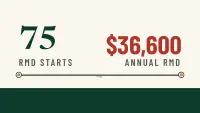
Time is on his side. For someone born in 1959, required minimum distributions (RMDs) begin at age 73, so his first RMD year is 2032. Until then, he controls the timing of any selling.
Once RMDs begin, a 401(k) distribution must be taken separately from each plan account, so a withdrawal from an IRA won’t satisfy it. Missing an RMD triggers a 25% excise tax, which falls to 10% if fixed within the correction window. That penalty applies only to an actual shortfall at year-end, regardless of a few minutes of website downtime.
Three Steps to Take Before the Next Outage
- Keep two years of withdrawals in cash inside the plan. At a 4% withdrawal rate, he takes about $20,000 a year. Holding $40,000 in the plan’s money market or stable value fund covers two years of spending, so neither a 2% decline nor a locked website forces him to sell stocks.
- Rebalance with exchanges inside the plan. If the decline showed him he holds too much stock, change the mix inside the 401(k) on a calm day. Keep yearly withdrawals below $109,000[2] single or $218,000 joint to stay out of the first IRMAA levels.
- Set up a backup way to reach the plan now. Save the recordkeeper’s phone number, find out the plan’s daily trade cutoff, and check whether trades can be placed by phone. Trading access varies by account and plan, and the time to learn the rules is before the next selloff.
Contact [email protected] for any questions or corrections.
Gerelyn Terzo is the author of dividend investing handbook "Dividend Investing Strategies: How to Have Your Cake & Eat It Too." A veteran financial journalist, she covers agri-finance for outlets like Global AgInvesting and the broader stock market and personal finance for 24/7 Wall Street. She began at CNBC and later helped launch Fox Business in New York. Gerelyn currently resides in Woodland Park, Colorado and dabbles in nature photography as a hobby.