How to Build $9,450 a Month in Dividend Income Without Selling a Single Share

This post may contain links from our sponsors and affiliates, and Flywheel Publishing may receive compensation for actions taken through them.
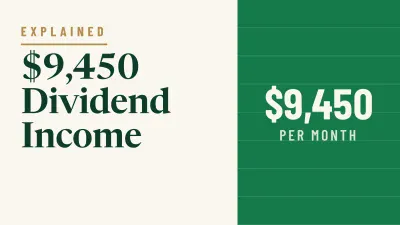
Selling shares in a down market just to cover the bills is the retirement move nobody wants to make. Income that shows up in your account on its own takes that choice away. If you’d rather never sell a share and your number is $9,450 a month, you’ll need $113,400 a year from dividends and interest. To hit this number, here is a look at the kind of different yields and one-six holding mix that can help get you there.
What $113,400 a Year Costs at Three Yields
Hitting your number ultimately all comes down to one equation: your income target divided by your yield equals the money you need invested.
In the conservative level (3% to 4%), dividing $113,400 by 3.5% gives about $3.24 million. Broad dividend ETFs and steady dividend growers sit here. The up-front cost is the highest, but your payouts tend to rise, and your principal tends to grow.
In the moderate level (5% to 7%), dividing $113,400 by 7% gives about $1.62 million. REITs, pipeline companies, and high-dividend funds live here. Dividend growth slows down, and over a few decades your income may fall behind inflation.
The aggressive level (8% to 14%) needs the least money: at a 12% yield, $113,400 a year takes $945,000. Covered-call funds, business development companies and junk bonds fill this level. These payouts face cuts more often, and share prices can trend lower even while the checks keep coming.
A $1.69 Million Mix Built From Six Paychecks
An editor’s model portfolio combines all three levels into a 7.29% yield, using the rates below. However, planning around a more conservative 6.7% yield, $9,450 a month takes about $1.69 million or at 7.29%, you’re looking at needing around $1.56 million.
- iShares Select Dividend ETF (NASDAQ:DVY), 15%: This is your growth anchor. It yields about 3.3%, charges a 0.4%[1] expense ratio, and is up 19% over the past year. One drawback: the quarterly payout changes from one quarter to the next, so plan around what it paid over the full trailing year.
- Enbridge (NYSE:ENB | ENB Price Prediction), 15%: This Canadian pipeline and gas utility company yields about 5.8%. Most of its earnings come from contracted or regulated assets, and management targets about 5% annual cash flow growth per share. One drawback: in a taxable account, Canada deducts tax on the dividend. The U.S. dollar payout also moves with the exchange rate, and it slid to $0.68 this quarter.
- VICI Properties (NYSE:VICI), 15%: This REIT owns Caesars Palace and MGM Grand on long leases and is 100% occupied. It yields about 7.6% after its 9th consecutive annual dividend increase[2]. The catch: Caesars and MGM pay 70% of its rent.
- Eaton Vance Tax-Managed Diversified Equity Income Fund (NYSE:ETY), 20%: This fund owns stocks and sells options on them for extra cash. It yields about 10.1% and pays monthly. The catch: it’s down 9% this year, it previously cut its monthly payout, and some distributions may include a return of investors’ own capital.
- iShares iBoxx $ High Yield Corporate Bond ETF (NYSEARCA:HYG), 25%: This junk bond fund pays monthly interest at a yield of about 6.3%. The catch: its borrowers default more often when the economy weakens.
- Trinity Capital (NYSE:TRIN), 10%: This business development company lends to smaller, venture-backed growth companies. The payout is $0.17 a month, a yield of about 11.9%. One catch: it runs 117%[3] debt-to-equity, and the shares trade near $17, well above its $14 net asset value per share.
Why the Smallest Yield Can Win Over Time
Picture $3.24 million in a 3.5% portfolio whose dividends grow 8% a year. Year one pays $113,400. Nine years of increases lift that to about $226,687. A 12% fund with a flat payout still sends you $113,400, and inflation has quietly shrunk what that check buys.
In this mix, Enbridge, VICI, and the dividend ETF do the growing. The three higher yielders pay the bills today. The whole point of a setup like this is never having to sell a share to cover a bill, and we walked through how to build that kind of income ladder step by step in a free guide here.
Taxes widen the gap. Bond interest and most BDC payouts get taxed at your ordinary income rate, and in 2026 a single filer hits the 24% bracket above $105,700.
Who This Mix Suits and What Could Shrink the Check
This mix fits someone with about $1.69 million who wants a full paycheck now and can live with some principal risk. A recession could hit the junk bonds and the venture lender at the same moment. A casino tenant in trouble would pressure VICI, and a stronger U.S. dollar would trim Enbridge’s payout.
- Figure out what you actually spend. If you actually need $7,000 a month, the money you need invested drops right along with it.
- Put each holding in the right account. In an IRA, the bond funds’ and the BDCs’ ordinary-income payouts aren’t taxed every year. Brokerages differ in how they handle Canadian withholding on Enbridge.
- Reinvest a piece in the early years. Sending part of the high-yield income back into the growers builds the increases that protect your check later.
The yield sets how much you need on day one. Dividend growth decides whether that check still covers your bills ten years from now.
Contact [email protected] for any questions or corrections.
David Beren has been a Flywheel Publishing contributor since 2022. Writing for 24/7 Wall St. since 2023, David loves to write about topics of all shapes and sizes. As a technology expert, David focuses heavily on consumer electronics brands, automobiles, and general technology. He has previously written for LifeWire, formerly About.com. As a part-time freelance writer, David’s “day job” has been working on and leading social media for multiple Fortune 100 brands. David loves the flexibility of this field and its ability to reach customers exactly where they like to spend their time. Additionally, David previously published his own blog, TmoNews.com, which reached 3 million readers in its first year. In addition to freelance and social media work, David loves to spend time with his family and children and relive the glory days of video game consoles by playing any retro game console he can get his hands on.