Her Husband’s Spend-Down Will Be $190,000. One Move the Nursing Home Will Never Mention Will Turn It Into Monthly Income and Leave Him Eligible for Medicaid the Following Month
Florida gives a nursing home spouse just $2,000 while the facility quietly waits for the rest of the couple's savings to run out. There is a legal move that stops the spend-down before it starts, and the nursing home has…

This post may contain links from our sponsors and affiliates, and Flywheel Publishing may receive compensation for actions taken through them.

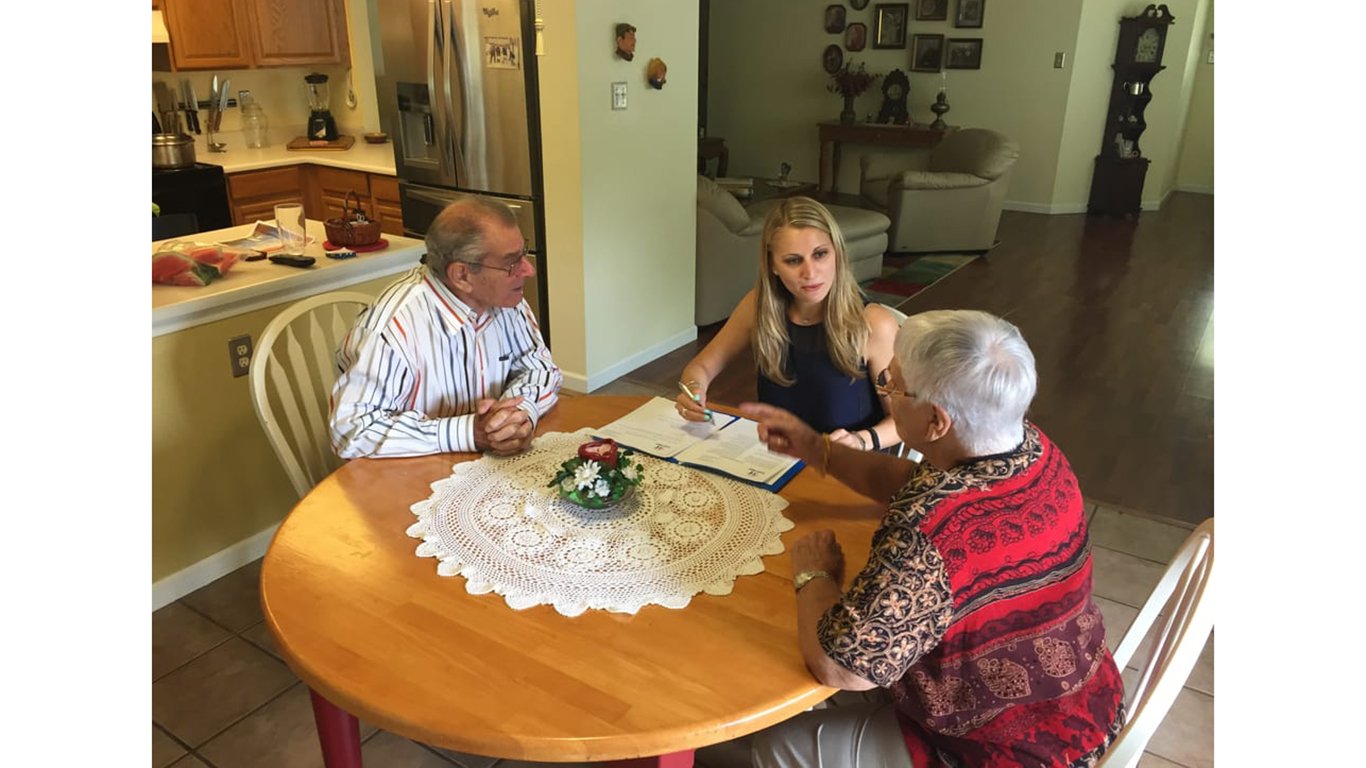
Picture a married couple in Florida. He needs long-term care in a facility, and she’s staying in the house they’ve owned for decades. The Medicaid caseworker adds up their countable savings and comes to $354,660. She can keep $162,660 and he can keep $2,000. The other $190,000 has to be spent before Medicaid pays anything.
That $190,000 is the spend-down. Most families picture writing checks to the nursing home until the money runs out. There’s another legal path: the wife can turn the excess into monthly payments in her own name. If the contract follows Florida’s Medicaid rules, the lump sum stops counting as an asset and comes back to her as income.
How Medicaid Arrives at a $190,000 Spend-Down
When one spouse applies, Medicaid counts the couple’s assets together. Then federal spousal impoverishment rules protect a share for the spouse at home. That share is called the Community Spouse Resource Allowance, and in 2026 it runs from $32,532 to $162,660.
Where you live changes the math. Florida uses the full 2026 maximum of $162,660 for the spouse at home. Other states use different calculations, so the same couple can face a much bigger spend-down elsewhere.
Turning $190,000 Into About $1,924 a Month
Here’s how it works. The wife uses the $190,000 to buy an immediate annuity, and she’s the annuitant. The lump sum leaves the asset column, and a monthly check comes back. Medicaid handles that check as her income, and it can’t make the spouse at home use her own income to pay for his care.
| Item | Before | After |
|---|---|---|
| Her protected savings | $162,660 | $162,660 |
| His allowed savings | $2,000 | $2,000 |
| Extra cash | $190,000 | $0 |
| Total countable | $354,660 | $164,660 |
| Her new monthly income | $0 | about $1,924 |
That payment assumes a 10-year term and a 4% interest rate, both picked for this example. Over the full term, she’d receive about $230,839. Even with zero interest, the $190,000 principal alone works out to about $1,583 a month. Putting the same money in a CD doesn’t solve the Medicaid problem because the money remains a countable asset.
Five Tests a Medicaid Annuity Has to Pass
Medicaid’s annuity rules have applied to contracts bought after February 8, 2006. A qualifying contract is generally:
- Irrevocable: she can’t cash it in.
- Nonassignable: she can’t sell the payments to anyone else (both required).
- Actuarially sound: the payments have to end within her life expectancy. Florida’s eligibility manual measures this against the average number of years of expected life remaining for the annuitant.
- Equal payments: level checks with no deferral and no balloon payments.
- State as remainder beneficiary: Florida generally has to be named to receive what remains after the annuitant dies, although the state can come behind a surviving spouse or a minor or disabled child in certain cases.
Florida applies its annuity rules to contracts bought for the spouse at home too. If her annuity doesn’t meet the state’s requirements, including the beneficiary and life-expectancy rules, the purchase can be treated as a transfer for less than fair value and trigger a penalty.
Where Timing and Her Income Can Trip Up the Plan
Buying the annuity doesn’t guarantee approval the next month. First, the insurer has to issue the contract and take the premium. Then the couple’s countable assets have to fall to about $164,660, and the application goes in with the contract attached. Florida’s caseworker then reviews the terms. Missing paperwork or a contract that needs fixing pushes the eligibility date back, and every month of private pay eats into the money the annuity could have protected.
The checks also change the income side. Medicaid can let the wife keep part of her husband’s income, but only enough to bring her up to a maintenance allowance capped at $4,066.50 a month in 2026. The more income she gets from the annuity, the less of his income can be shifted to her, and the more of his check may go toward the nursing home.
If the couple spends the $190,000 down by paying nursing-home bills, that money can disappear into care costs. A properly structured annuity turns the same lump sum into monthly income for the spouse who still has a house to run. The money doesn’t vanish from the family budget just because her husband needs Medicaid.
Contact [email protected] for any questions or corrections.
Gerelyn Terzo is the author of dividend investing handbook "Dividend Investing Strategies: How to Have Your Cake & Eat It Too." A veteran financial journalist, she covers agri-finance for outlets like Global AgInvesting and the broader stock market and personal finance for 24/7 Wall Street. She began at CNBC and later helped launch Fox Business in New York. Gerelyn currently resides in Woodland Park, Colorado and dabbles in nature photography as a hobby.