He Assumes He Must Sell His $400,000 House Before Medicaid Will Pay for His Nursing Home. Saying He Intends to Return Home Keeps It Exempt While He’s Alive, but the State Can Claim It After He Dies

This post may contain links from our sponsors and affiliates, and Flywheel Publishing may receive compensation for actions taken through them.
Picture a widower, a composite of the clients elder law attorneys describe, whose doctor says he needs a nursing home. He has a paid-off $400,000 house, and he’s sure Medicaid won’t pay a dime until he sells it and spends the money. Most people his age want to stay put: a Longbridge Financial study released in November 2026 found that 88% of homeowners 55 and older rate aging in place as extremely or very important, and that share rises to 93% among those 75 and older.
He’s wrong about the sale. Under Medicaid’s “intent to return” rule, a nursing home resident’s primary residence remains exempt from the asset test as long as he says he plans to go back home. Federal guidelines tell states to use the same subjective test of “intent to return” that is used by the Supplemental Security[1] Income program, so in most states his stated plan counts even if he never comes home. That protection ends at death. After that, the state can go after the house to recover what it spent on his care.
How “Intent to Return” Shields a $400,000 House in 2026
Almost everything else he has is considered by Medicaid, the joint federal-state program that pays for long-term nursing home care for people with limited means. A single applicant 65 or older can keep up to $2,000 in countable assets in most states. California runs looser. Its limit is $130,000 for one person[2], reinstated on January 1, 2026.
The house remains outside that count up to a home equity cap. In 2026, the minimum home equity limit is $752,000 and the maximum is $1,130,000, depending on the state. His $400,000 house falls under both. Starting in 2028, a federal law signed in 2025 sets a hard $1 million ceiling that won’t rise with inflation. That squeezes high-cost markets, but it leaves this house untouched.
States add their own conditions. Some set a time limit or a requirement that return be medically likely, so a signed statement that protects a house in one state can fail in the next.
Medicare, the federal health insurance most people get at 65, won’t cover this stay. It pays for up to 100 days[3] of skilled nursing facility care per benefit period, and only after a medically necessary hospital stay of 3 consecutive days or more. Even then, the 2026 skilled nursing coinsurance runs $217[4] a day starting on day 21. Long-term custodial care falls to Medicaid or the family checkbook.
Medicaid Estate Recovery Claims the House After Death
The intent-to-return statement protects the house only when the state decides whether he qualifies. Estate recovery runs on a separate track that starts when he passes. States must seek repayment from the estate of enrollees age 55 or older[5] for nursing facility services, home and community-based services, and related hospital and prescription drug costs.
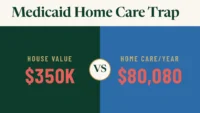
That bill adds up fast. The national median for a private nursing home room, per CareScout’s 2025 Cost of Care Survey, is $355 per day, or $129,575 a year. Three years at that private-pay rate comes to $388,725, nearly the whole house. Medicaid’s claim is based on what the state actually paid the nursing home, which usually runs lower, but a long stay can still consume most of the house’s value.
Clark Howard, the consumer advocate, gave one caller the blunt version on a 2018 episode, after the caller said the family was trying to keep the house so it could pass to him: “I’m afraid I have to tell you that the house will almost certainly go to the state, not you.” Times have changed, but the rule behind that warning still stands.
Federal law blocks or delays recovery in some cases. The state must wait while a surviving spouse is alive, and it can’t recover while there’s a child under 21 or a blind or disabled child. Our widower has none of those, so his estate gets no such protection.
Where he lives changes how much the state can reach. California limits repayment only to estate assets subject to probate[6], so a house that passes through a living trust can escape. At the other end, 36 states recover costs beyond what federal law requires.
Caregiver Child Exemption and Other Ways to Keep the House
The clearest exit is the Caregiver Child Exemption. Under it, a parent can transfer the home to an adult child who lived there continuously for 2 years before the parent entered the nursing home and gave care that delayed the move. Medicaid doesn’t penalize that transfer.
Most other gifts of the house trip Medicaid’s 5-year look-back. A family that deeds the house to the kids right before applying faces a penalty period with no coverage. A family that transferred it more than five years earlier generally keeps it.
When none of that works, heirs can apply for a hardship waiver, which requires the state to reduce, delay, or waive recovery when collecting would cause serious hardship. Each state sets its own criteria, and some are much harder than others.
The stakes are emotional as well as financial. The intent-to-return rule honors his attachment to the house while he’s alive. Keeping the house in the family after he passes takes planning done years before he ever needs a nursing home (we put the full checklist, titling, trusts, and beneficiary forms included, in a free estate planning guide).
Contact [email protected] for any questions or corrections.
Gerelyn Terzo is the author of dividend investing handbook "Dividend Investing Strategies: How to Have Your Cake & Eat It Too." A veteran financial journalist, she covers agri-finance for outlets like Global AgInvesting and the broader stock market and personal finance for 24/7 Wall Street. She began at CNBC and later helped launch Fox Business in New York. Gerelyn currently resides in Woodland Park, Colorado and dabbles in nature photography as a hobby.