56% of American Families Own Stock, Down From 58%. In the Bottom Half by Income, Just 31% Do

This post may contain links from our sponsors and affiliates, and Flywheel Publishing may receive compensation for actions taken through them.

Owning stock is how most American households share in market profits, whether a family picks shares itself or holds them through a 401(k) or a mutual fund. The Federal Reserve’s newest Survey of Consumer Finances, Changes in U.S. Family Finances from 2022 to 2025, shows 56% of families owned stock in 2025, down from 58% in 2022. Notably, the fall was concentrated among lower-income families.
The Fed considers a family as a stock owner if it holds shares directly or indirectly. Indirectly means through a retirement account like a 401(k) or IRA, or through a fund that buys stocks on the investor’s behalf. A nurse with a target-date fund in her workplace plan is considered a stockholder even if she’s never bought a single share on her own. Ownership is still higher than the 53% recorded in 2019, so the pandemic-era wave of new investors hasn’t fully reversed.
Stock Ownership Ranked by Income
When the Fed splits families by usual income, the gap is wide. Here’s the share of each group holding stock in 2025:
- Top 10% of earners: 97%
- Upper-middle (50th to 90th percentile): 77%
- All families: 56%
- Bottom half of earners: 31%
Nearly every high-earning family is in the market. Less than one in three lower-income families are. The Fed’s report says the bottom half accounted for nearly all of the overall decline in participation between 2022 and 2025. So the lowest-income families drove the fall.
Owners Got Richer While Fewer Families Owned
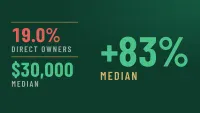
For families who stayed in, the median stock holding among owners rose from $56,900 to $77,400, a 36% jump. The median is the middle family in line, which keeps a few huge accounts from skewing the picture. If ten families each hold $10,000 and one holds $10 million, the median remains at $10,000 while the average balloons.
Much of that profit came from the market itself. The S&P 500 rose about 43% from early 2022 through the end of 2025. Bottom-half owners saw a real mean increase of around $13,000, while top-decile owners gained around $367,000. The dollar gap kept widening because the starting balances were so different.
Dollars Follow the Same Pattern
The Fed’s Distributional Financial Accounts track who holds the dollars rather than who owns any stock at all. As of mid-2026, the top 1% by income held 39.6%[1] of household stocks and mutual fund shares outside retirement plans. The bottom 20% held 1.5%[1], and the next 20% held 1%.
By age, households 70 and older hold 40.5%[1] of those stocks, while households under 40 hold 5.7%. That lines up with our Nov. 15 piece showing Americans 70 and older now hold a record share of household wealth. Rising markets reward people who already own shares, and older, higher-income families own the most.
Retirement Accounts Are the Main Entry Point
For most families, a retirement account is where stock ownership actually starts. In 2025, 54.9% of families had one, and the median balance among them was $106,000. Those balances are typically built through payroll deductions.
Workplace plans with automatic enrollment are one way lower-income families get in. The employer signs workers up by default, and they have to opt out to leave. The Fed found younger families have notably increased their participation over the past 15 years, which matches that pattern. We covered net worth from this same Fed survey on Oct. 28 and Nov. 3, and stock ownership sits underneath much of that story.
How Employer Matches Factor Into Ownership
The clearest path into the market for most workers runs through a 401(k). Many employers also match worker contributions. A match is extra pay that only shows up if the worker contributes enough to claim it, and it’s invested in the same funds that make someone a shareholder in the Fed’s count.
The next Survey of Consumer Finances will show whether the bottom-half figure recovers from 31%. The trend to track is whether more employers offer automatic enrollment, since that’s the mechanism most likely to move it.
Contact [email protected] for any questions or corrections.
David Beren has been a Flywheel Publishing contributor since 2022. Writing for 24/7 Wall St. since 2023, David loves to write about topics of all shapes and sizes. As a technology expert, David focuses heavily on consumer electronics brands, automobiles, and general technology. He has previously written for LifeWire, formerly About.com. As a part-time freelance writer, David’s “day job” has been working on and leading social media for multiple Fortune 100 brands. David loves the flexibility of this field and its ability to reach customers exactly where they like to spend their time. Additionally, David previously published his own blog, TmoNews.com, which reached 3 million readers in its first year. In addition to freelance and social media work, David loves to spend time with his family and children and relive the glory days of video game consoles by playing any retro game console he can get his hands on.