Just 54.9% of American Families Have a Retirement Account. The Typical Balance Among Them Is $106,000
Nearly half of American families have nothing set aside in an IRA or 401(k), and the families who do save look very different depending on whether you ask for the average or the middle. The gap reveals who the system…

This post may contain links from our sponsors and affiliates, and Flywheel Publishing may receive compensation for actions taken through them.
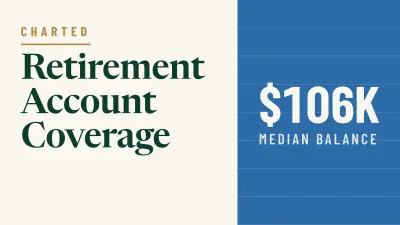
A little under half of American families don’t have any retirement account. That’s the starting point in the Federal Reserve’s 2025 Survey of Consumer Finances, which found that 54.9% of families held one, up slightly from 54.3% in 2022. In this survey, a retirement account means an IRA or a workplace account like a 401(k) or 403(b). Traditional pensions are counted separately.
What a Typical Account Holder Has Actually Saved
For families holding an account, the median balance rose from $95,200 to $106,000, an increase of 11%. Both figures are in 2025 dollars, so the gain reflects inflation. The median balance sits in the middle of the line. Half of account holders have more and half have less.
That figure only covers people who already have an account, so families with nothing saved aren’t included. Balances in these accounts can change through both investment returns and ongoing contributions.
Why the Average Balance Runs So Much Higher
The mean, or simple average, looks very different. It rose from $365,700 to $451,100, a 23% increase. An average adds up every family’s balance and divides by the number of families with an account, so a handful of outsized balances pull it higher. The media barely budges when a few multimillion-dollar accounts join the group, which is why it’s a closer read on a typical family.
Other Fed data points the same way. In the Fed’s Distributional Financial Accounts for the second quarter of 2026, households between the 80th and 99th income percentiles held 62% of all defined contribution retirement assets. The bottom 20% by income held 0.5%. Those are total dollars rather than typical balances, and they reflect the share of the money held by higher earners.
Who’s More Likely to Be Missing Out
Age plays a big part in who has an account and who doesn’t. The survey looked at participation in any retirement plan, pensions included, for families led by someone 64 or younger and found an overall rate of 65.1%. Around 70% of families aged 45 to 64 took part, compared with 66% of those aged 35 to 44.
Younger families have been catching up, though. IRA and workplace account participation for families under 35 went from 42% in 2016 to near 50% in 2025. Their balances are still small. The Fed reported mean retirement savings of $48,400 for account holders under 35, versus $670,200 for those aged 55 to 64, largely reflecting more years of saving and investing.
A lot of the gap comes down to access. Many workers, especially at small businesses or in part-time and gig jobs, aren’t offered a workplace plan. Without automatic payroll deductions, saving takes an extra step, and the Fed noted that higher-income families have higher participation rates within every age group and plan type. Families without savings lean more on Social Security, and the 2026 trustees report projects the combined trust funds will run dry in 2034, after which 83% of scheduled benefits would be paid.
Programs Built to Close the Coverage Gap
A growing number of states now run auto-IRA programs. These generally require employers that don’t offer their own plan to take some action, either setting one up or enrolling workers in a state-run IRA funded through paycheck deductions. Workers can usually opt out.
At the federal level, the Saver’s Match starts in 2027. It replaces the older Saver’s Credit and deposits 50% of an eligible saver’s contribution, up to $1,000 a year, straight into a retirement account for qualifying lower and middle-income workers. 24/7 Wall St. covered the eligibility details earlier this year.
People without a workplace plan can also open an IRA on their own. According to IRS Publication 590-A, the 2026 contribution limit is $7,500, or $8,600 for people age 50 or older. Readers curious what those contribution limits translate to over a career can plug their own numbers into the model below.
Where Every Balance in the Data Starts
Once an account exists, sticking with it seems to matter. Fidelity data in our earlier piece found that savers who stayed in the same 401(k) for five years averaged $304,200, compared with $146,400 across all savers. Our analysis of average retirement savings by age shows how those balances tend to build over a career.
For families outside that 54.9%, the available ways to open an account include enrolling in a plan at work, being signed up through a state auto-IRA, or opening an IRA independently. Every balance in the Fed’s survey, including the $106,000 median, is held in one of these account types.
Contact [email protected] for any questions or corrections.
David Beren has been a Flywheel Publishing contributor since 2022. Writing for 24/7 Wall St. since 2023, David loves to write about topics of all shapes and sizes. As a technology expert, David focuses heavily on consumer electronics brands, automobiles, and general technology. He has previously written for LifeWire, formerly About.com. As a part-time freelance writer, David’s “day job” has been working on and leading social media for multiple Fortune 100 brands. David loves the flexibility of this field and its ability to reach customers exactly where they like to spend their time. Additionally, David previously published his own blog, TmoNews.com, which reached 3 million readers in its first year. In addition to freelance and social media work, David loves to spend time with his family and children and relive the glory days of video game consoles by playing any retro game console he can get his hands on.