He’ll Lock In $3,100 a Month for Life at 65. At 3% Inflation, That Check Will Buy What $1,716 Buys Today When He’s 85

This post may contain links from our sponsors and affiliates, and Flywheel Publishing may receive compensation for actions taken through them.

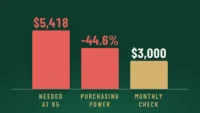
A hypothetical 65-year-old retiree hands an insurance company a single upfront payment and gets back a lifetime check of $3,100 a month. That number never changes. Prices do. If inflation averages 3% a year, the same check will buy at age 85 what $1,716 buys today. The math looks like this: $3,100 divided by 1.03 to the 20th power is $1,716. A level-payment annuity gives you a fixed number of dollars. It does not give you fixed purchasing power, and buyers who are close to retirement need to price in that difference before they sign.
Why a 3% Assumption May Be Too Low
The 3% figure looks modest against current data. The CPI was up 3.7%[1] year over year as of September 2026, the latest annual data available after a government shutdown wiped out October 2025 data. Headline PCE inflation ran at 3.84% in October, and core PCE, which strips out food and energy, came in at 3.26%. A year earlier, core PCE was 2.7%. A recent MarketWatch piece made the point that “most people haven’t run that math” on how much inflation their portfolio can take in.
How a Level Check Shrinks Over Time
The table below runs the same $3,100 check forward and shows what it buys in today’s dollars. This is a hypothetical example.
| Age | Inflation Rate | Purchasing Power in Today’s Dollars |
|---|---|---|
| 65 | None | $3,100 |
| 75 | 3% | $2,307 |
| 85 | 3% | $1,716 |
| 90 | 3% | $1,481 |
| 85 | 3.7% | $1,499 |
The losses add up, and they hit heaviest in the years when healthcare and long-term care costs usually rise. If inflation stays at the current CPI rate, the age-85 check buys less than half of what it did at purchase.
What “Guaranteed” Actually Means
The lifetime payment from this kind of annuity is guaranteed only by the insurance company’s claims-paying ability. No federal agency stands behind it. When an insurance company breaks, a state guaranty association provides a backstop up to a limit. Those limits vary by state, so check your own state’s association to see what applies to your contract. Some buyers split a large premium across more than one insurer to stay under their state’s limit.
Social Security Already Adjusts for Inflation
A level annuity has no cost-of-living adjustment (COLA). Social Security does. Its adjustments have swung widely: 14.3% in 1980, 8.7% in 2023, and 0% in 2010, 2011 and 2016. The protection varies from year to year and follows prices. That’s why some retirees compare an annuity purchase with a different move: spending savings to bridge the gap while delaying Social Security, which raises a lifetime benefit that is both inflation-adjusted and government-backed.
Ways Buyers Try to Offset the Erosion
- Increasing-payment riders: Some contracts offer a fixed annual step-up or a CPI-linked adjustment. In exchange, the starting check is lower, so it can take years before total payments catch up to the level option. Ask for quotes on both versions from the same insurance company on the same day.
- Laddered purchases: Buying smaller annuities at 65, 70 and 75 spreads the purchases across different rate environments, and each later purchase pays more per dollar because the buyer is older.
- A growth portion: Keeping part of the portfolio invested gives you money to cover the gap as the fixed check loses value.
How the Monthly Check Is Taxed
For an annuity bought with after-tax (nonqualified) money, part of what you receive each month is treated as a return of principal. Under 26 U.S.C. § 72(b)(1)[2], the excluded portion bears the same ratio to each payment as your original investment bears to the expected return. Under § 72(b)(2)[2], that exclusion ends once the unrecovered investment has been fully recovered. After that, the whole payment is taxable. Annuities bought inside a traditional IRA usually have no after-tax basis, so payments are generally fully taxable as ordinary income. In both cases the tax-free portion is a fixed dollar amount, and inflation erodes it just as it erodes the rest of the check.
Who This Structure Suits, and Who It Doesn’t
A level lifetime annuity tends to fit retirees who:
- Need a predictable floor to cover fixed costs such as a mortgage payment that won’t rise
- Already get most of their inflation protection from Social Security or a COLA-adjusted pension
- Are worried about living a long time and running out of money
It fits less well for retirees who:
- Expect this check to cover most of their spending for 25 years or more
- Have no other inflation-adjusted income
- Might need the lump sum back for emergencies, since most immediate annuities can’t be cashed out
A simple test: write down your essential monthly costs, then run them forward at 3% and at 4%. If Social Security plus the fixed check still covers them at age 85, the level payment may be enough. If it doesn’t, the gap tells you how much inflation protection you need to build in elsewhere (a full method for turning savings into a scheduled monthly income, with the mix and the withdrawal order, appeared in a free guide here).
What to Watch Before You Sign
Track the next few CPI and PCE releases. Core PCE reached 3.26% in October. Get quotes for level and increasing payments together, confirm the insurer’s ratings for financial strength, and look up your state’s guaranty limit. Once you annuitize, the payment terms are usually set for life, so this is a one-time decision.
Contact [email protected] for any questions or corrections.
Gerelyn Terzo is the author of dividend investing handbook "Dividend Investing Strategies: How to Have Your Cake & Eat It Too." A veteran financial journalist, she covers agri-finance for outlets like Global AgInvesting and the broader stock market and personal finance for 24/7 Wall Street. She began at CNBC and later helped launch Fox Business in New York. Gerelyn currently resides in Woodland Park, Colorado and dabbles in nature photography as a hobby.