His Adjustable-Rate Mortgage Will Reset at 66, So He Will Drain $200,000 From His $900,000 Traditional 401(k) to Pay It Off. Doing It in One Year Hands the IRS $35,871 and Erases His $6,000 Senior Deduction

This post may contain links from our sponsors and affiliates, and Flywheel Publishing may receive compensation for actions taken through them.
Take a 66-year-old single retiree with $900,000 in a Traditional 401(k) and an adjustable-rate mortgage (ARM) that will reset to a higher rate. He plans to pull $200,000 in 2027 and pay off the loan in one move. Here are his assumptions: he files single, he has not claimed Social Security, and he will have no other income that year.
Being debt-free feels like the safe choice. The bill for that single withdrawal will be $35,871 in federal income tax. He was born in 1961, so his required minimum distributions (RMDs) don’t start until age 75. That means the size and timing of this withdrawal are entirely his call.
All $200,000 Gets Taxed as Ordinary Income
A distribution from a qualified plan is taxable to the person who receives it, in the year it is paid out, under 26 U.S.C. § 402(a)[1].
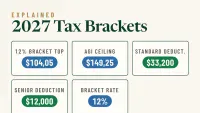
The IRS sets the 2027 single standard deduction at $16,600 plus $2,100[2] for single filers 65 or older. Once both come off, his taxable income is $181,300.
For 2027, a 24%[2] rate applies to single taxable income from $109,126 to $208,325, so his top dollars fall into that bracket.
| 2027 Bracket | Income Taxed | Tax |
|---|---|---|
| 10% | First $12,800 | $1,280 |
| 12% | $39,225 | $4,707 |
| 22% | $57,100 | $12,562 |
| 24% | $72,175 | $17,322 |
| Total | $181,300 | $35,871 |
His Senior Deduction Disappears Completely
Under the One, Big, Beautiful Bill Act, each taxpayer 65 or older gets a $6,000[2] senior deduction. The deduction shrinks by 6%[2] of income above $75,000 for single filers.
At $200,000 of income, the 6% reduction comes to $7,500. That is more than the deduction itself, so he loses all of it. The one-year plan pushes his top dollars into the 24% bracket and also costs him a deduction he would otherwise have kept. This phase-out is one of nine IRS rules that steadily drain retirement accounts, all charted in our free tax trap map.
Three Smaller Withdrawals Keep $20,811 Out of the IRS’s Hands
If he splits the same $200,000 evenly over three tax years, each withdrawal falls to about $66,667. That stays under the $75,000 phase-out line, so he keeps the full senior deduction each year.
As an illustration, apply 2027 brackets and deductions to every year. Taxable income falls to about $41,967 a year, all of it in the 10% and 12% brackets.
The tax comes to roughly $4,780 a year in 2027 and 2028 and $5,500 in 2029 after the senior deduction expires. The three-year total is $15,060, which saves $20,811 compared with the one-year plan.
The senior deduction is scheduled to expire after 2028, so the third year of withdrawals would lose it. Even without the deduction, that year’s taxable income of about $47,967 still stays in the 12% bracket.
He has two other options. He can keep the mortgage and refinance into a fixed rate, which ends the reset risk without touching the 401(k). Or he can make a partial paydown in 2027 that is big enough to shrink the reset payment but small enough to stay under the $75,000 income threshold. Either way, he should compare the interest he will pay over the next two years against the $20,811 in tax he saves.
Medicare Bills the Big Year Two Years Later
Medicare sets Part B premiums using income from the tax year 2 years prior, so his 2027 withdrawal will show up in his 2029 premiums.
Using the 2027 schedule as an example, single filers with income above $177,000[3] and up to $212,000 pay $544 a month.
The standard premium is $209. At 2027 rates, the surcharge adds up to $4,020 for the year.
Each $66,667 year stays well under the $112,000 first-tier line.
Moves to Make Before December 31
- Get the reset terms in writing. Ask the lender for the new rate, the payment cap and the first adjusted payment. Then get a quote on a fixed-rate refinance so you have a real number to weigh against the $21,531 in tax savings.
- Plan to keep each year’s income at or below the $75,000 threshold. Take the first two withdrawals in 2027 and 2028, while the senior deduction is still available. Every dollar above that line costs you 6 cents of the deduction on top of your bracket rate.
- Check each withdrawal against the Medicare income-related surcharge (IRMAA) level. Any year with income above $112,000 raises your Part B premium two years later. Add up all income before you request a distribution.
Contact [email protected] for any questions or corrections.
Gerelyn Terzo is the author of dividend investing handbook "Dividend Investing Strategies: How to Have Your Cake & Eat It Too." A veteran financial journalist, she covers agri-finance for outlets like Global AgInvesting and the broader stock market and personal finance for 24/7 Wall Street. She began at CNBC and later helped launch Fox Business in New York. Gerelyn currently resides in Woodland Park, Colorado and dabbles in nature photography as a hobby.