The IRS Just Set the 2027 Tax Brackets. A Married Couple Stays in the 12% Bracket Up to $104,050 of Taxable Income
Stack a standard deduction on top of a new senior break, and a retired couple's real income ceiling climbs far past the number most people quote. Before December 31, one overlooked window decides how cheaply they can use it.

This post may contain links from our sponsors and affiliates, and Flywheel Publishing may receive compensation for actions taken through them.
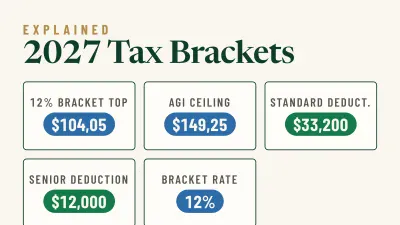
The IRS released its tax year 2027 inflation adjustments on Nov. 5, 2026, updating almost 70 provisions for returns filed in 2028. Retired married couples should look first at where the 12% bracket ends. That line decides how much income they can take next year before the government’s cut gets noticeably bigger.
Where Each 2027 Bracket Starts for Married Couples
For joint filers, the first $25,600 of taxable income gets the lowest rate. Income above that is taxed at 12% until taxable income passes $104,050. Above that point, the 22% rate begins.
That’s a wide band: the 12% bracket covers $78,450 of taxable income, and a couple sitting right at the top owes $11,974 in federal income tax before any credits. Crossing the line raises the rate only on the dollars above it.
Taxable Income Comes After Deductions
Brackets apply to taxable income, what’s left after deductions. Most retired couples don’t itemize, so their main deduction is the standard deduction. For joint filers, it rises to $33,200 in 2027, up $1,000 from 2026.
Older couples get an extra break on top of that. The Working Families Tax Cuts law, which is what the IRS now calls the 2025 tax package, created a senior deduction worth $6,000 for each spouse who has turned 65. It runs through tax years that start before 2029, so it still applies in 2027.
Married couples get $12,000 if both spouses qualify, according to IRS Publication 554. The deduction decreases by 6% of modified adjusted gross income above $150,000 on a joint return. Modified adjusted gross income is total income before deductions, with a few items added back.
How Much a 65-Plus Couple Can Earn and Still Pay 12%
Add the pieces together, and the ceiling rises. A couple who are both over 65 can have adjusted gross income of $149,250 and still land at the top of the 12% bracket. That figure is $104,050 of taxable income plus the $33,200 standard deduction plus $12,000 in senior deductions.
That total stands just under the $150,000 mark where the senior deduction starts to phase out, so the full amount remains. In 2027, each spouse 65 and older qualifies for an additional $1,700 standard deduction. That raises the couple’s potential income ceiling to $152,650, although the senior deduction begins shrinking above $150,000 in modified adjusted gross income. For a couple under 65, the same math tops out at $137,250.
Cash income can go even higher. Part of most retirees’ Social Security benefits stays out of adjusted gross income, so a couple’s actual spending money can top that ceiling while their taxable income stays inside the 12% band.
Three Ways Retirees Can Use the Room
Roth conversions. Any gap between a couple’s expected taxable income and $104,050 can be filled by moving traditional IRA money into a Roth and paying tax on it at 12%. Once that gap is used up, additional converted income enters the 22% bracket. Conversions can also make more Social Security benefits taxable, increasing the total tax cost. Those quiet years between the last paycheck and the first RMD are the cheapest window most retirees will ever get to convert, which is the focus of our free Roth conversion guide.
IRA withdrawals and capital gains. Couples who don’t want to convert can still take extra traditional IRA withdrawals in low-income years, before required distributions force bigger ones later. Long-term capital gains have their own 0% rate for lower-income filers. That 2027 threshold also sits in the full revenue procedure, so check it before selling appreciated shares.
Watch the other income tests. Social Security tax and Medicare’s income-related premium surcharges each use their own income measure, separate from the bracket math. A conversion that stays inside the 12% bracket can still make more of a couple’s benefits taxable or push them into a higher Medicare premium tier. We break down how those calculations work in our coverage.
Moves to Make Before December 31
The new figures cover income earned in 2027. Any conversion, withdrawal, or gain taken before December 31, 2026 still falls under this year’s brackets, and that room goes away at year-end. Our earlier piece on using this year’s brackets before they reset lays out what to check now.
One 2027 Number Married Retirees Should Keep
Write down $104,050, the point where the 12% bracket ends for married couples in 2027. For couples who are both 65 and older, the ceiling can rise above $152,000 in adjusted gross income after accounting for the additional senior deductions and their phase-out. Check every conversion, withdrawal, and sale planned for next year against that line.
Contact [email protected] for any questions or corrections.
David Beren has been a Flywheel Publishing contributor since 2022. Writing for 24/7 Wall St. since 2023, David loves to write about topics of all shapes and sizes. As a technology expert, David focuses heavily on consumer electronics brands, automobiles, and general technology. He has previously written for LifeWire, formerly About.com. As a part-time freelance writer, David’s “day job” has been working on and leading social media for multiple Fortune 100 brands. David loves the flexibility of this field and its ability to reach customers exactly where they like to spend their time. Additionally, David previously published his own blog, TmoNews.com, which reached 3 million readers in its first year. In addition to freelance and social media work, David loves to spend time with his family and children and relive the glory days of video game consoles by playing any retro game console he can get his hands on.