Myrtle Beach, South Carolina, Has Beaches, Golf and No State Tax on Social Security. What It Takes to Retire There at 66 on $800,000

This post may contain links from our sponsors and affiliates, and Flywheel Publishing may receive compensation for actions taken through them.
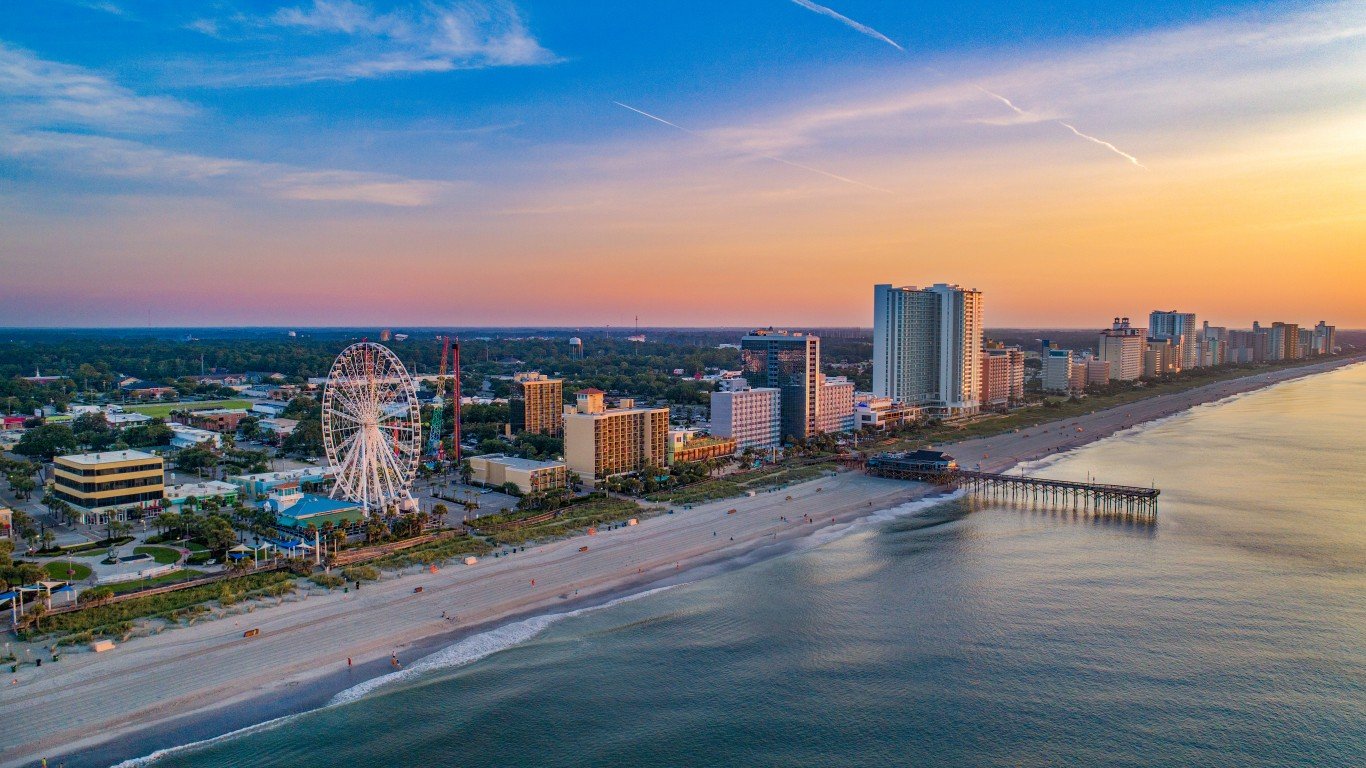
Retiring in Myrtle Beach pairs golf and beach access with homeowners insurance bills that carry wind deductibles written as a percentage of the house. This analysis looks at whether $800,000 and a Social Security check can pay for it at 66.
For a retiree on the Grand Strand, the numbers mostly work. What decides whether they keep working is the insurance bill.
What a Paid-Off Grand Strand Home Costs Each Year
Redfin puts the Myrtle Beach median sale price at $285K for the three months through October. Zillow’s typical home value is $319,700. Measures differ: Redfin shows the median sale price up 15.1% year over year, while the metro’s FHFA index rose only 0.96% over the past year, compared with 44.21% over five years. The metro’s FHFA index rose 0.96%[1] over the past year, compared with 44.21% over five years.
Our example assumes you pay cash for a $320,000 house with money from selling your old home, so the full $800,000 stays invested.
South Carolina’s property tax rules favor primary residences. Horry County assesses a primary residence at 4%[2] of market value and drops the school operating millage. The effective rate comes to about 0.46%, compared with 0.70% on a second home. The legal-residence rate requires an application.
| Annual line item | Cost |
|---|---|
| Property tax, $320,000 home | $1,472 |
| Homeowners insurance | $4,472 |
| Flood insurance (statewide NFIP average) | $929 |
| Utilities | $2,481 |
| Food, USDA moderate-cost plan, age 51 to 70 | $4,499 |
| Medicare Part B | $2,435 |
| Medigap Plan G | $2,028 |
| Part B deductible | $283[3] |
| Core total | $18,599 |
The utility figure comes from an average monthly bill of $206.76. Food uses the USDA’s moderate-cost plan at the high end of its $299.40 to $374.90[4] monthly range. The Medigap line assumes South Carolina’s average Plan G premium of $169 a month at 65. Part B costs $202.90[3] a month.
Worked Example: $800,000 Plus Social Security
The example uses the following assumptions: you’re single and 66, the house is paid off, and the $800,000 sits in a traditional IRA. Your Social Security matches the SSA’s average retired-worker benefit of $2,071[5] a month, or $24,852 a year. You take 4% from the portfolio, which is $32,000. Together, that’s $56,852 in gross income.
On the federal side, provisional income of $44,426 is above the $34,000 threshold, so about $13,362 of your benefit becomes taxable. Your deductions total $24,150: the $16,100 standard deduction, the $2,050 age add-on, and the $6,000 senior deduction, which lasts through 2028. Federal tax comes out to near $2,300.
South Carolina doesn’t tax Social Security. It also allows a $15,000[6] deduction starting the year you turn 65, though the $10,000 retirement deduction counts against it, so the two don’t combine.
South Carolina’s 2026 rules start from federal AGI and add a new income-adjusted deduction. State tax is likely small, under about $340, so confirm the figure with SCDOR or a tax preparer.
After tax, you have about $54,217 to spend. Subtract the core costs, and roughly $35,600 is left for green fees, a Part D plan, travel, gifts, replacing a car, and house maintenance. Maintenance alone runs about $3,200 a year if you budget 1% of the home’s value.
Core costs are comfortably covered with room to spare. Claiming at 66 comes with a reduced benefit, since your full retirement age is 67. A later claim raises the check for life and lowers the required portfolio withdrawals.
Insurance Is the Number That Can Break the Plan
Horry County could see premiums rise as much as 90% over the next decade, according to recent local reporting. A 40% jump would take the $4,472 premium to about $6,260.
Wind claims also come with their own deductible, often 1% of coverage, so one hurricane can cost you thousands even with a policy in place.
Taxes add to the cost of a storm. At this income, each extra $1,000 you take out from the IRA makes another $850 of your Social Security taxable. Your real marginal rate sits near 22.2%, even though you’re in the 12% bracket. So paying a storm deductible out of the IRA adds a tax cost on top of the bill itself.
What It Takes to Make Myrtle Beach Work
The plan holds up with $800,000 invested, a house bought with cash from somewhere else, the 4% legal-residence filing, and an initial withdrawal of 4% from a portfolio of low-cost index funds and a Treasury ladder.
That supports about $54,000 a year after tax and leaves real room for golf. A separate cash reserve held outside the IRA, sized to cover a wind deductible plus a few years of premium increases, adds a buffer. That reserve absorbs the coastal costs, so a bad storm season doesn’t force you into the tax hit above.
Contact [email protected] for any questions or corrections.
David Beren has been a Flywheel Publishing contributor since 2022. Writing for 24/7 Wall St. since 2023, David loves to write about topics of all shapes and sizes. As a technology expert, David focuses heavily on consumer electronics brands, automobiles, and general technology. He has previously written for LifeWire, formerly About.com. As a part-time freelance writer, David’s “day job” has been working on and leading social media for multiple Fortune 100 brands. David loves the flexibility of this field and its ability to reach customers exactly where they like to spend their time. Additionally, David previously published his own blog, TmoNews.com, which reached 3 million readers in its first year. In addition to freelance and social media work, David loves to spend time with his family and children and relive the glory days of video game consoles by playing any retro game console he can get his hands on.