A 73-Year-Old Couple Moved $420,000 of Their IRAs Into Two QLACs. Their First RMD Shrank by About $15,800, and the Checks Do Not Start Until 85

This post may contain links from our sponsors and affiliates, and Flywheel Publishing may receive compensation for actions taken through them.

The qualifying longevity annuity contract (QLAC) has one narrow job. It takes part of a traditional IRA out of the required minimum distribution (RMD) calculation and turns it into income that starts late in life. For retirees whose first RMD year is 2026, that can shrink a taxable withdrawal right away. It also sets up a tax bill that comes due years later, and sales pitches rarely spend much time on that part.
How a $420,000 Purchase Shrinks the First RMD
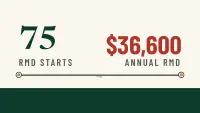
Hypothetical example: A married couple were both born in 1953, so their RMD age is 73. Their first RMD year is 2026, with a deadline of April 1, 2027. Late in 2025, each spouse moved $210,000 from their own traditional IRA into a QLAC, with income set to start at 85. That matches the per-person premium cap. IRS Notice 2025-67 says the cap “remains $210,000” for 2026.
Here is how the calculation works. An IRA’s RMD starts with its balance as of December 31 of the preceding calendar year[1] (26 CFR 1.408-8(b)(2)). Under 26 CFR 1.408-8(h)(1), the special QLAC rule in § 1.401(a)(9)-5(b)(4) applies to an IRA[1], so the QLAC’s value stays out of that balance. That balance is then divided by the Uniform Lifetime Table factor, which is 26.5 at age 73.
Taking out $210,000 cuts each spouse’s RMD by about $7,925. For the household, taking out $420,000 cuts the first-year total by about $15,849. Each spouse still figures their own RMD. The IRS lets an owner “withdraw the total amount from one or more of the IRAs” they own, but that does not let one spouse’s withdrawal count toward the other’s RMD.
A Tax Bill That Arrives at 85
A smaller RMD puts off tax. It does not cancel it. Under 26 U.S.C. § 408(d)(1), any amount paid out of an IRA “shall be included in gross income”[2] under section 72. If the QLAC was bought with pretax money, its checks count as ordinary income for tax purposes once they begin.
That income lands on top of Social Security and the RMDs still coming from the IRA money left outside the QLACs. The RMD divisor also gets smaller every year, so those remaining withdrawals take a bigger share of the balance as the couple ages. In effect, the couple accepts smaller taxable withdrawals in their 70s in exchange for larger taxable income in their late 80s (avoiding that later bill is the whole subject of our free first-year tax bomb guide). Whether that works out depends on tax brackets years from now, and nobody knows those yet. A widowed spouse who files as a single taxpayer can face that larger income with narrower brackets.
The IRA money outside the QLACs is still on the RMD schedule. If a withdrawal comes up short, the excise tax is 25% of the missing amount under § 4974(a). It drops to 10% if the shortfall is fixed within the correction window in § 4974(e).
What Backs the Guarantee and What It Costs
QLAC payments depend only on the issuing insurer’s ability to pay claims. State guaranty associations offer a backstop, but their coverage limits differ from state to state, so buyers should check the limit where they live.
QLACs have real tradeoffs:
- Locked-up money: The premium is committed for roughly a dozen years and is generally hard to get back if plans change.
- Inflation: A fixed check that starts at 85 buys less than the same amount would buy today.
- Dying before 85: What heirs get depends on whether a return-of-premium death benefit was chosen. That option usually lowers the monthly payout.
- Payout quotes: Payouts change by insurer, age and contract features, so get every quote in writing and note the date.
The insurer must file yearly reports until the year the owner attains age 85[3] (26 CFR 1.6047-2(b)(1)) and send the owner a copy by January 31. Keep those statements. Roth IRAs are excluded: under 26 CFR 1.408-8(h)(4), the QLAC rule “does not apply to a Roth IRA.”[1]
Who This Trade Suits and Who Should Pause
These questions can help retirees judge their own fit:
- Do you need your RMD cash to live on? A QLAC works best for households that would otherwise reinvest their RMDs.
- Does your family tend to live long? The return grows with each year lived past 85. Serious health problems weaken the case.
- How much cash is left outside the QLAC? If emergency savings or long-term care costs depend on the IRA, locking money in a QLAC makes those costs harder to cover.
- Which tax bracket is likely higher, today’s or later? A QLAC pays off most when today’s bracket is the higher one.
- What are the other options? Taking RMDs and putting the after-tax cash into a Treasury ladder keeps the money accessible, but it does not provide income for life.
Deadlines and Rule Changes Ahead
The cap goes up. IRS Notice 2026-66 raises the QLAC premium limit from $210,000 to $220,000 for 2027. Considering the cap counts lifetime premiums, even buyers who used the full $210,000 gain room. Each spouse in our scenario could move another $10,000 from their traditional IRA into a QLAC in 2027.
Timing matters too. A first RMD can wait until April 1, 2027, but every later RMD is due by December 31. Waiting means two taxable withdrawals in 2027.
Regulators still have work to finish. IRS announcement 2026-7 says parts of future final RMD regulations will apply starting with the first distribution calendar year that begins at least six months after they are published. In the meantime, taxpayers must rely on a reasonable good-faith interpretation of the law. For the couple in this example, the RMD cut showed up in the first year. The full tax cost won’t be known until the checks start at 85.
Contact [email protected] for any questions or corrections.
Gerelyn Terzo is the author of dividend investing handbook "Dividend Investing Strategies: How to Have Your Cake & Eat It Too." A veteran financial journalist, she covers agri-finance for outlets like Global AgInvesting and the broader stock market and personal finance for 24/7 Wall Street. She began at CNBC and later helped launch Fox Business in New York. Gerelyn currently resides in Woodland Park, Colorado and dabbles in nature photography as a hobby.