Their Daughter Needs a $400,000 Mortgage. They’ll Lend It to Her Themselves at the Rate the IRS Publishes Each Month, Record the Deed, and She Can Still Deduct the Interest the Way She Would With a Bank

This post may contain links from our sponsors and affiliates, and Flywheel Publishing may receive compensation for actions taken through them.

An adult child comparing bank mortgage quotes may need $400,000. Meanwhile, the parents’ savings may sit in accounts with modest yields. A family mortgage loan can solve both problems. You lend her the money at the rate the IRS issues each month, secure the loan with a recorded deed of trust, and she can still take the mortgage interest deduction the same way she would on a bank loan. Federal tax law supports both pieces.
Two provisions of federal tax law make the arrangement work. First, the IRS sets a minimum interest rate every month, called the applicable federal rate (AFR). If you charge at least that rate, the below-market loan rules don’t apply, so the IRS has no lost interest to treat as a gift.
Second, whether interest counts as deductible mortgage interest depends on how the loan is secured. Who makes the loan doesn’t matter. A recorded lien held by Mom and Dad works the same way as one held by a bank.
A Rate Well Below Today’s Bank Quotes
Loans with terms longer than 9 years[1] use the long-term AFR. For November 2026, that rate is 5.52% compounded annually, or 5.45% compounded semiannually, under Rev. Rul. 2026-21. For December 2026, Rev. Rul. 2026-24 lowers it to 5.36% annually and 5.29% semiannually. A loan made in November uses November’s rate, and one made on or after December 1 would use December’s, which then stays fixed for the life of the loan. Freddie Mac’s average 30-year fixed rate was 7.21%[2] for the week of Nov. 25, 2026.
Where the Tax Code Backs This Up
Section 7872 of the Internal Revenue Code covers below-market loans. Under 26 U.S.C. § 7872(f)(2)(A)[3], the benchmark for a term loan is the AFR in effect on the day the loan is made, compounded semiannually. For the deduction, 26 U.S.C. § 163(h)(3)(B)(i)[4] defines acquisition debt as debt used to buy, build, or substantially improve a qualified residence and secured by that residence.
IRS Publication 936 explains what “secured” means. The borrower signs an instrument, such as a mortgage or deed of trust, that pledges the home, allows the home to satisfy the debt if she defaults, and is “recorded or is otherwise perfected under any state or local law that applies.”
Who Qualifies and Who Gets Left Out
The strategy fits parents with cash they can tie up for years and a child who is buying, building, or substantially improving a main home or second home. The deduction only pays off if she itemizes on Schedule A. If she comes out ahead taking the standard deduction, the interest saves her nothing.
For debt secured after December 15, 2017, deductible acquisition debt is capped at $750,000 ($375,000 if married filing separately). The current code applies that cap to tax years after 2017 with no end date, under § 163(h)(3)(F)(i)(II)[4]. A handshake loan with no recorded lien doesn’t qualify.
How to Set Up a Family Mortgage That Holds Up
- Sign a promissory note stating the amount, term, an interest rate at or above the AFR for the month the loan is made, and the payment due dates.
- Draw up an amortization schedule and follow it. Payments by check or bank transfer leave a clear paper trail.
- Record the mortgage or deed of trust with the county where the home is located.
- Exchange taxpayer identification numbers using Form W-9. Your daughter reports interest that doesn’t appear on a Form 1098 on Schedule A, line 8b. Publication 936 lists penalties of $50 per failure for missing identification details.
- Report the interest she pays you as income on your own return, taxed at your bracket.
What Happens When the Payments Stop
Once the loan is made, the parent acts as the lender. If the borrower falls behind, the recorded lien gives the parent the legal right to foreclose on the child’s home. Parents who prefer not to foreclose may choose forgiveness instead. Any principal or interest you forgive counts as a gift.
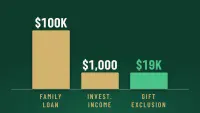
In 2026, the first $19,000 of gifts to any one person (rising to $20,000 in 2027) falls under the annual exclusion, according to Rev. Proc. 2025-32. Anything beyond that amount requires a gift tax return and reduces your lifetime exemption.
Brothers and sisters may notice, too. Whatever she still owes when you die becomes an asset of your estate, and her siblings may see the loan as a head start they never got. Some families offset the unpaid balance against the borrower’s inheritance. Others forgive it in the will. Either choice is clearer when documented in writing (we include the full estate cleanup checklist, beneficiary forms, and titling in a free guide).
The mortgage deduction depends on the recorded lien and who holds it. When the rate meets the AFR, the deed is recorded, and payments stay on schedule, the IRS treats the family loan like other secured mortgage debt.
Contact [email protected] for any questions or corrections.
David Beren has been a Flywheel Publishing contributor since 2022. Writing for 24/7 Wall St. since 2023, David loves to write about topics of all shapes and sizes. As a technology expert, David focuses heavily on consumer electronics brands, automobiles, and general technology. He has previously written for LifeWire, formerly About.com. As a part-time freelance writer, David’s “day job” has been working on and leading social media for multiple Fortune 100 brands. David loves the flexibility of this field and its ability to reach customers exactly where they like to spend their time. Additionally, David previously published his own blog, TmoNews.com, which reached 3 million readers in its first year. In addition to freelance and social media work, David loves to spend time with his family and children and relive the glory days of video game consoles by playing any retro game console he can get his hands on.