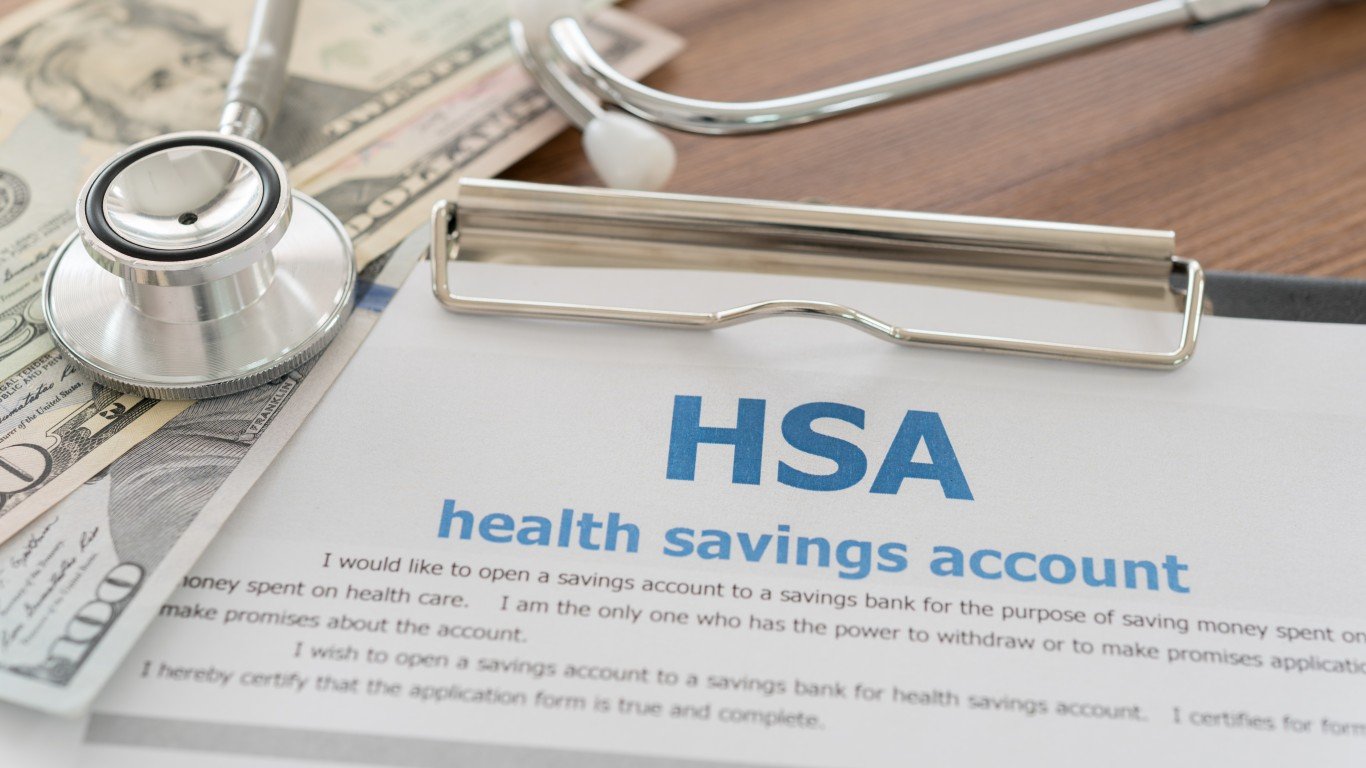
At 62, She Put $35,750 Into Her 401(k) and $8,750 Into an HSA. Only One Lowered Her Social Security Wages.
Two payroll deductions can look identical on a pay stub but treat Social Security wages in completely opposite ways, and the difference could quietly reshape a retirement benefit decades before it gets collected.

This post may contain links from our sponsors and affiliates, and Flywheel Publishing may receive compensation for actions taken through them.

A 62-year-old worker directs $35,750 into her workplace 401(k), taking advantage of the enhanced catch-up available in her early sixties. She also sends $8,750 into a family Health Savings Account (HSA) through payroll. Both deductions shrink the paycheck she takes home. Only one lowers the wages Social Security sees.
Her 401(k) contribution still counts as Social Security and Medicare wages even though traditional deferrals generally escape current federal income tax. HSA contributions made through a qualifying cafeteria plan can avoid all three. The HSA gives her an extra tax break today, but it also leaves a slightly smaller number on her Social Security earnings record.
The 401(k) Leaves Social Security Wages Alone
For 2026, someone age 60, 61, 62 or 63 can contribute as much as $35,750 to a qualifying 401(k) if the plan permits catch-ups. That combines the $24,500 regular employee limit with an $11,250 enhanced catch-up.
Those employee deferrals remain wages for Social Security purposes. So if she earns $100,000 and sends $20,000 to a traditional 401(k), the contribution can reduce income subject to federal income tax, but it does not turn her $100,000 of covered wages into $80,000. The retirement account gets funded without shaving those dollars from her Social Security record.
The HSA Buys a Different Tax Break
An HSA funded through a Section 125 cafeteria-plan salary reduction receives another layer of favorable treatment. Those contributions generally are not subject to federal income tax, Social Security tax or Medicare tax. That is why the HSA can make Box 3, Social Security wages, smaller.
For 2026, the family HSA contribution limit is $8,750. Because she is older than 55, she can potentially contribute another $1,000 to her own HSA, bringing her limit to $9,750 if she is otherwise eligible and employer contributions have not already used part of the available limit.
That payroll exclusion saves real money now. If the contribution would otherwise have been subject to both the 6.2% Social Security tax and 1.45% Medicare tax, every $1,000 routed through the cafeteria plan can save $76.50 in employee payroll taxes. The trade is that those same dollars generally do not become covered earnings.
Whether That Matters Depends on Her Record
Social Security builds retirement benefits from a worker’s highest 35 years of indexed earnings. If this is already one of her weaker years, shaving several thousand dollars from covered wages may not matter. If it still ranks among her top 35 and replaces an even weaker year, however, the smaller earnings figure can slightly trim her eventual monthly benefit.
There is another ceiling to remember. Social Security only credits earnings up to $184,500 in 2026. If her compensation remains above that amount even after the HSA exclusion, the contribution may not reduce the covered earnings used for her benefit at all. That is why this is not an argument against the HSA. Its combination of deductible contributions, tax-free growth and tax-free qualified medical withdrawals remains unusually powerful.
The Route Into the HSA Changes the Result
She can also contribute directly to an HSA outside payroll. If eligible, she can generally take the income-tax deduction on her return, but she gives up the payroll-tax exclusion. The direct contribution does not go backward and reduce the Social Security wages her employer already reported. So she really has two versions of the same HSA contribution: one preserves more covered wages, while the other preserves more of today’s paycheck. Before choosing between them:
- Check Box 3 of the W-2 against gross compensation and see whether another strong earnings year would actually improve the 35-year Social Security record.
- Compare that potential benefit with the payroll taxes saved by making the HSA contribution through the employer’s cafeteria plan.
- Remember that HSA eligibility ends once Medicare enrollment begins, making these last pre-Medicare years particularly useful for funding the account.
The 401(k) and HSA can sit beside each other on the same pay stub and still be doing different jobs. One builds retirement savings without shrinking her Social Security wages. The other can shrink those wages, but sends the payroll-tax savings back into her pocket today.
Contact [email protected] for any questions or corrections.
Gerelyn Terzo is the author of dividend investing handbook "Dividend Investing Strategies: How to Have Your Cake & Eat It Too." A veteran financial journalist, she covers agri-finance for outlets like Global AgInvesting and the broader stock market and personal finance for 24/7 Wall Street. She began at CNBC and later helped launch Fox Business in New York. Gerelyn currently resides in Woodland Park, Colorado and dabbles in nature photography as a hobby.