Her One-Employee Workplace Finally Offered Retirement Savings. The 5% Deduction Bought Her a Roth IRA and $0 From the Boss.
After decades without a single workplace benefit, she finally got automatic enrollment in a retirement account at her tiny employer. But the word "workplace" is doing a lot of heavy lifting in ways most auto-enrolled workers never think to question.

This post may contain links from our sponsors and affiliates, and Flywheel Publishing may receive compensation for actions taken through them.

The Moment That Felt Like a Milestone
Picture a woman in her early fifties who has spent her working life at very small shops: dental offices, a family-run bakery, a two-person accounting practice. She has never once been offered a workplace retirement benefit. Then a letter arrives. Her state’s savings mandate now reaches employers her size, and she has been automatically enrolled at 5% of pay.
For the first time, money is moving straight from her paycheck into retirement savings. That is progress. But the “workplace retirement” goal invites an assumption the program does not deliver: that her employer is putting something in too. On a $55,000 salary, a 5% contribution means $2,750 a year from her. From the boss: $0.
What the 5% Actually Bought
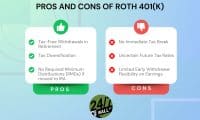
The program she joined is a payroll-deduction Roth individual retirement account (IRA), not a 401(k). The employer handles the payroll connection, but the employee owns the account and supplies the money. Payroll-deduction IRA arrangements do not provide employer contributions. That distinction matters. A 401(k) can include a match, profit-sharing contribution or other employer money. This Roth IRA cannot. The 5% deduction is savings she was not making before, but there is no second pile quietly accumulating beside it.
The tax treatment is different, too. Her Roth contribution is made with after-tax dollars, so it does not lower her federal taxable income today. A traditional pretax 401(k) contribution generally would. The Roth bargain comes later: qualified withdrawals can be tax-free.
And the account comes with IRA-sized guardrails. For 2026, the combined contribution limit across traditional and Roth IRAs is $7,500, plus a $1,100 catch-up contribution for someone 50 or older, for a total of $8,600. Roth eligibility also phases out at higher incomes. A worker automatically enrolled through payroll still has to make sure she is eligible to contribute. The 5% is a starting point, not a retirement plan in itself. For someone who has gone decades without workplace savings, the more important question may be whether 5% is enough.
Social Security Does Not Lose a Dollar of Wages
Here is one place where the stripped-down account does not hurt her. Her Roth IRA contribution does not reduce the wages credited to her Social Security record. Retirement benefits are based on a worker’s highest 35 years of covered earnings, and routing some of her paycheck into an after-tax IRA does not erase those wages.
But this is not a special advantage over a traditional 401(k). Pretax 401(k) elective deferrals also remain subject to Social Security and Medicare taxes and stay in Social Security wages. They reduce current federal taxable wages, not the earnings credited toward Social Security. So saving for retirement does not force her to choose between building the IRA and building her future Social Security benefit. Both can move forward at once.
The Roth May Matter More After Social Security Starts
The more interesting interaction arrives in retirement. Qualified Roth IRA withdrawals are not included in gross income. That gives her a pool of retirement money she may be able to tap without adding income that helps determine whether part of her Social Security benefit becomes taxable. The IRS generally looks at one-half of Social Security benefits plus other income when applying those taxation rules.
That flexibility matters for a worker who never accumulated a large employer plan. She may enter retirement with three primary levers: Social Security, whatever she manages to build in this Roth IRA and ordinary savings. The account may be modest, but its tax treatment can make it unusually useful once monthly benefits begin.
The Missing Match Still Matters
None of that turns $0 from the employer into a feature. If she earns $55,000 and stays at 5%, she contributes $2,750 this year. An employer matching 3% of pay would have added another $1,650. Over years, the absence of employer money becomes a real gap.
That is the push-and-pull inside these auto-IRA programs. They solve one problem remarkably well: workers at tiny employers finally get an easy, automatic way to save. They do not solve the second problem, which is who funds retirement besides the worker. She should celebrate the first deduction. Then she should look past the 5% printed on the enrollment notice and decide whether it is enough. The account came from work. The money did not.
Contact [email protected] for any questions or corrections.
Gerelyn Terzo is the author of dividend investing handbook "Dividend Investing Strategies: How to Have Your Cake & Eat It Too." A veteran financial journalist, she covers agri-finance for outlets like Global AgInvesting and the broader stock market and personal finance for 24/7 Wall Street. She began at CNBC and later helped launch Fox Business in New York. Gerelyn currently resides in Woodland Park, Colorado and dabbles in nature photography as a hobby.