He Plans to Claim Social Security at 62 and Park Every Check in 10-Year Treasurys Yielding 5.14%. Each Year He Waits Lifts His Check About 7% to 8%, With Inflation Adjustments on Top

This post may contain links from our sponsors and affiliates, and Flywheel Publishing may receive compensation for actions taken through them.
He just turned 62, and his plan sounds solid. He’ll claim Social Security the first month he can and put every deposit into 10-year Treasurys, which yielded about 5.1% this week. That comes after a month in which the AI trade pushed the Treasury market around. His reasoning is simple: money in his account makes interest, and money left with the government makes nothing.
This idea has been around a long time. Years ago, a listener to a consumer-advice radio show argued that the case for waiting ignores “all the money you could have received and invested during the time you waited,” and estimated his own break-even age was 69 at a 3% return. With yields above 5%, the argument looks even better today.
In reality, he is comparing a fixed-rate bond against a monthly check that adjusts for inflation and keeps coming as long as he lives.
Why a 5% Treasury Yield Is Smaller Than It Looks
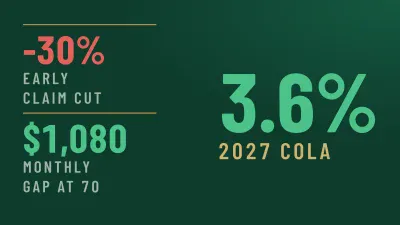
If his full retirement age (FRA) is 67, claiming at 62 cuts his check by up to 30%. Every year he waits past 67 adds 8%, up to age 70.
On a $2,000 benefit at the standard retirement age, that works out to $1,400 a month at 62 versus $2,480 at 70. The later check is 77% larger.
Those increases come before inflation. Annual cost-of-living adjustments (COLAs) are added on top, and they apply to his benefit from age 62 whether he has claimed or not. The adjustment for 2027 is 3.6%.
The Treasury yield gets no such boost. If inflation stays near this year’s adjustment, the 5.1% yield leaves only about 1.5% after inflation. Prices for households 62 and older rose 3.9%[1] over the past year, so his actual buffer may be even smaller.
As a rough estimate, investing $16,800 a year from 62 to 70 at that 1.5% real return gives him roughly $142,000 in today’s dollars by 70.
By then, a person who waited receives $1,080 more each month, or $12,960 a year. If he draws that gap from his savings, the money runs out around age 82, and that is before taxes. From then on, the person who waited stays ahead for life.
His Treasury Interest Can Make His Benefits Taxable
The IRS starts with half of his benefits and adds his other income, including interest. For someone filing alone, up to half of his benefits become taxable once that total passes $25,000[2]. Up to 85% become taxable above $34,000[2].
For joint filers, those lines are $32,000[2] and $44,000.
Treasury interest is exempt from state income tax, but it counts fully in this federal formula. As his Treasury holdings grow, the interest grows with them, and more of his Social Security can become taxable each year. Waiting works the other way: the larger check comes later with less investment income around it.
Timing also affects his retirement accounts. If he was born in 1960 or later, required withdrawals kick in at age 75. That leaves the years from 62 to 70 open to live on IRA money instead. Those withdrawals cover the wait, and they shrink the balance that would otherwise force large taxable distributions later.
What to Weigh Before Filing at 62
Many early claimers worry that the system will fail them. The trustees project the combined trust funds will run dry in 2034[3], after which incoming taxes would still cover 83% of promised benefits. Any such cut would apply to a delayed check too, so it doesn’t change which check is bigger.
- Claiming early is the toughest choice to undo. The reduced check is locked in for life. If he is married and the higher earner, it also shrinks the survivor benefit his spouse could depend on for decades.
- His likely lifetime matters more than the yield. The Treasury plan comes out ahead mainly if he dies before his early 80s or if inflation stays well below current levels. Claiming at 62 can still make sense for someone in poor health or who needs the income now. Bonds are a tricky benchmark with which to outsmart the system.
Your birth year, marital status, other income and health can shift these numbers. Run your own figures through a free account at ssa.gov ahead of filing.
Contact [email protected] for any questions or corrections.
Gerelyn Terzo is the author of dividend investing handbook "Dividend Investing Strategies: How to Have Your Cake & Eat It Too." A veteran financial journalist, she covers agri-finance for outlets like Global AgInvesting and the broader stock market and personal finance for 24/7 Wall Street. She began at CNBC and later helped launch Fox Business in New York. Gerelyn currently resides in Woodland Park, Colorado and dabbles in nature photography as a hobby.