He Lets His Tesla Drive at 93, Trusting the Brand. A $400,000 Crash Judgment Could Reach His Savings, While His $2,800 Social Security Check Stays Off-Limits to the Victim

This post may contain links from our sponsors and affiliates, and Flywheel Publishing may receive compensation for actions taken through them.
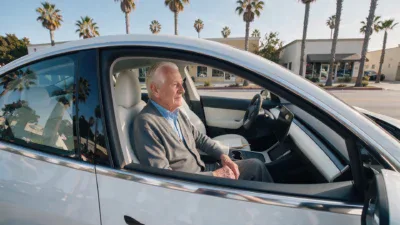
Picture a 93-year-old widower who still drives himself to the pharmacy, to church and to his daughter’s house on Sundays. He bought a Tesla (NASDAQ:TSLA | TSLA Price Prediction) because the ads made it sound like the car would handle the hard parts. Now he turns on the self-driving feature, keeps his hands in his lap and trusts it.
That ad exists. In July, Tesla posted a video of a 93-year-old San Diego resident named Lois using its Full Self-Driving (Supervised) software to run errands and visit family. Elon Musk has said the technology “enables safer mobility for senior citizens.” Tesla’s own fine print says the software still requires a driver to monitor the road and that none of its features replace an attentive person at the wheel. If the car runs a red light, the law treats him as the driver.
Personal injury lawyer Brian White told Fortune: “The seniors who would benefit most from a car that drives itself are often the ones least able to supervise one.”
Suppose a crash ends in a $400,000 judgment against him and his auto policy covers $100,000. The injured family can seek the remaining $300,000 from assets that are not protected by law. At his age, that matters more than any claiming strategy. He needs to know what they can take and what stays his.
Why His $2,800 Check Sits Behind a Federal Wall
Federal law, at 42 U.S.C. 407[1], shields Social Security benefits from garnishment and seizure by private creditors, and that includes someone holding a judgment from a car accident. His $2,800 a month, or $33,600 a year, keeps coming no matter how large the verdict.
The protection follows the money into his bank account. Under a Treasury rule in effect since May 1, 2011, a bank that receives a garnishment order must review the account’s two-month lookback period and protect any federal benefits directly deposited during that window. With two $2,800 deposits during that window, the bank automatically protects $5,600 or his account balance, whichever is lower. He does not have to file anything to get that protection.
The exceptions are narrow. Benefits can still be garnished for certain federal debts, child support or alimony. A private crash judgment does not qualify.
His benefit also grows over time. Thanks to the 3.6% cost-of-living adjustment (COLA) for 2027, a $2,800 check rises to roughly $2,900. The estimated average retired-worker benefit for January 2027 is $2,170, putting his benefit above average.
Where His Savings Become Fair Game
His other money depends on what kind of account holds it. A 401(k) from a private employer falls under the Employee Retirement Income Security Act, the federal law governing workplace plans, and is generally protected from judgment creditors. Outside bankruptcy, an IRA’s protection depends on state and federal law, and some states shield IRAs far less than others. Bank savings, CDs and brokerage accounts usually have little protection.
Required withdrawals add a twist. At 93, the IRS divisor is 10.1, so a traditional IRA worth $300,000 at the previous year-end requires a withdrawal of about $29,700 this year. Once that money lands in checking, its creditor protection depends on state law. The bank’s automatic two-month shield covers only the federal benefit deposits.
Two Moves Worth Making Before the Next Drive
The protections that hold up best are the ones set up before anything goes wrong:
- Give Social Security its own account. Have benefits deposited into an account that receives nothing else. The automatic shield still works in a mixed account, but a clean account makes it far easier to prove that any balance above two months of benefits came from Social Security if a creditor challenges it.
- Check the liability coverage now. The gap between his auto policy limit and a judgment against him is the amount he could still owe personally. An umbrella policy that sits above auto coverage can close much of that gap. Retitling assets or giving money to the kids after a crash is the mistake that is hardest to undo, because courts can reverse transfers made to avoid a creditor.
His Social Security check will be there either way. What deserves attention is everything else he has saved, and whether he and his family should talk openly about whether he should still be the one managing that car. State exemption laws, account types and the exact wording of an insurance policy can change the answer from one household to the next, so an hour with an elder-law attorney in his state is worth spending before he needs one.
Contact [email protected] for any questions or corrections.
Gerelyn Terzo is the author of dividend investing handbook "Dividend Investing Strategies: How to Have Your Cake & Eat It Too." A veteran financial journalist, she covers agri-finance for outlets like Global AgInvesting and the broader stock market and personal finance for 24/7 Wall Street. She began at CNBC and later helped launch Fox Business in New York. Gerelyn currently resides in Woodland Park, Colorado and dabbles in nature photography as a hobby.