The Post Office’s 630,000 Workers
As the economy cools and moves into recession, U.S. Postal Service should do what thousands of American businesses will do and cut headcount to save money.


One point management makes about the U.S. Postal Service (USPS) is that it has 630,000 employees. That makes it one of the largest employers in America. It also allows USPS to run its 34,000 offices. However, the figure is much too large to fulfill the declining need for the institution.
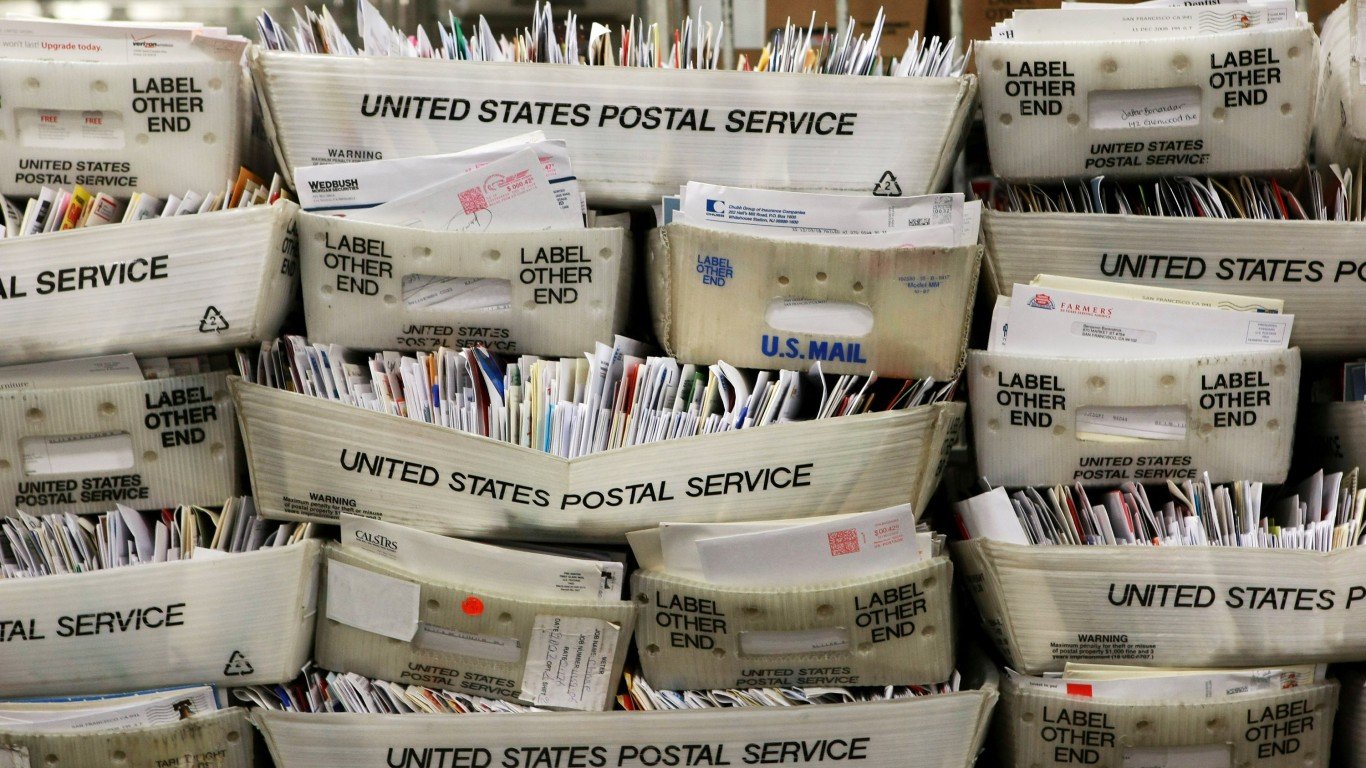
The employee base allows USPS to do several things it does not have to do. The first is that postal carriers deliver a huge amount of junk mail. Without that junk mail, USPS could not be in business at its current size. The value of junk mail to Americans is limited, particularly if it fuels the need to employ many of the 630,000 workers.
First-Class Mail is another overused service. It already has been largely replaced by email. Email also allows people to deliver attachments that, in the past, would have been packages. USPS also delivers huge numbers of bills. Americans could be encouraged, even with incentives, to pay their bills online.
USPS continues to believe there is a need to deliver mail six days a week. Few Americans must get their mail more than two or three times a week. The need for more days is fiction.
USPS has 34,000 offices. Many of these are in towns with only a few thousand residents. Even the locations in the smallest towns have ten employees or more. It is an anachronistic system.
As the economy cools and moves into recession, USPS should do what thousands of American businesses will do. This is to cut headcount to save money. It not only would drive a more sensibly sized organization but would bring USPS into the 21st century.
Contact [email protected] for any questions or corrections.
Douglas A. McIntyre is the co-founder, chief executive officer and editor in chief of 24/7 Wall St. and 24/7 Tempo. He has held these jobs since 2006.
McIntyre has written thousands of articles for 24/7 Wall St. He is an expert on corporate finance, the automotive industry, media companies and international finance. He has edited articles on national demographics, sports, personal income and travel.
His work has been quoted or mentioned in The New York Times, The Wall Street Journal, Los Angeles Times, The Washington Post, NBC News, Time, The New Yorker, HuffPost USA Today, Business Insider, Yahoo, AOL, MarketWatch, The Atlantic, Bloomberg, New York Post, Chicago Tribune, Forbes, The Guardian and many other major publications. McIntyre has been a guest on CNBC, the BBC and television and radio stations across the country.
A magna cum laude graduate of Harvard College, McIntyre also was president of The Harvard Advocate. Founded in 1866, the Advocate is the oldest college publication in the United States.
TheStreet.com, Comps.com and Edgar Online are some of the public companies for which McIntyre served on the board of directors. He was a Vicinity Corporation board member when the company was sold to Microsoft in 2002. He served on the audit committees of some of these companies.
McIntyre has been the CEO of FutureSource, a provider of trading terminals and news to commodities and futures traders. He was president of Switchboard, the online phone directory company. He served as chairman and CEO of On2 Technologies, the video compression company that provided video compression software for Adobe’s Flash. Google bought On2 in 2009.