





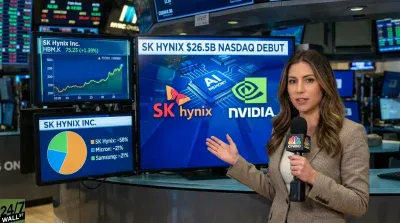
Something broke in Seoul, and the tremor reached Wall Street on Monday. South Korea’s KOSPI has fallen roughly 25% from its June peak, and Korean equities plunged more than 20% in a single session, its worst day this month. SK Hynix, the crown jewel of the AI memory trade, had its worst day in Seoul and saw its Nasdaq shares tumble. The trigger was almost mundane: a South Korean brokerage trimmed its second-quarter profit estimate for SK Hynix, citing reliance on fixed-price high-bandwidth memory contracts and slower-than-expected HBM4 shipments. Is Micron next?
Micron Is Already Feeling It
Micron Technology (NASDAQ:MU | MU Price Prediction) fell 5% Monday, from $979.30 to $930.32, dragged into the same downdraft that hit SanDisk (NASDAQ:SNDK) and Western Digital (NASDAQ:WDC) Seagate (down 5.2%), Lam Research (down 5.3%), AMD (down 4.3%), and Applied Materials (down 4.3%). When one memory maker’s guidance wobbles, the complex trades as a single organism. Even after the slide, MU is up about 9.82% over the past month, roughly 243% year to date, and nearly 697% over the past year. That is a parabolic chart taking a breather, which is exactly when the “bubble” question gets loudest.
The Bull Case Hasn’t Changed
The HBM pricing pressure that spooked Korea is what Micron’s bulls have been buying. TD Cowen reiterated a Buy this month with a $1,600 target, arguing a structural shortage of high-bandwidth memory persists beyond 2027. Micron has locked in roughly $22 billion in customer commitments through multi-year agreements with take-or-pay clauses and pricing floors, and has committed $250 billion to US manufacturing and R&D. CEO Sanjay Mehrotra frames these Strategic Customer Agreements as a way to “significantly enhance the durability and predictability of Micron’s strong financial performance.” Analyst consensus sits around $1,486, with 9 strong buys and 31 buys against a single strong sell.
Price Target & Analyst Ratings
The Bear Case Is About the Cycle
Memory is cyclical, and cycles turn. The SK Hynix cut reminds that HBM pricing power can soften faster than order books suggest. Fixed-price contracts that protect revenue on the way up can cap it on the way down. Our internal model rates Micron a HOLD near fair value, around $955 versus the $930 current level. GuruFocus flags the stock as trading well above its estimated fair value. With a beta of 2.14, Micron moves about twice as hard as the market in either direction. Insiders reinforce caution: EVP April Arnzen sold 32,127 shares on July 1 at $1,077 to $1,095, and Mehrotra unloaded stock across 40 transactions on June 26 between $1,128 and $1,192. Zero discretionary buying.
Price Scenarios
What Separates Micron
Micron owns US fabs, carries broad product exposure including HBM4, and holds contracted revenues and pricing floors. It is the American memory champion at a moment when Washington is subsidizing domestic chipmaking and tariffs complicate Asian supply. If the memory trade bifurcates, Micron’s structural position is arguably the strongest in the group, which is precisely why it has outrun everyone.
Bottom Line
Both things are true. The HBM shortage thesis is intact and analysts still see substantial upside. This is also a violently cyclical, high-beta stock sitting on one of the largest one-year gains in the market, and the catalyst that just took 25% off Korea’s index applies directly to it. Watch Micron’s fiscal Q4 report closely: that is the tell on whether US memory names decouple from Korean cyclicals or follow them down. Polymarket traders are hedged both ways, pricing a roughly 50% chance of $1,320 in July and a 50% chance of $840. Korea just found out what thin air feels like. Micron holders may be about to.
Contact [email protected] for any questions or corrections.










 Top Gaining Stocks
 Top Losing Stocks