Winners and Losers If Trump Carries Out Threat to Cut Off Trade With China
Of all the threats that the president has made since his tenure began, the threat to cut off all trade with any country doing business with North Korea is, inarguably, the most unrealistic.

This post may contain links from our sponsors and affiliates, and Flywheel Publishing may receive compensation for actions taken through them.
President Donald Trump apparently did not get Teddy Roosevelt’s memo about speaking softly and carrying a big stick. Of all the threats that he has made since his tenure as 45th President of the United States of America began, the threat to cut off all trade with any country doing business with North Korea is, inarguably, the most unrealistic.
To see exactly why, let’s examine just the numerical consequences of proceeding with such a move. According to the Massachusetts Institute of Technology’s Atlas Media, the top export destinations of North Korea are China, India, Pakistan and Burkina Faso. The top import origins are China, India, Russia, Thailand and the Philippines.
Taken at its word then, all trade with China, India, Pakistan, Burkina Faso, Russia, Thailand and the Philippines would have to be suspended until further notice. The total dollar amount of goods exported to these countries in 2016 was $170 billion. The total dollar amount of goods imported from these countries in 2016 was $566 billion.
The most glaring thing to analyze first about these numbers is the total trade deficit with all these countries, which amounts to $396 billion last year, and which will grow in 2017 assuming trade is not stopped. A trade deficit of $396 billion is not a bad thing so long as dollars are still excepted by these countries in order to pay for it. But if those dollars are no longer being sent abroad to pay for trade deficits, they will simply stay in the United States.
The result will be twofold: First, a much higher money supply within the United States, raising consumer prices from the monetary supply side, and second, much fewer goods within the United States from lack of imports, raising consumer prices from the goods supply side. Not to mention a domino line of bankruptcies for firms reliant on exporting to these countries and importing from them.
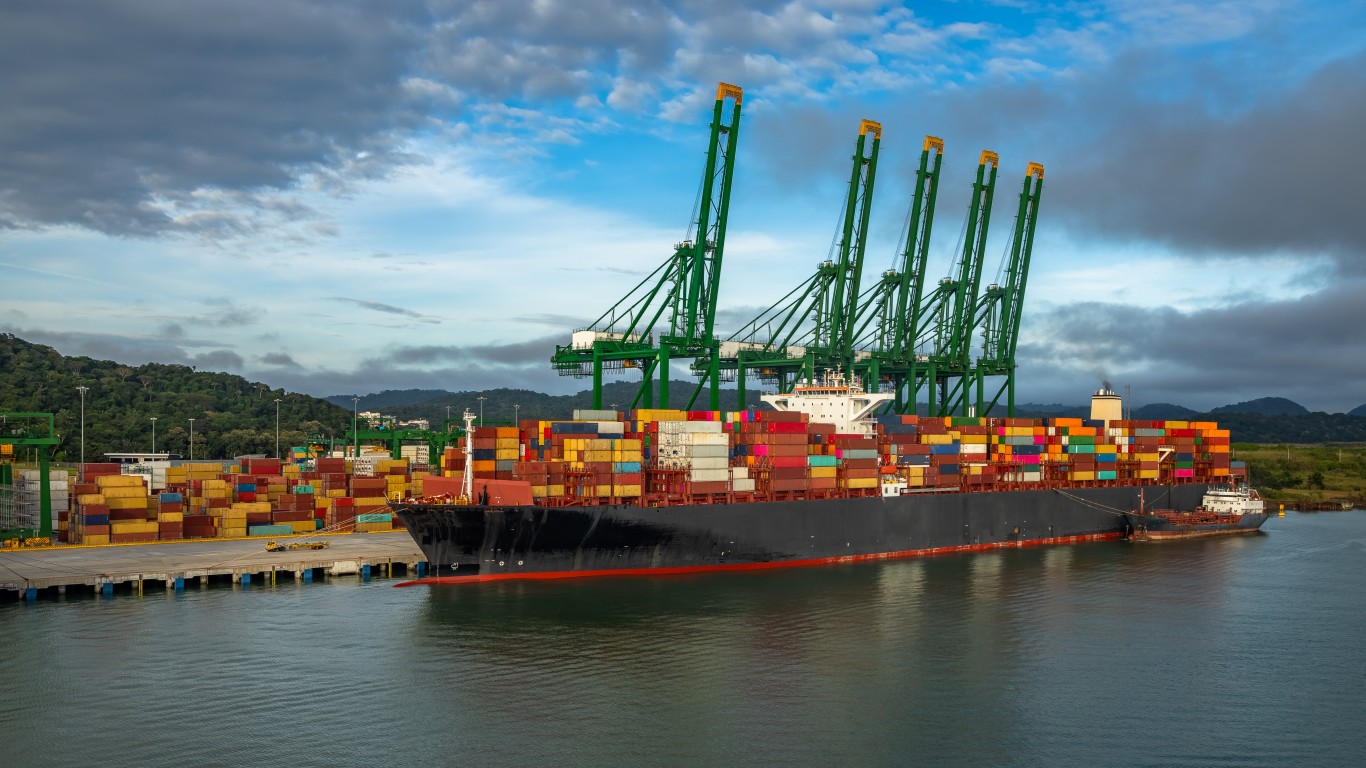
The immediate effects of a suspension of trade with any country doing business with North Korea would be quite catastrophic then, making the chances of it ever happening quite low. However, on the very small chance that it or something like it happens like a suspension of trade with China (by far the largest trading partner of any of these countries) for even a short time, the biggest losers will be retail and industrials reliant on Chinese machinery, and the biggest winners will be American firms that produce goods normally imported from China.
The top import categories from China in 2016, according to the Office of the United States Trade Representative, were electrical machinery ($129 billion), general machinery ($97 billion), furniture and bedding ($29 billion), toys and sports equipment ($24 billion), and footwear ($15 billion). The top export categories are agriculture, aircraft, machinery and cars. This means that the firms that would suffer the most are in the semiconductor, agricultural, aircraft and automotive sectors.
Expect agricultural firms such as Monsanto Co. (NYSE: MON), tech firms like Microsoft Corp. (NASDAQ: MSFT), aircraft companies like Boeing Co. (NYSE: BA), automotive General Motors Co. (NYSE: GM) and its domestic competitors all to plummet if there is any sort of progress made in such sweeping trade restrictions, even if they are just rumors.
On the upswing will be commodities and hard assets, and U.S. firms that manufacture them. Domestic oil firms and miners will get a huge if temporary boost, and the U.S. dollar will plummet. Price inflation would spike higher and U.S. Treasury yields would spike as well, forcing the Federal Reserve to monetize, which could further exacerbate price inflation.
It is of course extremely unlikely that the president would go ahead with a move like this, and even if he wanted to it would probably be scuttled somewhere along the executive corridors of power. For now, it seems that mere rumors of such a move will gyrate the stock prices of these companies in the short term, until all this belligerent talk is over and stocks go back to what they were doing beforehand.
In a word, it looks like this will be a trader’s market until geopolitical storms start dying down and trends can be restored.
Contact [email protected] for any questions or corrections.
Douglas A. McIntyre is the co-founder, chief executive officer and editor in chief of 24/7 Wall St. and 24/7 Tempo. He has held these jobs since 2006.
McIntyre has written thousands of articles for 24/7 Wall St. He is an expert on corporate finance, the automotive industry, media companies and international finance. He has edited articles on national demographics, sports, personal income and travel.
His work has been quoted or mentioned in The New York Times, The Wall Street Journal, Los Angeles Times, The Washington Post, NBC News, Time, The New Yorker, HuffPost USA Today, Business Insider, Yahoo, AOL, MarketWatch, The Atlantic, Bloomberg, New York Post, Chicago Tribune, Forbes, The Guardian and many other major publications. McIntyre has been a guest on CNBC, the BBC and television and radio stations across the country.
A magna cum laude graduate of Harvard College, McIntyre also was president of The Harvard Advocate. Founded in 1866, the Advocate is the oldest college publication in the United States.
TheStreet.com, Comps.com and Edgar Online are some of the public companies for which McIntyre served on the board of directors. He was a Vicinity Corporation board member when the company was sold to Microsoft in 2002. He served on the audit committees of some of these companies.
McIntyre has been the CEO of FutureSource, a provider of trading terminals and news to commodities and futures traders. He was president of Switchboard, the online phone directory company. He served as chairman and CEO of On2 Technologies, the video compression company that provided video compression software for Adobe’s Flash. Google bought On2 in 2009.