Exxon’s Next Move: Permian Expansion or Deepwater Dive After Hess Loss?
Try, Try Again Exxon Mobil’s (NYSE:XOM | XOM Price Prediction) recent loss in arbitration to Chevron (NYSE:CVX) over the $53 billion Hess acquisition marked a significant setback, denying Exxon a prized stake in Guyana’s prolific Stabroek Block. The arbitration panel…

Try, Try Again
Exxon Mobil’s (NYSE:XOM | XOM Price Prediction) recent loss in arbitration to Chevron (NYSE:CVX) over the $53 billion Hess acquisition marked a significant setback, denying Exxon a prized stake in Guyana’s prolific Stabroek Block. The arbitration panel rejected Exxon’s claim to a right of first refusal, allowing Chevron to finalize the deal on July 18.
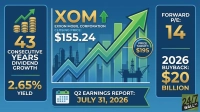
Despite this defeat, Exxon reported robust second-quarter earnings of $7.1 billion, or $1.64 per share, surpassing Wall Street’s $1.54 estimate. The beat was driven by record production of 4.6 million barrels per day — the highest since the Exxon-Mobil merger over 25 years ago.
However, lower oil prices, down 10% year-over-year due to increased OPEC+ output, cut profits by 23% from $9.2 billion in the year-ago period. With CEO Darren Woods signaling openness to acquisitions, Exxon faces a strategic crossroads: double down on the Permian Basin or pursue deepwater opportunities to bolster its portfolio.
Permian Basin Opportunities
The Permian Basin, where Exxon already holds a strong position following its $59.5 billion acquisition of Pioneer Natural Resources in 2024, remains a compelling target for further M&A. The region’s low-cost, high-output shale plays align with Exxon’s strategy to optimize production efficiency.
Potential targets include Occidental Petroleum (NYSE:OXY), which holds significant Permian acreage but faces balance sheet constraints, making it a candidate for a strategic buyer like Exxon. Another possibility is Diamondback Energy (NASDAQ:FANG), valued at around $42.7 billion, with a strong Delaware Basin presence and a track record of operational efficiency.
Acquiring such assets would allow Exxon to leverage existing infrastructure, reduce costs, and boost output in a region where it already pumped a record 1.6 million barrels per day in Q2. However, heightened competition and rising asset valuations in the Permian could challenge Exxon’s ability to secure deals without overpaying.
Deepwater Opportunities
Alternatively, Exxon could pivot to deepwater assets, particularly in regions like the Gulf of America or offshore West Africa, where high-margin, long-life projects offer resilience against price volatility. Deepwater assets also complement Exxon’s expertise in complex, capital-intensive projects, as demonstrated by its Guyana operations.
Potential targets include Kosmos Energy (NYSE:KOS), with its stakes in Ghana and Equatorial Guinea, offering exposure to high-yield deepwater fields. Another candidate is Murphy Oil (NYSE:MUR), with Gulf of America assets that could enhance Exxon’s U.S. offshore portfolio.
Deepwater acquisitions would diversify Exxon’s geographic footprint and provide a hedge against Permian-specific risks, such as regulatory pressures or resource saturation. However, deepwater projects carry higher upfront costs and environmental scrutiny, which could complicate integration and public perception.
A Third Way?
Instead of pursuing acquisitions, Exxon could prioritize returning value to shareholders through its substantial free cash flow (FCF). In the second quarter, Exxon paid out $9.2 billion to shareholders, including $4 billion in dividends and $5 billion in share repurchases, and is on track to buy back $20 billion in shares this year.
With FCF bolstered by cost reductions of $1.4 billion in 2025 and $13.5 billion since 2019, Exxon could raise its dividend, currently yielding around 3.5%, to enhance shareholder returns without the risks of M&A. This approach avoids integration challenges and potential overpayment for assets in a volatile market.
However, forgoing acquisitions could limit growth in reserves and production, potentially ceding market share to rivals like Chevron, especially in high-growth regions like Guyana.
Contact [email protected] for any questions or corrections.
After two decades of patrolling the dark corners of suburbia as a police officer, Rich Duprey hung up his badge and gun to begin writing full time about stocks and investing. For the past 20 years, he’s been cruising the markets looking for companies to lock up as long-term holdings in a portfolio while writing extensively on the broad sectors of consumer goods, technology, and industrials. Because his experience isn’t from the typical financial analyst track, Rich is able to break down complex topics into understandable and useful action points for the average investor. His writings have appeared on The Motley Fool, InvestorPlace, Yahoo! Finance, Money Morning, and, of course, 24/7 Wall St. He has been featured in both U.S. and international publications, including MarketWatch, Financial Times, Forbes, Fast Company, and USA Today.