NVIDIA CEO Jensen Huang Directly Address 3 of the Biggest Bear Arguments Against the Stock
After delivering banner years in 2023 and 2024, NVIDIA (Nasdaq: NVDA | NVDA Price Prediction) is once again seeing strong gains in 2025. The company’s stock is now up 32% year-to-date and shares trade near their all-time highs. Yet, despite these…

This post may contain links from our sponsors and affiliates, and Flywheel Publishing may receive compensation for actions taken through them.

After delivering banner years in 2023 and 2024, NVIDIA (Nasdaq: NVDA | NVDA Price Prediction) is once again seeing strong gains in 2025. The company’s stock is now up 32% year-to-date and shares trade near their all-time highs.
Yet, despite these gains, NVIDIA remains a battleground stock on Wall Street. Bulls cheer each announcement of companies like Meta and Microsoft raising capital spending plans while bears question whether ROI on AI spending exists.
Last week, NVIDIA and OpenAI announced a partnership where NVIDIA can invest up to $100 billion in the company. Once again, on Wall Street the consensus is split whether this is ‘bubble-like’ behavior of NVIDIA investing in a company that will use the money simply to buy their products, or a savvy move getting equity in a startup that has 700 million users on its platform.
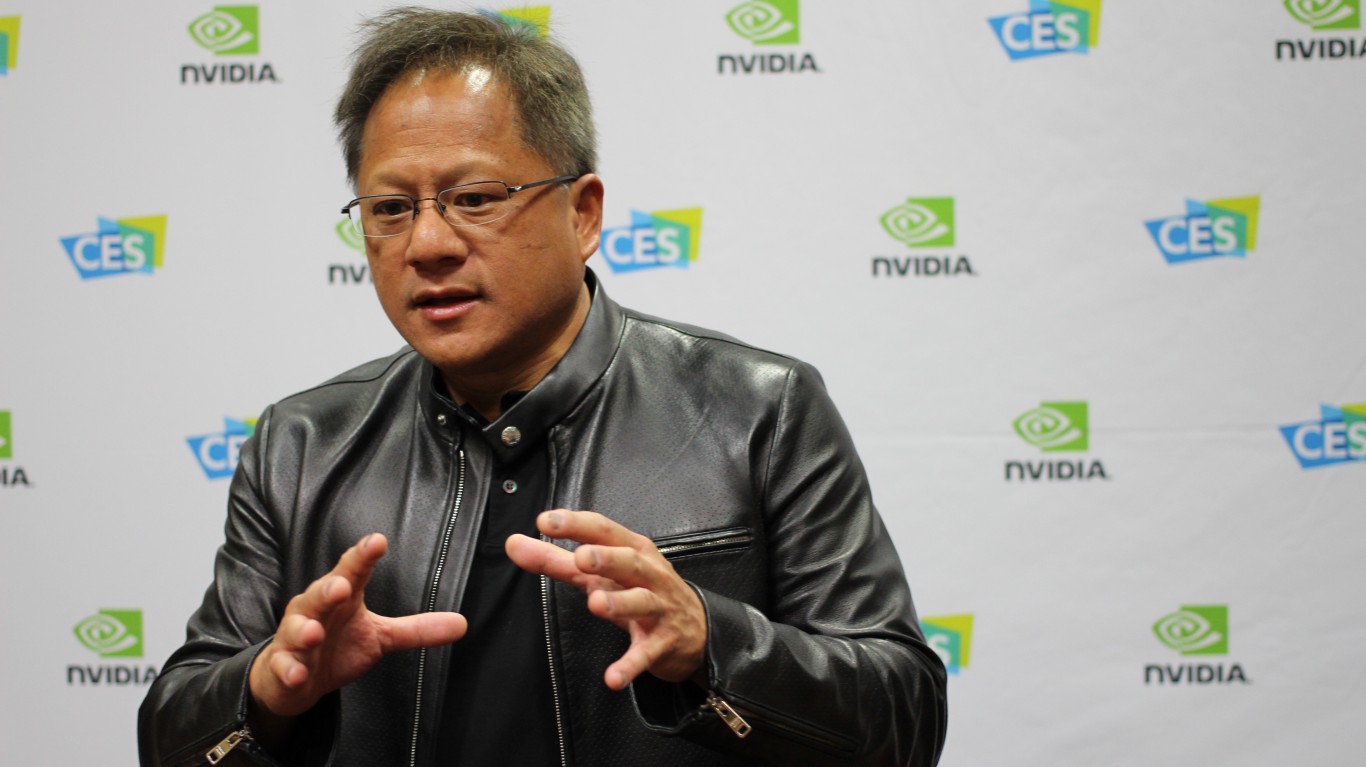
On Friday, NVIDIA CEO Jensen Huang sat down with Venture Capitalist Brad Gerstner and directly addressed hot-button issues like the company’s OpenAI investment, the ROI on AI spending, NVIDIA’s advantage over rivals, and much more. We watched the full 104-minute interview and have selected the three most important questions and answers that investors need to pay attention to.
Jensen Huang on NVIDIA’s $100 Billion Investment in OpenAI
“I think that OpenAI is likely going to be the next multi-trillion dollar hyperscale company … If that’s the case, the opportunity to invest before they get there, this is some of the smartest investments we can possibly imagine… We love the opportunity to invest. We don’t have to invest, right? And it’s not required for us to invest, but they’re giving us the opportunity to invest. This this new partnership is about helping OpenAI to build their own self-build AI infrastructure for the first time, right? And so this is us working directly with OpenAI at the chip level, at the software level, at the systems level, at the AI factory level”
This answer from Jensen is important because it offers more details on the strategy NVIDIA is pursuing with its investment into OpenAI.
NVIDIA has been aggressive in funding companies across its broader technology ecosystem. For example, the company invested $100 million into CoreWeave (Nasdaq: CRWV) in April 2023 and served as an anchor investor during CoreWeave’s IPO. Beyond direct equity funding, NVIDIA also signed a ‘capacity order’ to provide CoreWeave with $6.3 billion worth of its GPUs.
The broader strategy at play here is NVIDIA knows customer concentration will remain one of its greatest threats. NVIDIA has revealed in its financial filings that it has four customers that each account for more than 10% of its sales. These customers aren’t named, but it’s widely known they’re Amazon, Microsoft, Alphabet, and Meta.
This customer concentration is one of the greatest threats facing NVIDIA. The company commands gross margins exceeding 70%, and extreme customer concentration would allow these larger customers to push back on pricing over time. Knowing this, NVIDIA has long worked to diversify its customer base.
So, it’s worth paying attention to Jensen Huang’s words that their funding for OpenAI is explicitly for the company’s efforts to build its own computing infrastructure. That is to say, NVIDIA’s investment is directed at making OpenAI another hyperscale-level customer.
It should be noted that beyond OpenAI’s efforts to build their own ‘self-build AI infrastructure,’ their partnership with Oracle (Nasdaq: ORCL) is large enough that Oracle’s cloud business could be similar in scale to Alphabet by 2029.
In short, NVIDIA likes the upside of owning more of OpenAI, but its $100 billion investment is equally as focused on helping it diversify its customer base.
Is the OpenAI Investment Round-tripping?
“10 gigawatts is like $400 billion, right? $400 billion will have to be largely funded by their offtake, right? It has to be funded by their capital, the money they’ve raised through equity and whatever debt they can raise. Those are the three vehicles. And the equity that they could raise and the debt that they could raise has something to do with the confidence of the revenues that they could sustain, for sure. And so smart investors and smart lenders will consider all of these factors… It’s an opportunity to invest in them, and as we were mentioning earlier, this is likely going to be the next multi-trillion dollar hyperscale company. And who doesn’t want to be an investor in that?
Round-tripping is when companies create a circular flow of money to inflate financial results. The famous Dot-Com example of this was Nortel, which would arrange credit for carriers to buy Nortel gear. After the Dot-Com bubble burst the SEC charged Nortel over improper revenue recognition.
Huang’s answer here is essentially that demand already exists for OpenAI’s equity (the company recently raised money at a $500 billion valuation) and their ability to raise capital will come from their ability to sustain revenues rather than NVIDIA’s investment being into a company with no real economic substance.
It should be noted that just today, OpenAI announced partnerships with several payment platforms (including Stripe and Shopify) that will allow consumers to buy products directly through ChatGPT. This is likely the beginning of OpenAI’s next revenue model where they collect both advertising and affiliate dollars beyond subscription revenue.
NVIDIA and China
“We’re up against a formidable, innovative, hungry, fast-moving, underregulated [country.] Some of the things I’ve heard, they could never build AI chips… That just sounded insane. Two, that China can’t manufacture. Come on, if there’s one thing they can do, it’s manufacture. And three, that they’re years behind us. Come on, they’re nanoseconds behind us. So we’ve got to go compete.”
It hasn’t been all good news for NVIDIA this year. One notable story was new restrictions that halted the company’s sales of export-compliant chips into China. Even with restrictions now lifted, the geopolitical tensions are far from over. The Financial Times recently reported that the Chinese government has banned the purchase of NVIDIA’s chips. China formerly contributed 20% of NVIDIA’s revenue, and CEO Jensen Huang estimates chip bans are causing $50 billion in lost annual revenue.
And yet, despite losing access to a market of this size, NVIDIA has managed to keep surpassing expectations. Wall Street now expects the company to report $206.5 billion in revenue this year. That’s sales growth of 58%. Estimates for next year call for the company to deliver another 32% of sales growth.
Jensen Haung emphasized in the interview that his guidance to investors is still to expect zero revenue from China, but the company is developing a Blackwell export-compliant chip for the market. Whether or not that chip passes export restrictions or Chinese leadership allows domestic companies to buy it remains to be seen.
Contact [email protected] for any questions or corrections.
Douglas A. McIntyre is the co-founder, chief executive officer and editor in chief of 24/7 Wall St. and 24/7 Tempo. He has held these jobs since 2006.
McIntyre has written thousands of articles for 24/7 Wall St. He is an expert on corporate finance, the automotive industry, media companies and international finance. He has edited articles on national demographics, sports, personal income and travel.
His work has been quoted or mentioned in The New York Times, The Wall Street Journal, Los Angeles Times, The Washington Post, NBC News, Time, The New Yorker, HuffPost USA Today, Business Insider, Yahoo, AOL, MarketWatch, The Atlantic, Bloomberg, New York Post, Chicago Tribune, Forbes, The Guardian and many other major publications. McIntyre has been a guest on CNBC, the BBC and television and radio stations across the country.
A magna cum laude graduate of Harvard College, McIntyre also was president of The Harvard Advocate. Founded in 1866, the Advocate is the oldest college publication in the United States.
TheStreet.com, Comps.com and Edgar Online are some of the public companies for which McIntyre served on the board of directors. He was a Vicinity Corporation board member when the company was sold to Microsoft in 2002. He served on the audit committees of some of these companies.
McIntyre has been the CEO of FutureSource, a provider of trading terminals and news to commodities and futures traders. He was president of Switchboard, the online phone directory company. He served as chairman and CEO of On2 Technologies, the video compression company that provided video compression software for Adobe’s Flash. Google bought On2 in 2009.