AMD Keeps Falling After Beat-and-Raise Q3. Should You Buy?
Advanced Micro Devices (NASDAQ:AMD | AMD Price Prediction) recently reported strong third-quarter results, with revenue hitting $9.2 billion, up 36% year-over-year, and beating Wall Street’s $8.7 billion estimate. Adjusted earnings of $1.20 per share also topped the $1.16 consensus, while…


Advanced Micro Devices (NASDAQ:AMD | AMD Price Prediction) recently reported strong third-quarter results, with revenue hitting $9.2 billion, up 36% year-over-year, and beating Wall Street’s $8.7 billion estimate. Adjusted earnings of $1.20 per share also topped the $1.16 consensus, while the company raised its Q4 guidance to $9.6 billion.
Despite this beat-and-raise performance, AMD’s stock has declined 9% in the days after. Considering the stellar, record results and the chipmaker’s upbeat outlook for the immediate future — not to mention the long-term potential of artificial intelligence (AI) — is the market offering a discount that is just too cheap to ignore?
Strong Data Center Growth Fuels Q3 Success
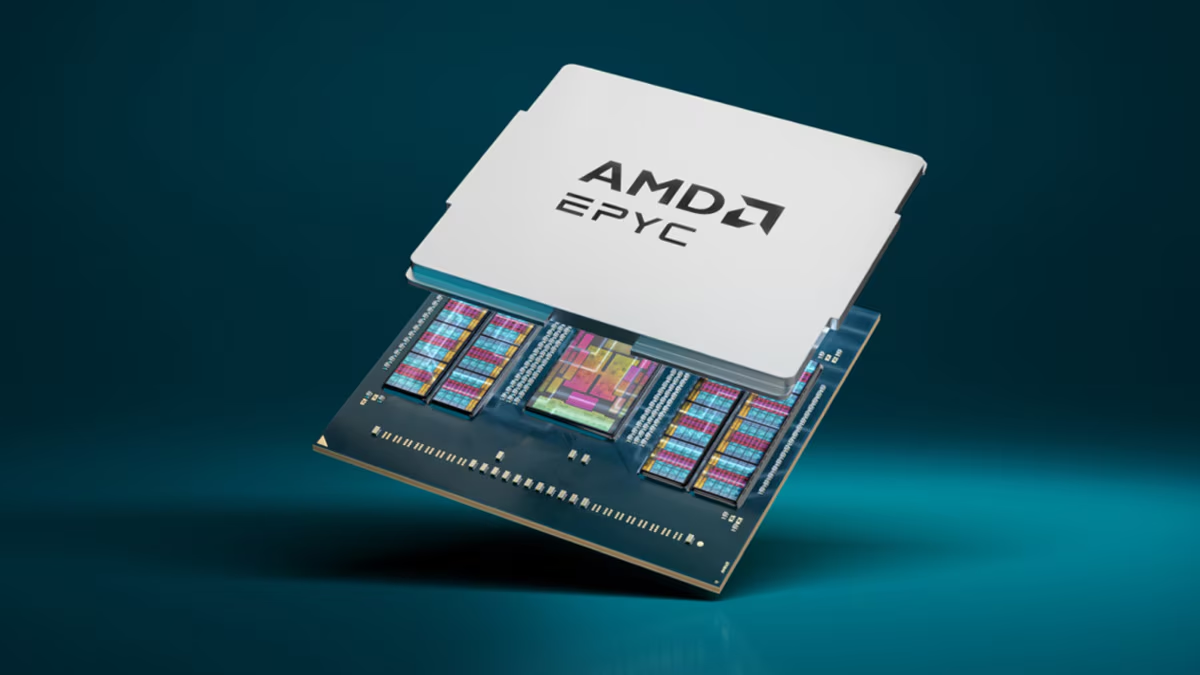
AMD’s data center segment led the charge in Q3, generating a record $4.3 billion in revenue, a 22% increase from last year, driven by the Instinct MI350 series GPUs and EPYC processor gains. Operating income rose to $1.1 billion, though the margin dipped to 25% from 29% due to higher revenue scaling.
This segment’s 611.64% total revenue growth since March 2021, with a 54.4% CAGR, underscores AMD’s AI and server market traction. As this segment previously posted only modest growth, its explosive performance over the past four years demonstrates the speed and agility it displayed in quickly making up for lost time.
However, the lack of MI308 GPU sales to China, a potential growth area, may have tempered the market’s expectations.
Client and Gaming Segments Show Mixed Results
The client segment, catering to PCs, saw a 46% revenue jump to $2.8 billion, fueled by AI-enabled PC upgrades and a Windows cycle. This rebound reflects broader market recovery, with Gartner noting an 8% rise in global PC shipments.
Gaming revenue hit $1.3 billion, up 181%, signaling a strong comeback after pandemic-related dips. Yet, operating income across segments remains uneven, with the third quarter in recent years being uneven. This volatility raises questions about cost management as AMD scales production to meet demand.
A Deal with AI’s New “Kingmaker”
AMD also signed a multi-year deal with new kingmaker OpenAI last month, involving hundreds of thousands of MI450 GPUs and a potential 10% stake via a warrant, promising significant revenue. Although AMD initially got a stock price bump after announcing the agreement — similar to ones seen by Oracle (NYSE:ORCL), Nvidia (NASDAQ:NVDA), and others after announcing OpenAI partnerships — the euphoria could not withstand the sentiment following the earnings report.
The deal, starting revenue recognition in mid-2026, may be too future-focused for investors, while OpenAI’s $12 billion quarterly loss and AMD’s exclusion from China sales add uncertainty. This contrasts with Nvidia’s immediate AI ecosystem dominance, leaving AMD’s stock vulnerable to profit-taking despite the partnership.
Wall Street’s Ongoing Love Affair
Analyst sentiment remains positive as AMD continues to benefit from strong investor confidence. A string of already bullish analysts hiked their price targets on the chipmaker’s shares, with most coming in around the $300 per share range. Benchmark, however, boosted its price to a market high of $325 per share the day after earning, implying 30% upside from where it traded. The premium is even greater now after AMD’s slide.
Key Takeaway
AMD’s fundamentals are solid, with strong data center and client growth, but the stock’s decline after the third quarter suggests market caution about valuation. The stock goes for 112x trailing earnings and 35x estimates, well above Nvidia’s more attractive valuation of 51x and 27x, respectively.
The OpenAI deal’s long-term potential offsets near-term risks like China sales delays and margin pressures. Nvidia CEO Jensen Huang just said the chipmaker has no current plans to ship AI chips to China and reports indicate the U.S. is blocking sales of Nvidia’s scaled-down chip designs there beginning today.
At under $228 per share today, AMD stock is a buy for long-term investors betting on AI and PC recovery. However, short-term volatility and competition from Nvidia warrant a wait-and-see approach for more conservative investors unless the stock dips further, offering a better entry point and value.
Contact [email protected] for any questions or corrections.
After two decades of patrolling the dark corners of suburbia as a police officer, Rich Duprey hung up his badge and gun to begin writing full time about stocks and investing. For the past 20 years, he’s been cruising the markets looking for companies to lock up as long-term holdings in a portfolio while writing extensively on the broad sectors of consumer goods, technology, and industrials. Because his experience isn’t from the typical financial analyst track, Rich is able to break down complex topics into understandable and useful action points for the average investor. His writings have appeared on The Motley Fool, InvestorPlace, Yahoo! Finance, Money Morning, and, of course, 24/7 Wall St. He has been featured in both U.S. and international publications, including MarketWatch, Financial Times, Forbes, Fast Company, and USA Today.