Dave Ramsey’s Advice for Aging Baby Boomers: ‘Take Social Security Early at 62’
At different stages of life, you might have to make some tricky financial decisions. For example, if you decide to become a homeowner, you'll need to calculate how much you can afford to spend on housing. And if you decide…


Retirement forces some of the most consequential financial decisions a person will ever make. Should you help pay for your kids’ college at the expense of your own nest egg? How much house can you actually afford on a fixed income? And then there is perhaps the most pivotal question of all: when should you start collecting Social Security?
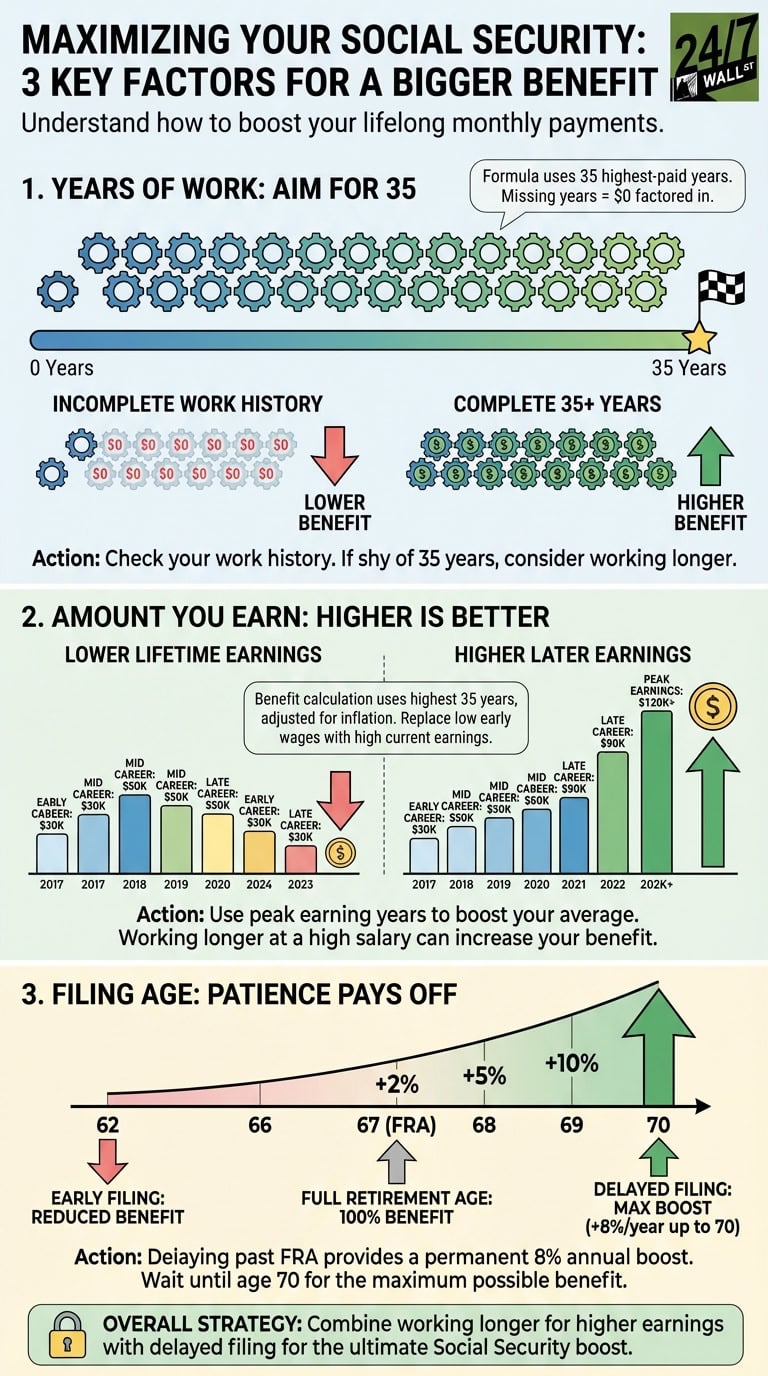
The answer is far from obvious. You can file as early as 62, but doing so permanently shrinks your monthly check. Wait until full retirement age (FRA) and you collect 100% of your earned benefit. Hold out until 70 and your payment grows even further.
For anyone born in 1960 or later, FRA is 67. Filing at 62 triggers a permanent 30% reduction in monthly benefits, while every year you delay past FRA adds a guaranteed 8% to your payment, up to age 70. On the SSA’s projected average benefit of roughly $2,071 per month for 2026 (reflecting the 2.8% cost-of-living adjustment), early filing produces roughly $1,450 per month versus about $2,590 per month at 70. That annual gap of more than $13,000 follows you for life.
Personal finance personality Dave Ramsey holds a clear, and frequently debated, position on this choice: claim at 62. Here is why he believes that, and why his view deserves a closer look from both sides.
Why Ramsey believes in signing up for Social Security at 62
Ramsey’s core argument is a simple mortality calculation. As he has told listeners and readers, “Your retirement payments die when you die…so you might as well take the money and make the most of it while you can.” His reasoning is straightforward: if you do not live a long life, claiming early maximizes your total lifetime payout. Because no one can predict their lifespan with certainty at 62, he favors taking the money sooner rather than placing a long-odds bet on living into your 80s.
The second pillar of his argument centers on investment returns. Rather than waiting for the government to release a larger check, Ramsey suggests routing early Social Security payments directly into a diversified mutual fund. He has argued that “you can do a much better job investing that money than the government ever could,” pointing to the long-run historical returns of broad equity portfolios. In his view, eight years of compounding on early checks can more than offset the guaranteed 8% annual boost that comes from delayed filing.
Critically, Ramsey does not recommend claiming early just to spend the proceeds. His advice is premised on being debt-free, having emergency savings in place, and actually investing every dollar of those early checks. For retirees who meet those conditions, he frames the early-claim strategy as a genuine wealth-building tool rather than a financial shortcut.
A significant and growing shadow now hangs over Social Security as a whole. The 2026 Social Security Trustees Report, released June 9, projects that the OASI Trust Fund will be depleted in the fourth quarter of 2032, one quarter earlier than the 2025 report estimated. At that point, ongoing payroll tax revenue would cover only 78% of scheduled benefits. The program’s long-term actuarial deficit also widened sharply, growing from 3.82% to 4.42% of taxable payroll over the 75-year projection window, a deterioration that the Committee for a Responsible Federal Budget called the largest single-year worsening in nearly half a century. The Bipartisan Policy Center notes that the worker-to-beneficiary ratio, which stood at 5-to-1 in 1960, has already fallen to roughly 2.9-to-1 in 2026 and is projected to drop further to 2.2-to-1 by the 2070s.
Part of the acceleration stems from the One Big Beautiful Bill Act, signed into law on July 4, 2025. The law created a temporary additional deduction of $6,000 per eligible person (or $12,000 for married couples where both spouses qualify) for taxpayers age 65 and older, covering tax years 2025 through 2028. By lowering beneficiaries’ federal tax liability on Social Security income, the legislation directly reduced the tax revenue that flows back into the trust funds, pushing the depletion date forward. That looming shortfall is a core reason Ramsey urges people to treat Social Security as a supplement to their own savings rather than a foundation.
The break-even math Ramsey overlooks
Filing at 62 gives you a five-year head start on collecting checks, but at the permanent cost of a 30% reduction in your monthly payment. Actuarial calculations place the break-even point, the age at which a delayed filer’s cumulative lifetime benefits catch up with and surpass those of an early filer, somewhere between 78 and 78.5 years old. Anyone who lives past that age comes out ahead by waiting.
The longevity data cuts sharply against the early-claim assumption. According to the CDC’s final 2024 mortality statistics, overall U.S. life expectancy reached a record high of 79.0 years in 2024. At age 65, a typical American can expect to live roughly 19.7 additional years on average, placing the statistical retiree well into their mid-80s. Women at 65 can expect another 20.8 years; men, another 18.4. Claiming at 62 is essentially a bet that you will not outlive the statistical median. For a large share of retirees, those are poor odds.
The tax drag of “claiming to invest”
Routing early Social Security payments into a taxable investment portfolio, as Ramsey recommends, introduces tax complications that can quietly erode the strategy’s advantages. When a retiree’s provisional income exceeds $34,000 for single filers or $44,000 for married couples filing jointly, up to 85% of Social Security benefits become subject to federal income tax. This effect, commonly called the “tax torpedo,” can push retirees into higher marginal brackets they would not otherwise reach.
There is also the Medicare cost to consider. Generating additional capital gains and dividend income from newly invested Social Security checks can push a retiree’s modified adjusted gross income above the Income-Related Monthly Adjustment Amount (IRMAA) thresholds, triggering higher Medicare Part B and Part D premiums. Because IRMAA is calculated using income from two years prior, those premium surcharges arrive as a delayed and often surprising bill.
It is worth noting that the One Big Beautiful Bill Act’s senior deduction may partially offset the tax torpedo for moderate-income retirees from 2025 through 2028. The $6,000 single-filer deduction begins to phase out above $75,000 in modified adjusted gross income, and the $12,000 joint deduction phases out above $150,000. Higher-income seniors see limited or no relief, making the benefit far from universal.
The working-and-filing trap (the earnings test)
Retirees who claim benefits at 62 while still earning a paycheck face a direct financial penalty. Under the Social Security earnings test, anyone who has not yet reached FRA and earns more than $24,480 in 2026 will have $1 in benefits withheld for every $2 earned above that threshold. A more generous rule applies in the calendar year a retiree reaches FRA: benefits are reduced by $1 for every $3 earned above $65,160, counting only earnings before the month FRA is reached. The withheld amounts are eventually restored through higher monthly payments once the retiree crosses into FRA, but the interim cash-flow disruption can be severe, especially for anyone counting on those checks to fund market investments.
Congress has considered eliminating the earnings test entirely. As of mid-2026, the Senior Citizens’ Freedom to Work Act had been referred to committee with no floor vote scheduled, so the test remains on the books for now.
The practical implication is clear. To execute Ramsey’s claim-and-invest strategy as he describes it, a retiree generally needs to be fully retired at 62 and have enough savings to cover living expenses while directing all Social Security income into the market. That is a prerequisite many 62-year-olds have not yet met. For anyone still earning a wage, filing early can mean receiving little to no Social Security income for stretches of the year, while the permanent benefit reduction stays in place regardless.
How to decide when to claim Social Security
The right claiming age is genuinely personal, and no single formula works for everyone. A few honest questions can sharpen the decision considerably:
- How much income will my savings provide outside of Social Security?
- How good is my health, and do I expect to live an average lifespan or longer?
- What does my family history of longevity look like?
- Do I plan to keep working in retirement, or will I need larger benefits to cover my basic expenses?
- How will my early filing choice affect the long-term survivor benefits for my spouse if I am the higher earner?
- Will total provisional income from investments inadvertently trigger higher taxes or Medicare IRMAA premium surcharges?
A financial advisor can work through these variables with your specific numbers. The stakes are high enough, and the decision permanent enough, that a paid consultation is almost always worth the cost.
Editor’s note: This pass added the CDC’s finding that U.S. life expectancy at birth reached a record 79.0 years in 2024, included the Bipartisan Policy Center’s worker-to-beneficiary ratio data showing the ratio fell from 5-to-1 in 1960 to roughly 2.9-to-1 in 2026, and added the Committee for a Responsible Federal Budget’s characterization of the 2026 actuarial deficit widening as the largest single-year deterioration in nearly half a century.
Contact [email protected] for any questions or corrections.
Maurie Backman has more than a decade of experience writing about financial topics, including retirement, investing, Social Security, and real estate. Her work has appeared on sites that include The Motley Fool, USA Today, U.S. News & World Report, The Washington Post, and Kiplinger.
Prior to becoming a full-time financial writer, Maurie worked in the financial industry trading distressed debt. She then changed course and spent a few years designing electronic toys. After a stint in content marketing and UX, she shifted back into writing and has since covered everything from the housing market to estate planning to Medicare.
When she's not busy writing, Maurie can be found hiking, walking her dogs, driving her kids to their various sports practices and games, and curling up with a good book. She cooks on occasion and bakes way too often.