Will Rivian (RIVN) Stock Hit $50 by 2030?
If you missed out on the multi-decade returns of Tesla (NASDAQ:TSLA | TSLA Price Prediction) stock, maybe you’ll get a second chance with electric vehicle (EV) manufacturer Rivian Automotive (NASDAQ:RIVN). For the next four to five years, some loyal RIVN stockholders hope…


If you missed out on the multi-decade returns of Tesla (NASDAQ:TSLA | TSLA Price Prediction) stock, maybe you’ll get a second chance with electric vehicle (EV) manufacturer Rivian Automotive (NASDAQ:RIVN). For the next four to five years, some loyal RIVN stockholders hope to achieve Tesla-like growth.
In the most optimistic scenario, Rivian stock would stage a spectacular comeback and rally to $50 by 2030. However, in a more pessimistic scenario, Rivian could run out of money next year and file for bankruptcy.
No one knows for sure whether RIVN stock will become a hero or a zero by 2030. Still, you could have a huge winner on your hands with a share position in Rivian, so let’s see what’s under the hood with this fascinating EV producer.
Is Rivian Stock the “Comeback Kid”?
Whether Rivian stock is “dead money” or the “comeback kid” largely depends on your time frame. If your lookback period is five years, then the “dead money” theory seems to hold up.
Alarmingly, RIVN stock has lost 80% of its value during the past five years. But then, the picture looks much brighter if we zoom in on the past 12 months.
Now, the “comeback kid” theory is in effect as Rivian stock has gained 54% over the past year. In theory, if the stock continues to add 50% every year through 2030, then a $50 is an easy target price.
That’s a highly ambitious projection, though. To be more informed and realistic, we need to delve into Rivian’s actual results, so we’ll do that right now.
No Imminent Danger
After performing an inspection of Rivian’s third-quarter 2025 results, we’ll find that it’s a good-news, bad-news situation. The good news is that Rivian’s revenue surged 78.3% from $874 million in the year-earlier quarter to $1.558 billion in Q3 2025.
On the other hand, Rivian’s cost of revenue and operating expenses also grew during that period. Consequently, the company’s net loss increased 6% year-over-year, from $1.1 billion to $1.167 billion.
Furthermore, Rivian’s cash and cash equivalents declined from $5.294 billion as of December 31, 2024, to $4.441 billion as of September 30, 2025. It appears, then, that the company’s capital position is dwindling but at least Rivian isn’t in immediate danger of running of out cash.
It’s understandable that Rivian needs to spend money in the short term. For example, the company recently developed its artificial intelligence (AI) infused Rivian Autonomy Platform, which “has been designed around an AI-centric end-to-end approach.”
That said, we can’t disregard the fact that Rivian is still a money-losing operation. Until the company’s capital outlays on AI technology and other investments translate to substantial profits, it may be difficult to invest in Rivian with complete confidence.
It’s All About the R2 Now
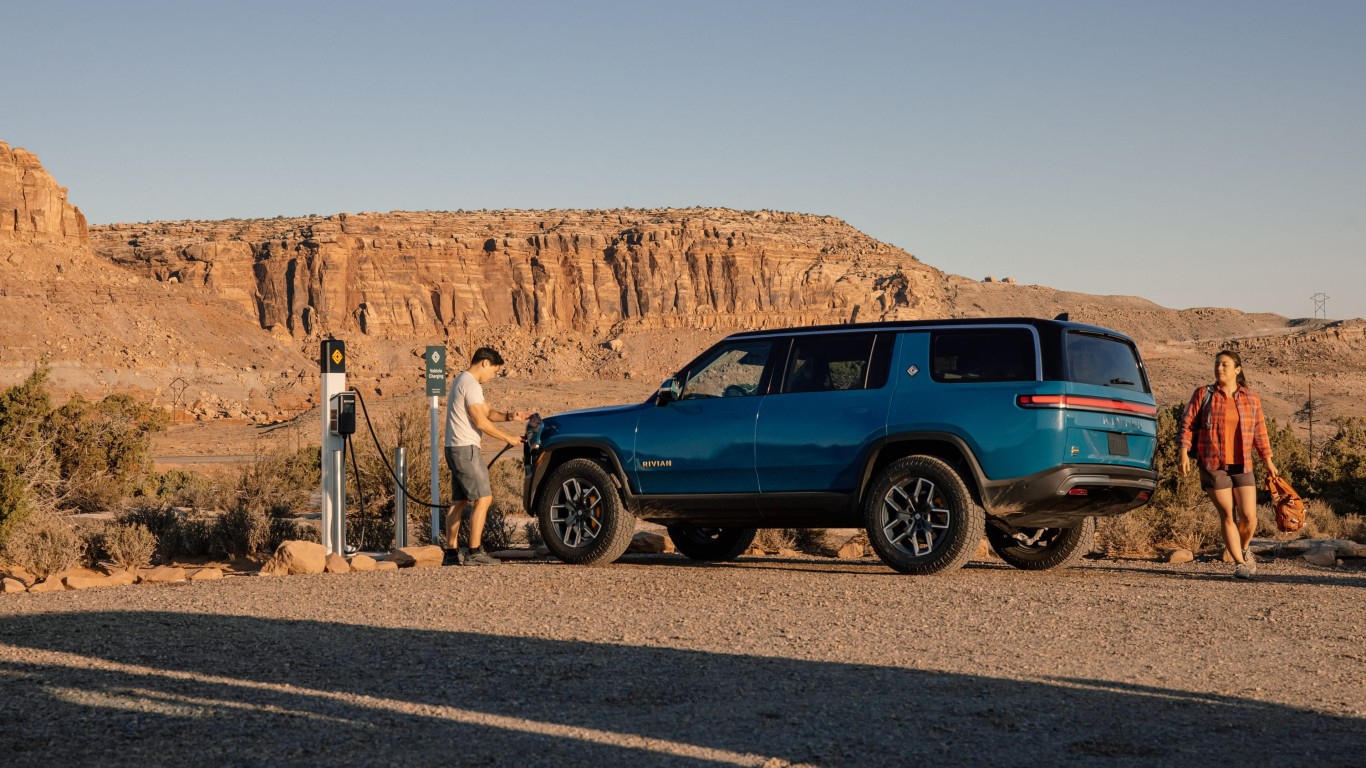
Although Rivian offers an R1T electric pickup truck, the automaker’s future will evidently “ride or die” on the upcoming R2 SUV model. By all indications, Rivian’s success or failure through 2030 could depend on the R2.
In the company’s Q3 2025 press release, Rivian declared that the R2 model’s “progress remains on track for deliveries in the first half of 2026.” A great deal of buzz on financial social media appears to be centered around this much-hyped SUV launch.
In other words, if Rivian’s R2 launch next year is a letdown, it will be quite difficult for RIVN stock to hit $50 by 2030. Indeed, the next four to five years could be painful for Rivian’s loyal shareholders.
For what it’s worth, Car and Driver‘s write-up on the upcoming Rivian R2 makes the SUV model sound highly appealing. With a starting price of $45,000, the R2 might actually be able to compete with Tesla’s Model Y.
In case you’re curious, the longest-range R2 is expected to provide more than 300 miles of range. Also, one version of the R2 is anticipated to accelerate to 60 miles per hour in under 3 seconds.
Don’t Get Your Hopes Up
The range and speed stats for Rivian’s R2 SUV are all well and good, but they don’t guarantee strong sales. For all we know, next year’s R2 launch could be a success or a bust.
Frankly, it’s worrisome that the R2 launch will be, to a certain extent, make-or-break for Rivian in 2026. If the R2 gets off on the wrong foot, Rivian’s path to recovery through 2030 will be unclear.
Thus, without the R2 sales data in hand right now, it’s too optimistic to expect RIVN stock to zoom from its current price of around $21 to $50 by 2030. Rivian isn’t in imminent risk of bankruptcy, but the wise move is to keep your position size in Rivian stock small if you choose to invest at all.
Contact [email protected] for any questions or corrections.
David Moadel is financial writer specializing in stocks, ETFs, options, precious metals, and Bitcoin. David has written well over 1,000 articles for leading online publications, helping investors understand markets, income strategies, and risk.His work has appeared in The Motley Fool, InvestorPlace, U.S. News & World Report, TipRanks, ValueWalk, Benzinga, Market Realist, TalkMarkets, Finmasters, 24/7 Wall St., and others.With a master’s degree in education, David has taught at the elementary, high school, and college levels. That teaching background shapes his writing style: clear, educational, and practical. David has also built a loyal social-media audience by providing trustworthy financial content on YouTube, X/Twitter, and StockTwits.